
Why Is My Second Story Always Hotter in Phoenix? (And What Actually Fixes It)

Why Is My Second Story Always Hotter in Phoenix? (And What Actually Fixes It)
TL;DR: Second stories in Phoenix homes almost always run hotter than ground floors because heat rises, Phoenix attics exceed 140 degrees in summer, and most tract home duct systems were designed for single-story cooling loads. The fixes range from $0 (ceiling fan direction) to $3,500 (duct balancing) to $8,000-plus (HVAC zoning system). If your upstairs is 5 to 8 degrees warmer than downstairs, the problem is almost certainly duct design or insulation, not your AC unit itself.
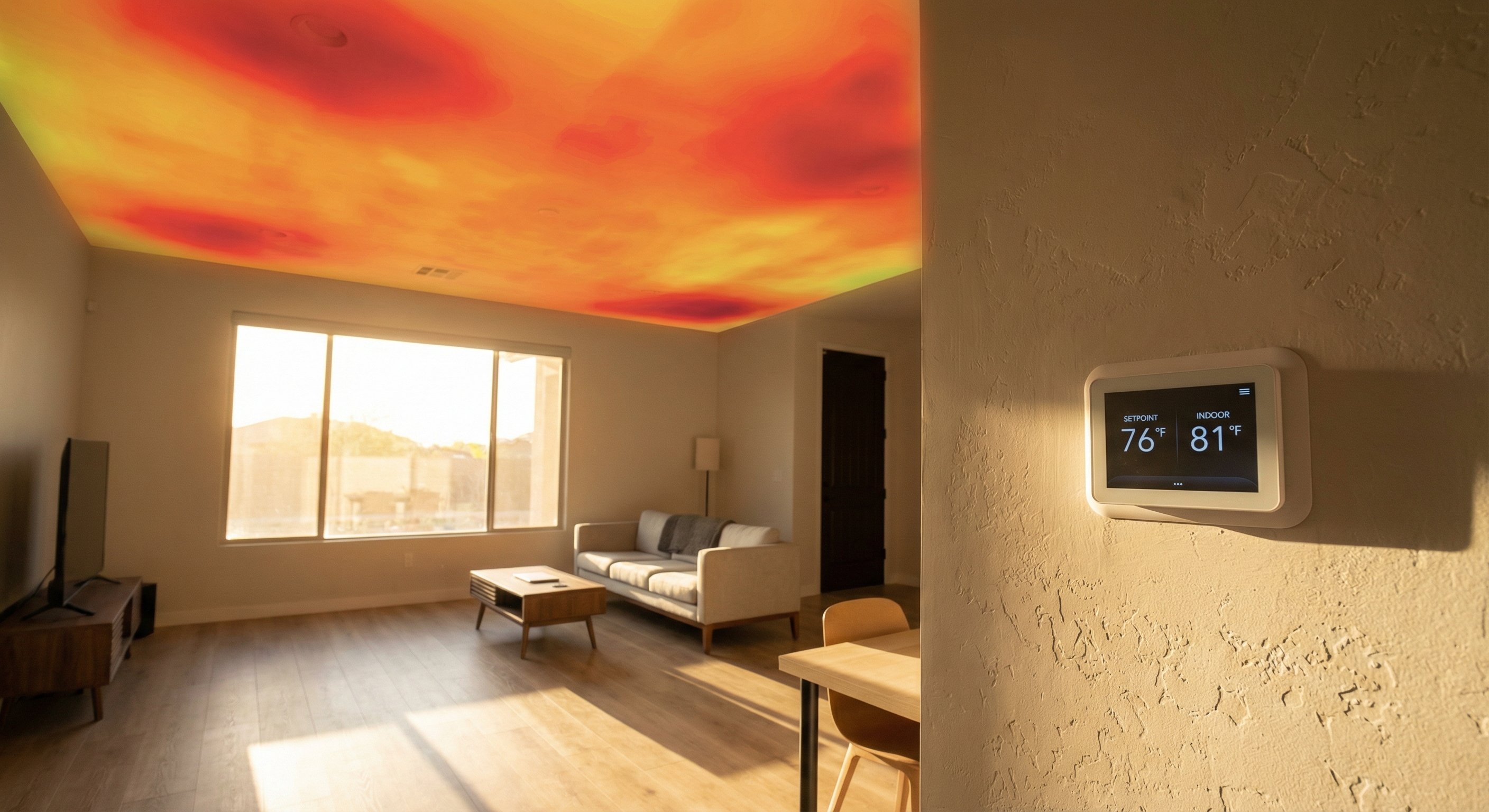
It is 104 degrees outside. Your thermostat reads 76 downstairs and 83 upstairs. Your AC unit has been running since 7 a.m. without cycling off. You have a 3-year-old Lennox system that checked out fine on its last maintenance visit. So why does your second floor feel like a different house?
This is one of the most common complaints I hear from Phoenix homeowners, and the answer is almost never the air conditioner. The unit is doing its job. The problem is where the cooled air goes, how it gets there, and what happens to it between the ductwork and your second-floor bedrooms.
Here is what is actually going on and what you can do about it.
Why Phoenix Makes This Problem Worse Than Other Cities
Phoenix is one of the worst climates in the country for second-story heat buildup, for reasons that go beyond just the高温.
Our attics are extreme. During a typical July afternoon, attic temperatures in unconditioned Phoenix homes routinely hit 140 to 150 degrees Fahrenheit. That heat radiates down through the ceiling of your second floor constantly, all day, even when your AC is running flat out. Your system is simultaneously fighting two opposing forces: cooling your living space and offsetting the radiant heat bleeding through your ceilings from a 145-degree attic.
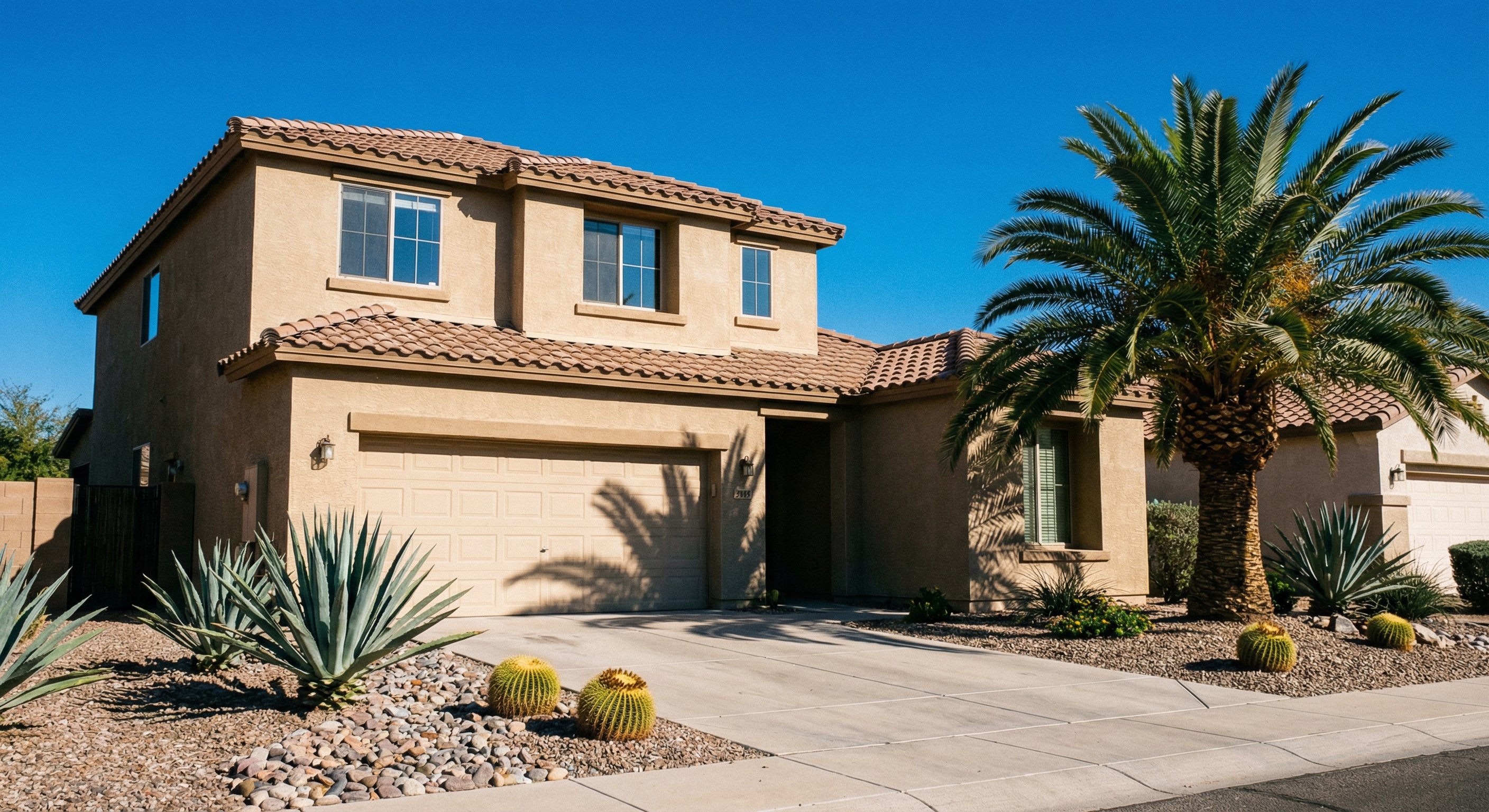
The geometry of most Phoenix tract homes amplifies this. The majority of homes built in the Phoenix metro between 1975 and 2005 are two-story designs with the air handler located in the downstairs utility closet or garage. Supply ducts run vertically through interior walls, then horizontally through the attic before dropping down into second-floor rooms. Every foot of duct in that attic is a foot of uncooled pipe carrying air that arrives at your second-floor registers already warmed by 20 to 30 degrees.
Older two-story homes in neighborhoods like Arcadia, McCormick Ranch, or the various Gilbert subdivisions were built when cooling costs were lower and efficiency standards were looser. The duct systems were sized for the home that existed in 1985, not the home you are living in today with larger master bedroom additions, more occupants working from home, and exterior rooms that have been converted into living space.
Why Heat Rises and Why That Is Only Part of the Problem
The basic physics are simple. Hot air rises. That is not a Phoenix problem, that is a physics problem. But heat rising does not fully explain why your second floor is 7 degrees warmer than your first floor.
The real culprit in most Phoenix homes is duct placement and design. In a typical single-story Phoenix home, supply registers are distributed across the ceiling of each room. Air returns are located in hallways or common areas. This creates a relatively even circulation pattern.
In a two-story home with a downstairs air handler, the second floor is essentially tacked on to a system that was designed for one floor. The installer extended duct runs up through the attic, and those runs serve the second floor bedrooms. In the process, several things go wrong.
First, the longest duct runs serve the rooms furthest from the air handler, typically the master bedroom at the opposite end of the house. Air arriving at the end of a 40-foot flex duct run has lost significant cooling capacity simply from traveling through a hot attic. Second, second-floor supply registers are almost always located in the ceiling, pushing cold air up toward an already-hot ceiling where it immediately begins absorbing radiant heat from above. Third, return air grilles in most two-story Phoenix homes are located downstairs. Cold air on the second floor has no efficient path back to the return, so it sits stratified at the ceiling level while the return downstairs pulls cooler air from the floor.
This is not a failure of your AC. This is a design limitation of how most two-story Phoenix homes were ducted 30 to 40 years ago.
The Most Overlooked Cause: Uninsulated Ducts in Hot Attics
Before you call anyone to talk about zoning systems or new ductwork, check the most overlooked issue in Phoenix two-story homes: uninsulated supply duct walls in the attic.
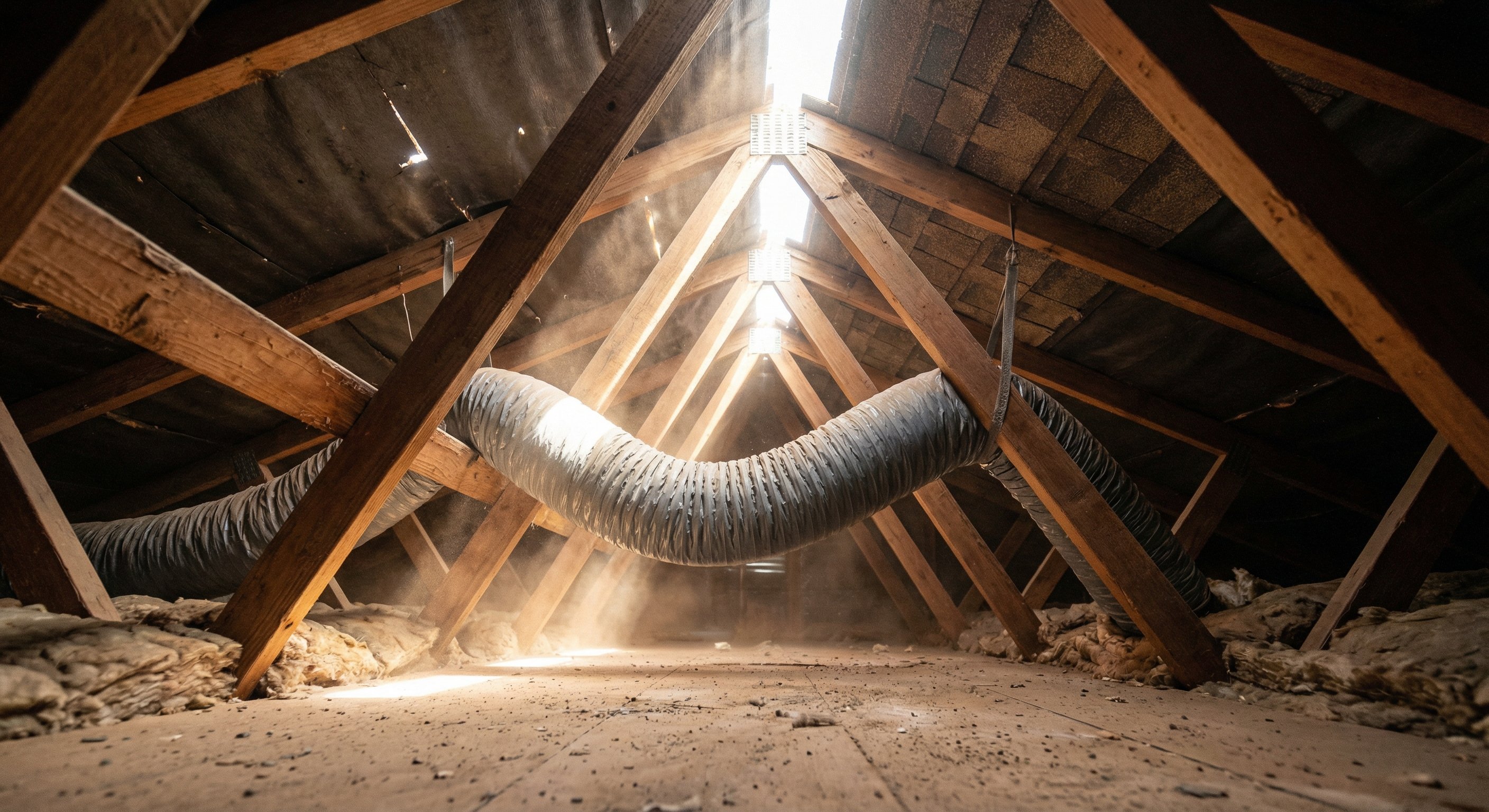
The flex duct carrying cold air to your second floor bedrooms almost certainly runs horizontally through the attic for some portion of its path. If that duct is not externally insulated, the 55-degree air inside is gaining 20 to 35 degrees of heat through the duct walls before it reaches your bedroom register. You are paying to cool air that is being heated before it arrives.
You can check this yourself. Go into your attic during a summer afternoon, around 3 or 4 p.m. when the attic is hottest. Find the flex duct runs going to your second floor. Put your hand on the duct wall. If it feels warm or hot to the touch, it is uninsulated or under-insulated. Properly insulated duct should feel roughly ambient attic temperature, not hot.
Many Phoenix tract homes were built with flex duct that has an R-value of 4 or 6 in the duct wall itself, which is not enough for a 140-degree attic environment. The fix is having your attic duct runs wrapped with R-8 external insulation, which costs $1,500 to $3,500 for a full attic wrap on a typical two-story home.
This is one of the highest-return improvements you can make for second-story comfort, and it is often the cheapest option on this list.
Skip the dealer markup
See What a New AC Actually Costs in Phoenix, Arizona
AC Rebel shows you the real equipment price — no sales pitch, no inflated quote. Get matched with a licensed installer and keep $3,000–$5,000 in your pocket.
Get My Direct Price →Quick Fixes That Actually Help (Start Here)
Before spending money on a zoning system or new ductwork, try these:
Reverse your ceiling fans. This is free and takes 30 seconds. Most ceiling fans have a switch on the housing that changes rotation direction. In summer mode, fans should rotate counterclockwise, which pushes air downward and creates a wind-chill effect. Running fans on the wrong setting in summer can actually make rooms feel warmer by pulling hot air down from the ceiling.
Close downstairs supply registers. Most two-story Phoenix homes have dampers in the ductwork that allow you to partially or fully close downstairs registers. Closing the downstairs registers forces more air upstairs. This does not increase total cooling capacity, but it can rebalance airflow in homes where the downstairs gets too much and the upstairs gets too little. Note that this will make your downstairs noticeably warmer, so it works best when you are primarily trying to cool bedrooms at night rather than living spaces during the day.
Check your return grille location. If your second floor has no return air grille, that is a major airflow bottleneck. Cold air on the second floor has nowhere to go except back down through gaps in the ceiling or around the door frames. Adding a return grille on the second floor is a relatively affordable modification, typically $300 to $600, that can significantly improve stratification.
Seal your second-floor ceiling and duct connections. Air leakage from the attic into your second floor living space is invisible but significant. Gaps around ceiling light fixtures, HVAC boot connections, and wire penetrations allow hot attic air to enter living spaces directly. Having your second-floor ceiling air-sealed by an insulation contractor costs $400 to $900 and can reduce heat intrusion measurably.
Mid-Tier Fix: Duct Balancing and Replacement
If quick fixes are not enough, the next step is professional duct modification.
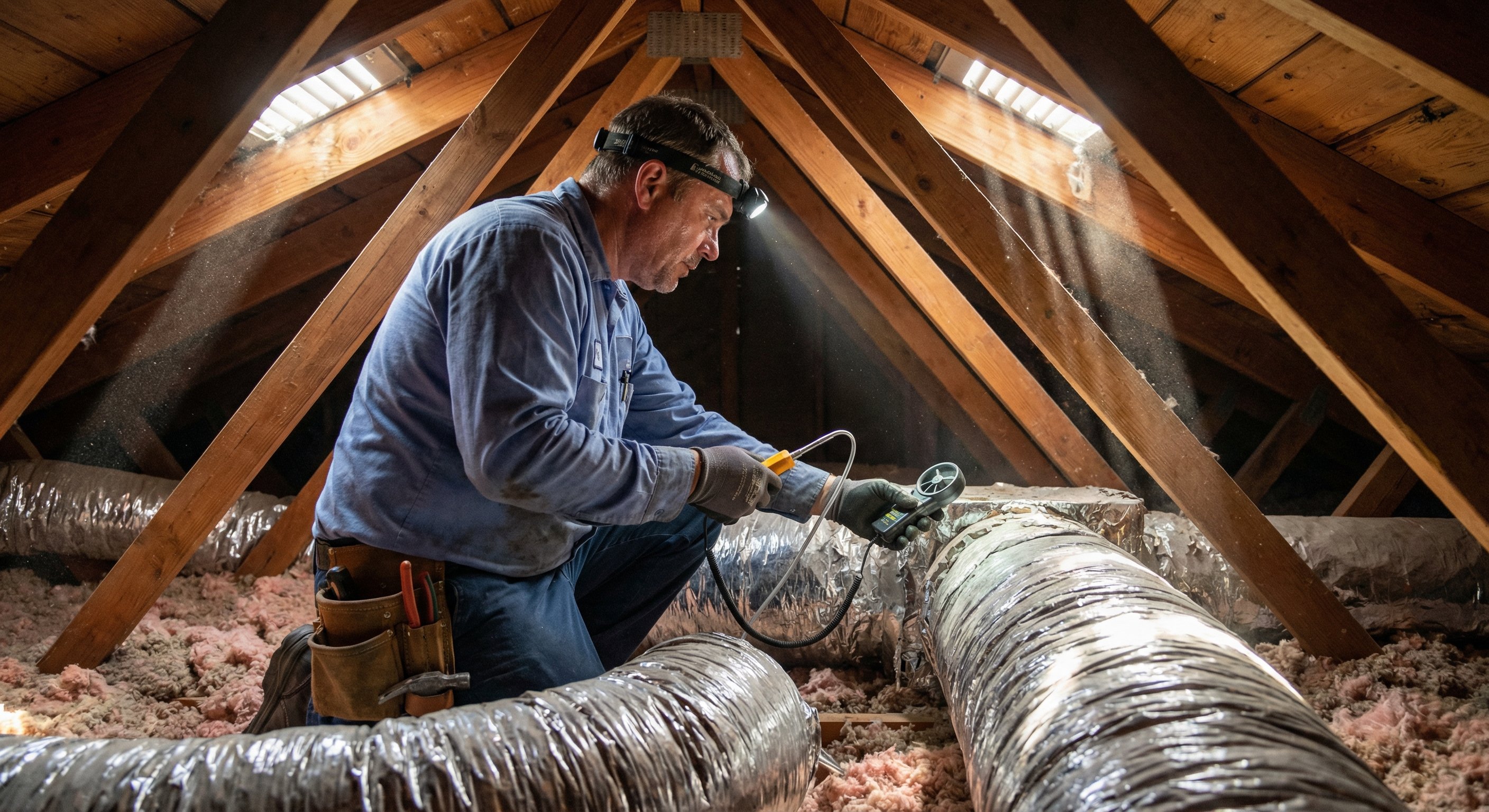
Duct balancing involves having an HVAC technician use a digital manometer to measure airflow at each supply register, then adjust the damper settings or replace fixed air deflectors with adjustable ones to redistribute airflow toward the second floor. This is the same work shown in the attic photo above. A proper balancing job runs $800 to $2,500 and often requires adding a second return on the upper floor or converting ceiling-mounted supply registers to sidewall registers that push air into the room rather than up toward the hot ceiling.
Duct replacement in the attic is more invasive and more expensive but is sometimes the only real solution for homes where the original duct runs are so undersized or degraded that balancing cannot correct it. Full replacement of the attic portion of a two-story duct system typically runs $4,000 to $8,000 depending on home size and accessibility.
Both of these approaches require a qualified HVAC contractor who understands the difference between fixing an airflow problem and just moving it somewhere else. The cheap version of duct balancing is someone adjusting dampers by feel. The right version is someone with a manometer and a clipboard measuring actual CFM at each register before and after adjustments.
The Big Investment: HVAC Zoning for Two-Story Homes
For homeowners who have tried the above approaches and are still uncomfortable, HVAC zoning is the most comprehensive solution available.
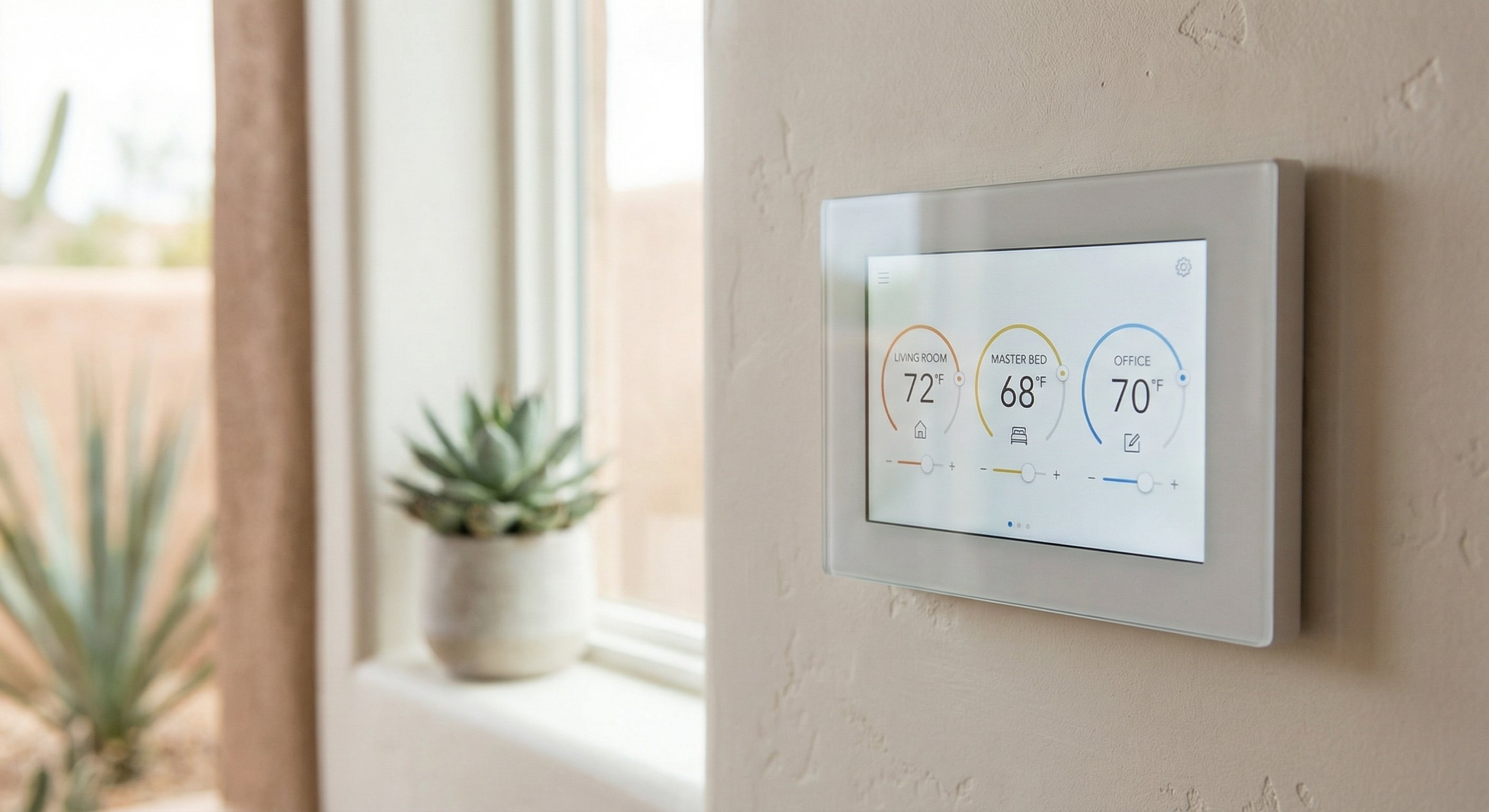
A zoning system divides your home into two or more independent climate zones, each with its own thermostat or temperature sensor and its own motorized damper in the ductwork. The system controls which zones receive conditioned air at any given time based on demand in each zone. When your thermostat calls for cooling upstairs but not downstairs, only the upstairs dampers open.
In a Phoenix two-story home, this means the upstairs can run for cooling cycles throughout a summer afternoon while the downstairs dampers stay closed. You are not cooling rooms that do not need it. Your system is not fighting thermostat conflicts between floors.
The cost of a dual-zone HVAC zoning system on a two-story Phoenix home typically runs $6,000 to $12,000 for the zoning hardware and installation. This is a significant investment, and it makes the most sense in these situations:
Your second floor is consistently 5 to 8 degrees warmer than your first floor despite your AC running constantly. Your downstairs thermostat is controlling the whole house, which means you are either too cold downstairs or too hot upstairs depending on the season. You have rooms that are occupied at different times of day, making independent control genuinely valuable. You are already replacing your AC unit, which makes adding zoning a marginal cost addition rather than a standalone project.
According to ENERGY STAR, proper zoning can reduce HVAC energy costs by 10 to 15 percent in homes with consistent temperature imbalances between zones. In Phoenix, where summer APS and SRP bills can exceed $350 per month with older systems, a 10 to 15 percent reduction is meaningful.
When the Problem Is Your AC, Not Your Ductwork
It is worth noting that ductwork and duct design are not always the culprit. Before spending $8,000 on a zoning system, confirm your AC unit is actually performing correctly.
A properly functioning AC in Phoenix should produce a supply-to-return temperature differential of 16 to 20 degrees when measured at the evaporator coil. If your return air is 78 degrees and your supply air is only 62 degrees, that is only a 16-degree differential, which is acceptable. If your supply air is only 68 degrees, that differential is too narrow and points to a refrigerant, airflow, or coil problem that needs addressing before you touch your ductwork.
Have a technician measure this with a true digital thermometer at the supply and return plenums, not at a wall register. Register readings are affected by duct heat gain and are not accurate measurements of what your system is actually producing.
If the temperature differential is in range but your second floor is still hot, the problem is distribution and duct design, not your cooling equipment.
What This Costs in Phoenix (Real Numbers)
| Fix | Phoenix Cost Range | Best For |
|---|---|---|
| Reverse ceiling fans | Free | Immediate improvement, minimal disruption |
| Close downstairs dampers | Free | Simple balancing experiment |
| Add second-floor return grille | $300 to $600 | Return airflow bottleneck |
| Air-seal second floor ceiling | $400 to $900 | Attic air intrusion |
| Wrap attic ductwork with R-8 | $1,500 to $3,500 | Uninsulated duct heat gain |
| Professional duct balancing | $800 to $2,500 | Uneven airflow distribution |
| Partial duct replacement | $4,000 to $8,000 | Severely undersized or damaged ductwork |
| Dual-zone HVAC zoning system | $6,000 to $12,000 | Persistent multi-story imbalance |
These ranges assume a typical two-story Phoenix home with 2,000 to 2,800 square feet and a downstairs air handler. Homes with slab foundations, difficult attic access, or custom duct configurations will run higher.
The Honest Take on What Is Worth It
If your second floor is 2 to 3 degrees warmer than your first floor and you are comfortable downstairs, the free fixes are probably enough. Adjust your fans, try the damper adjustments, and see if it is tolerable.
If your second floor is 5 degrees or more warmer and you are running the AC constantly to compensate, the duct insulation fix is where you should start. At $1,500 to $3,500, it is the highest-return investment on this list for most Phoenix homeowners because it addresses the root cause rather than just moving air around.
If you have done the insulation, the balancing, and the air-sealing and you are still uncomfortable, a zoning system is the right call. It solves the problem permanently rather than patching it.
Most homeowners in this situation also discover that their AC unit was never undersized for their home. It was simply never given the duct system it needed to deliver that cooling to the right places.
Get a free instant quote at AC Rebel to see what a new cooling system with properly designed ductwork would cost for your Phoenix home. Direct pricing means you see the unit cost and installation cost separately, with no dealer markup buried in the numbers.
Frequently Asked Questions
Why is my second floor so much hotter than my first floor in Phoenix?
In a Phoenix two-story home, the second floor is hotter because heat rises toward it from the first floor and because the attic above it routinely exceeds 140 degrees in summer. The ductwork serving the second floor typically runs through that hot attic, meaning the cold air arriving at second-floor bedrooms has already absorbed significant heat. Return air grilles are usually located downstairs, so cold air on the second floor has no efficient path back to the system, causing it to stratify at ceiling level.
Does closing vents help cool a second floor?
Closing downstairs supply registers can push more air to the second floor, but it reduces total airflow to the downstairs and can cause your AC to work harder since it is essentially fighting a blocked duct system. It is a useful diagnostic tool to see if airflow is the problem, but it is not a long-term solution. If you close vents downstairs for more than a few hours at a time, have a technician check for back-pressure issues in the ductwork.
How much does HVAC zoning cost in Phoenix?
A dual-zone HVAC zoning system for a two-story Phoenix home typically costs $6,000 to $12,000 installed. The cost varies based on the number of zones, the type of zoning hardware used, and whether the installation is done alongside an AC replacement or as a standalone retrofit. ENERGY STAR reports that zoning can reduce HVAC energy costs by 10 to 15 percent in homes with persistent temperature imbalances between zones.
Can duct insulation really fix second-story heat?
Yes, in many cases. Wrapping uninsulated attic ductwork with R-8 insulation prevents the 20 to 35 degree heat gain that happens as cold air travels through a 140-degree attic. This is one of the most cost-effective fixes on this list, typically costing $1,500 to $3,500 for a full attic wrap on a two-story Phoenix home. Many homes built in the 1980s and 1990s were not insulated externally at the duct, and adding insulation addresses the root cause rather than treating symptoms.
Should I replace my AC if my second floor is always hot?
Probably not, unless your AC is also failing the temperature differential test or is more than 15 years old. In most cases, second-story heat is a duct design problem, not an equipment problem. Replacing the AC unit without fixing the ductwork will give you a newer, more efficient unit delivering the same amount of conditioned air to the same poorly-designed duct system. Address the ductwork first, then evaluate whether the AC unit needs replacement on its own merits.
Ready to stop overpaying?
See Your Direct AC Price in 2 Minutes
Skip the dealer. Buy your AC unit at direct pricing and pay a vetted local installer only for the installation. No sales calls. No hidden markup. Most homeowners save $3,000–$5,000+ compared to a traditional quote.
Get My Direct Price — No Credit Card2-minute quote · Licensed installers · 10-year warranty options