
Your AC Died in Phoenix. Here's What to Do in the Next 6 Hours

Your AC Died in Phoenix. Here's What to Do in the Next 6 Hours
TL;DR: When your AC dies in Phoenix during summer, spend the first 15 minutes checking thermostat batteries and your circuit breaker before calling anyone. If the breaker is not the issue, call a licensed contractor for same-day diagnostic (expect $75 to $150). If the unit is over 12 years old and the repair estimate exceeds $600, start getting replacement quotes instead. AC Rebel lets you see real unit prices immediately, so you know whether a $12,000 replacement quote is fair or a panic premium.
It is 4 p.m. on a Thursday in July. The temperature outside is 111 degrees. You get home from work and notice the house feels wrong. You check the thermostat: 93 degrees and climbing. The AC is running but producing no cool air, or it has stopped entirely. Your first instinct is to call the first HVAC company you can find on Google. That instinct will cost you.
Phoenix homeowners in this situation get taken for between $3,000 and $7,000 more than they should, every summer, because they do not have time to shop around. This guide is built around that reality. It gives you a specific 6-hour action plan with real time stamps, real costs, and honest decision gates so you can make the best call under pressure.
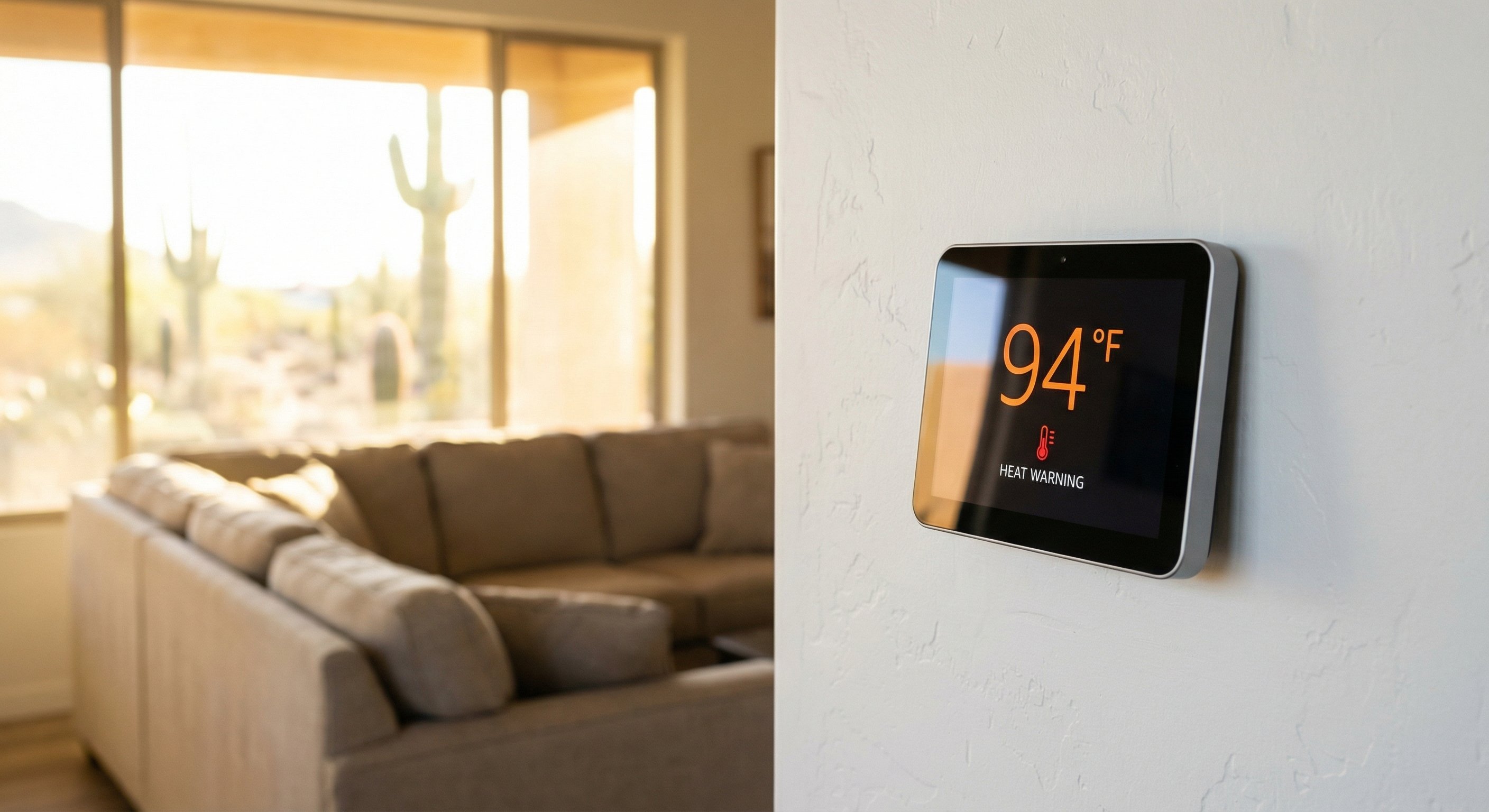
Hour 0 to 0:15: Two Things to Check Before Calling Anyone
Do not dial a single number yet. Two things stop an AC from working that you can check in 15 minutes with zero tools, and fixing them costs nothing.
Thermostat batteries. If your thermostat screen is blank or showing incorrect information, new batteries might be the entire fix. Pop them out, put fresh ones in, and try again. This takes 2 minutes. If the screen was blank and comes on, test the cooling setting.
The circuit breaker. Walk to your electrical panel. Look for the HVAC breaker (usually a double-pole 30 to 50 amp breaker) and confirm it is firmly in the on position. If it has tripped, reset it and wait 30 seconds before trying the thermostat again. If it trips immediately the second time, stop resetting it. A repeatedly tripping HVAC breaker can indicate a compressor electrical failure, and forcing it risks damage to the wiring.
If neither of those is the problem, you have a real equipment failure on your hands. Now you need information before you need action.

Hour 0:15 to 1:00: Get a Diagnostic Call Without Committing to Anything
Call a licensed Phoenix HVAC contractor and request a same-day diagnostic visit. Tell them you need a diagnosis only, not a repair authorization on this call. Ask specifically what their diagnostic fee is before they come out. Legitimate contractors charge $75 to $150 for this. Companies that refuse to quote a diagnostic fee over the phone are either going to surprise you with the bill or try to sell you something you do not need.
While you wait for the technician to arrive, do one more thing: open the AC Rebel quote wizard on your phone. You do not need to finish it yet. Just start it. You want to know what a new unit actually costs before a contractor tells you that a $1,400 repair is your only option. The unit cost information is free and available immediately, and it changes how every subsequent conversation goes.
Hour 1:00 to 2:00: What the Diagnosis Actually Means
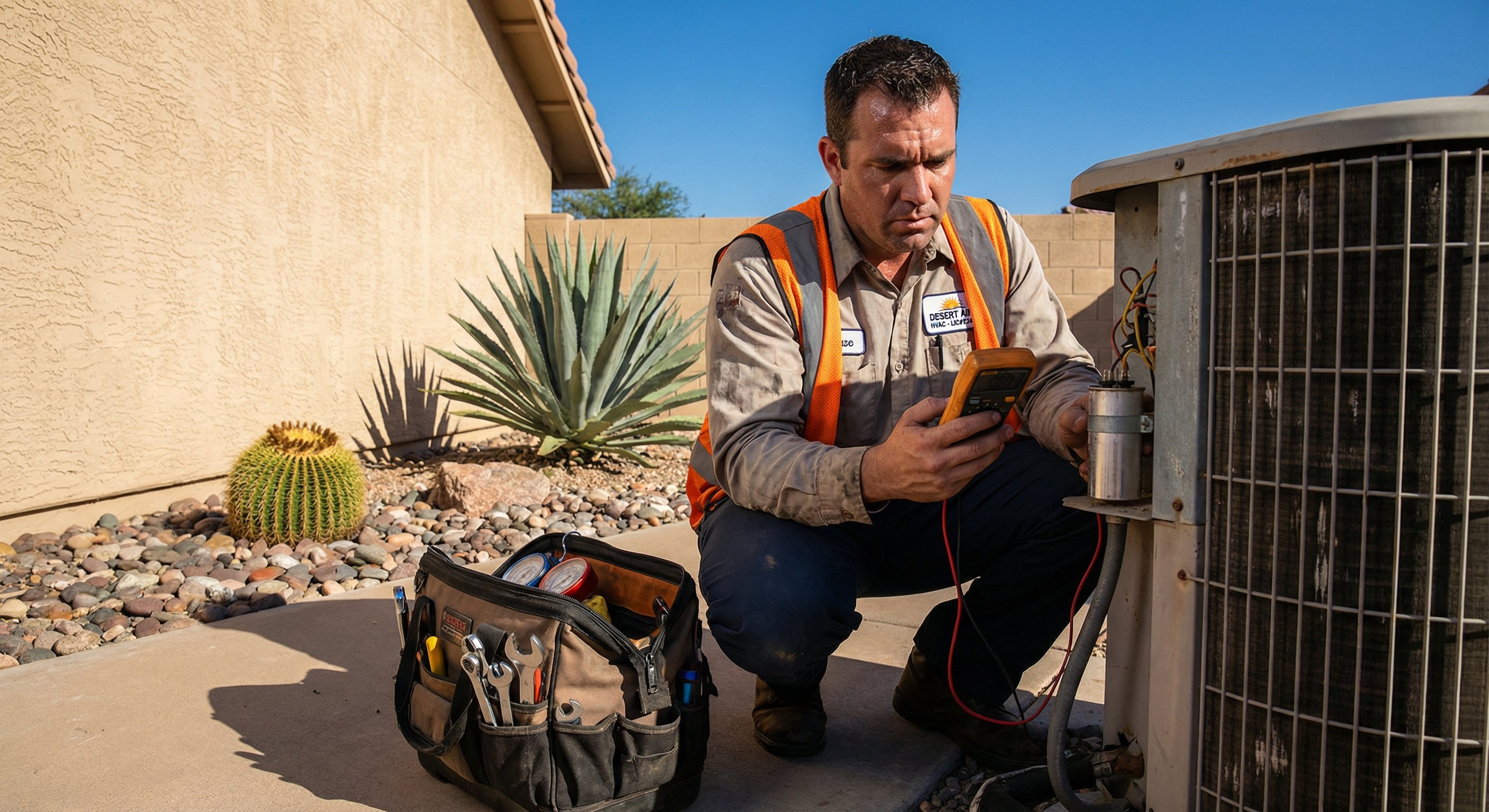
When the technician arrives, they should test the capacitor, contactor, and compressor windings with actual meters and give you a specific diagnosis with a written quote. Here is what the most common diagnosis scenarios mean for your decision.
Refrigerant leak or low charge. The technician adds refrigerant to find the leak, then patches it. This repair typically runs $250 to $600 in the Phoenix market. If your system is under 10 years old and this is the first major issue, it is worth fixing. If the system is over 12 years old, that same leak will likely recur, and you are spending repair money on equipment that is nearing the end of its useful life in one of the country's most demanding climates.
Failed capacitor or contactor. These are the two most common AC failures in Phoenix heat, and they are also the most affordable to repair. Capacitor replacement runs $150 to $350 with labor. Contactor replacement runs $150 to $350. If the unit is under 10 years old, fix it. If it is 10 to 12 years old, weigh the repair cost against replacement, which we get to next.
Compressor failure. This is the $1,500 to $2,800 repair that makes replacement the better call in almost every scenario. If your outdoor unit is 12 years old or older, do not spend this money. A new outdoor unit with a fresh 10-year warranty costs less than a compressor replacement plus the labor, and you are starting over with aging equipment.
Get the diagnosis in writing. Ask for the written quote before the technician leaves. If they give you a verbal diagnosis followed by pressure to sign a repair authorization on the spot, ask for the quote in writing and tell them you need to think about it. Any contractor who guilts you for taking 30 minutes to make a decision on a $1,000-plus decision is not someone you want working on your home.
Skip the dealer markup
See What a New AC Actually Costs in Phoenix, Arizona
AC Rebel shows you the real equipment price — no sales pitch, no inflated quote. Get matched with a licensed installer and keep $3,000–$5,000 in your pocket.
Get My Direct Price →Hour 2:00 to 3:00: The Replace Versus Repair Calculation in Phoenix
This is the most important decision gate in the entire process, and most contractors do not walk you through it honestly because they make more money on replacement. Here is how to think about it.
Replace your AC if any of these are true: the system is 12 years old or older, the repair estimate exceeds $600 and the system is over 10 years old, this is the second or third significant repair in the past two years, or the quote is for compressor replacement on equipment that is more than 10 years old.
Repair your AC if all of these are true: the system is under 10 years old, the repair is under $600, this is the first significant repair, and the technician can confirm the rest of the system is in good condition.
Phoenix homeowners often undervalue replacement because they think a new system is a luxury. It is not. An AC running at 10 to 12 SEER in Phoenix costs 30 to 40 percent more per month to run than a current 16 to 20 SEER system. Over five years of Arizona summers, that efficiency gap costs you $1,500 to $3,000 in additional utility bills, on top of the repair bills you keep paying. Replacement is often the cheaper option over a five-year horizon even before you factor in the comfort cost of an unreliable system.
Hour 3:00 to 4:00: Getting Replacement Quotes Without Getting Played
If you are leaning toward replacement, the single most important thing you can do in this window is get at least two quotes before authorizing anyone to order equipment. This is where Phoenix homeowners lose the most money.
The typical scenario: your AC dies in the afternoon, you call a company, someone comes out and tells you it is a compressor failure and you need a new system. They can have it installed tomorrow. The quote is $11,400. You are hot, you have a family, and the next day is Friday of a holiday weekend. So you sign.
That $11,400 quote often includes a $4,000 to $6,000 dealer markup on the unit itself. If you bought that same unit direct and paid a licensed contractor only for the installation labor, the total bill would be $6,500 to $8,500. The markup is not a markup in their mind. It is just how the industry works. But you do not have to participate in it.
AC Rebel shows you the unit price before you commit to anything. You see what the equipment actually costs, compare it against what a traditional dealer would charge, and then get matched with a vetted local contractor for installation only. For most Phoenix homeowners replacing a 10 to 15-year-old system, the savings on the unit itself run $3,000 to $5,000 or more compared to a dealer quote.
Financing is also worth exploring in this window. Payments on an $8,000 system through a home improvement loan or GreenSky-style financing typically run $87 to $150 per month depending on term and credit profile. That is less than most Phoenix families pay for streaming services and phone bills combined, and it is the difference between replacing now and running a broken system through another weekend of 110-degree heat.
Hour 4:00 to 6:00: What to Do Right Now Before the System Gets Ordered
If you have decided to replace, do these three things before you authorize anyone to order equipment.
Confirm the tonnage. Your existing outdoor unit has a data plate with a model number. The tonage tells you the cooling capacity. Most Phoenix homes need 3 to 5 tons depending on square footage and insulation. Do not let a contractor tell you that you need a larger unit than you currently have without a Manual J heat load calculation. Oversized units short-cycle and wear out faster, and they cost more to install.
Confirm the SEER rating. Current federal minimum is 14 SEER. For Phoenix, anything under 16 SEER is a poor efficiency choice for a new purchase. Target 16 to 20 SEER for the best balance of upfront cost and long-term utility savings. A SEER 18 system uses roughly 25 percent less electricity than a SEER 14 system over its lifetime in a Phoenix climate.
Ask about the installation timeline. In peak summer, good contractors are booked 3 to 7 days out. If someone tells you they can install tomorrow, ask why. Same-day installation usually means they are using whatever unit they have sitting in their warehouse, which may not be the right size or efficiency tier for your home. 3 to 5 days is a reasonable timeline for a proper installation.
The 6-Hour Summary: Decision Gates at a Glance
| Time | Action | Decision Gate |
|---|---|---|
| 0:00 to 0:15 | Check thermostat batteries and circuit breaker | Either fixed or you have a real failure |
| 0:15 to 1:00 | Call contractor for diagnostic, start AC Rebel quote wizard | Get unit cost information in parallel |
| 1:00 to 2:00 | Receive diagnosis and written repair quote | Repair under $600 and under 10 years old = fix it. Otherwise, lean replace. |
| 2:00 to 3:00 | Do the replace versus repair calculation | System over 12, repair over $600, repeat failure = replace |
| 3:00 to 4:00 | Get two replacement quotes using real unit prices | Compare dealer markup vs. direct pricing |
| 4:00 to 6:00 | Confirm tonnage, SEER, and install timeline | Authorize replacement with confirmed specs |
Frequently Asked Questions
How long can I go without AC in Phoenix in summer?
In a typical Phoenix home with no shade and daytime temperatures above 108 degrees, interior temperatures can reach 95 to 100 degrees within 3 to 4 hours even with fans running. After 6 hours, conditions become uncomfortable and potentially unsafe for children, elderly family members, and anyone with heat-sensitive medical conditions. Do not wait until Monday. If your AC dies Thursday afternoon, deal with it Thursday evening.
Should I repair or replace my AC if it is 12 years old?
Replace it. A 12-year-old AC in Phoenix is operating at 10 to 12 SEER efficiency at best, and the compressor and major components are approaching the end of their design life in one of the country's most demanding climates. A repair on aging equipment that costs over $600 is almost always more expensive over a 5-year window than replacement with a new 16 to 20 SEER system.
Can I get emergency AC service in Phoenix on the same day?
Yes, most licensed Phoenix HVAC contractors offer same-day diagnostic service. Diagnostic fees run $75 to $150. Same-day repair or replacement is harder to guarantee because it depends on contractor availability and whether the right equipment is in stock. If someone can install a new system tomorrow, confirm the unit specifications match your home before authorizing the work.
Why are AC quotes so different in Phoenix?
The biggest variable is not labor or location. It is the unit markup. A traditional dealer buys a 3-ton Carrier unit for roughly $3,200 and marks it up to $6,800 before adding installation labor. That $3,600 markup is built into every line of their quote. Direct pricing platforms show you the $3,200 unit cost upfront. The difference between the two pricing models on a single installation is typically $3,000 to $6,000.
Is financing a new AC worth it in Phoenix?
For most Phoenix homeowners, yes. A new 16 to 20 SEER system costing $8,000 to $10,000 financed over 60 to 84 months typically runs $87 to $167 per month. That is comparable to what an inefficient older system costs you in summer utility bills alone, before accounting for repair costs. Financing makes sense when replacement is the right decision, not as a reason to replace sooner than you otherwise would.
What size AC unit does a typical Phoenix home need?
Most Phoenix metro homes between 1,800 and 2,800 square feet need a 3-ton to 4-ton unit. Homes under 1,500 square feet typically need 2 to 3 tons. Oversized units are a common problem in older Phoenix neighborhoods where previous owners installed units based on rule-of-thumb sizing rather than actual heat load calculations. Your existing unit's tonnage is listed on the outdoor condenser's data plate.
If your AC died this summer in the Phoenix metro area, get a free instant quote at acrebel.com and see exactly what replacement costs without the dealer markup.

Ready to stop overpaying?
See Your Direct AC Price in 2 Minutes
Skip the dealer. Buy your AC unit at direct pricing and pay a vetted local installer only for the installation. No sales calls. No hidden markup. Most homeowners save $3,000–$5,000+ compared to a traditional quote.
Get My Direct Price — No Credit Card2-minute quote · Licensed installers · 10-year warranty options