
Why Phoenix ACs Fail Sooner Than the National Average (And What to Do About It)

Why Phoenix ACs Fail Sooner Than the National Average (And What to Do About It)
TL;DR: Phoenix ACs typically last 8-12 years, not the 15-20 years quoted by manufacturers based on milder climates. The reason is straightforward: when outdoor temperatures hit 115°F, your condenser cannot reject heat efficiently, which stresses every component in the system. The compressor, capacitor, and coils all fail faster in Arizona heat. Maintenance helps, but at a certain point, pouring money into a dying system costs more than replacing it. Phoenix homeowners who understand this math save the most.
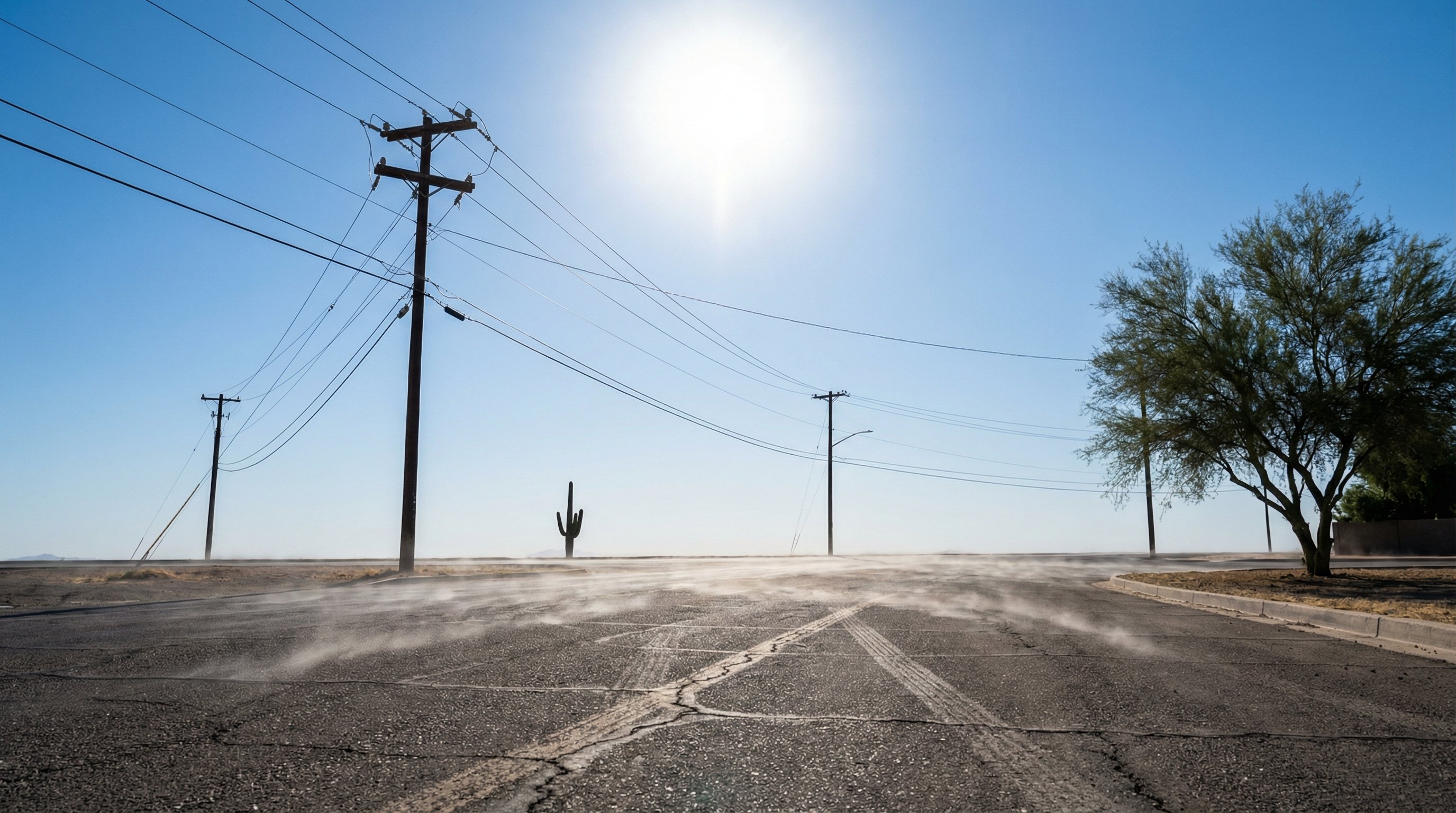
Your AC was supposed to last 15 years. It is 9. You are already paying for a second opinion on a compressor quote.
This is not bad luck. It is physics, and Phoenix homeowners deserve to understand why it happens before they get handed a $10,000 replacement bill.
The 115°F Problem Nobody Talks About
AC systems are rated to dissipate heat. That is their entire job. They move heat from inside your home to the outside.
When it is 85°F in Chicago, that is an easy task. When it is 115°F in Phoenix for 47 consecutive days every summer, the math changes completely.
Here is what happens: the outdoor coil (called the condenser) needs outside air to be cooler than the refrigerant inside to dump heat. When the outside air is nearly as hot as the refrigerant, heat transfer slows to a crawl. The compressor works harder and longer, generating more heat inside its own housing, which raises refrigerant temperatures further, reducing cooling capacity and forcing the system to run even more.
This vicious cycle is called condenser coil saturation, and it is the single biggest reason Phoenix ACs die faster than units in any other major US city.
The national average lifespan for a central AC system is 15-20 years. Most manufacturer warranties reflect this. But those averages come from markets where summer peaks are 90-95°F. Phoenix does not play by those rules, and neither does your AC when it is trying to cool a 76°F home in late July.
The Three Fastest Killers of Phoenix ACs
Not all AC failures are equal. Three components consistently fail earliest in Phoenix because of how the heat interacts with each one.
Compressor Damage
The compressor is the heart of your system. It is a pump that circulates refrigerant between the indoor evaporator coil and the outdoor condenser coil. It runs on an electric motor, and electric motors generate heat when they work harder.
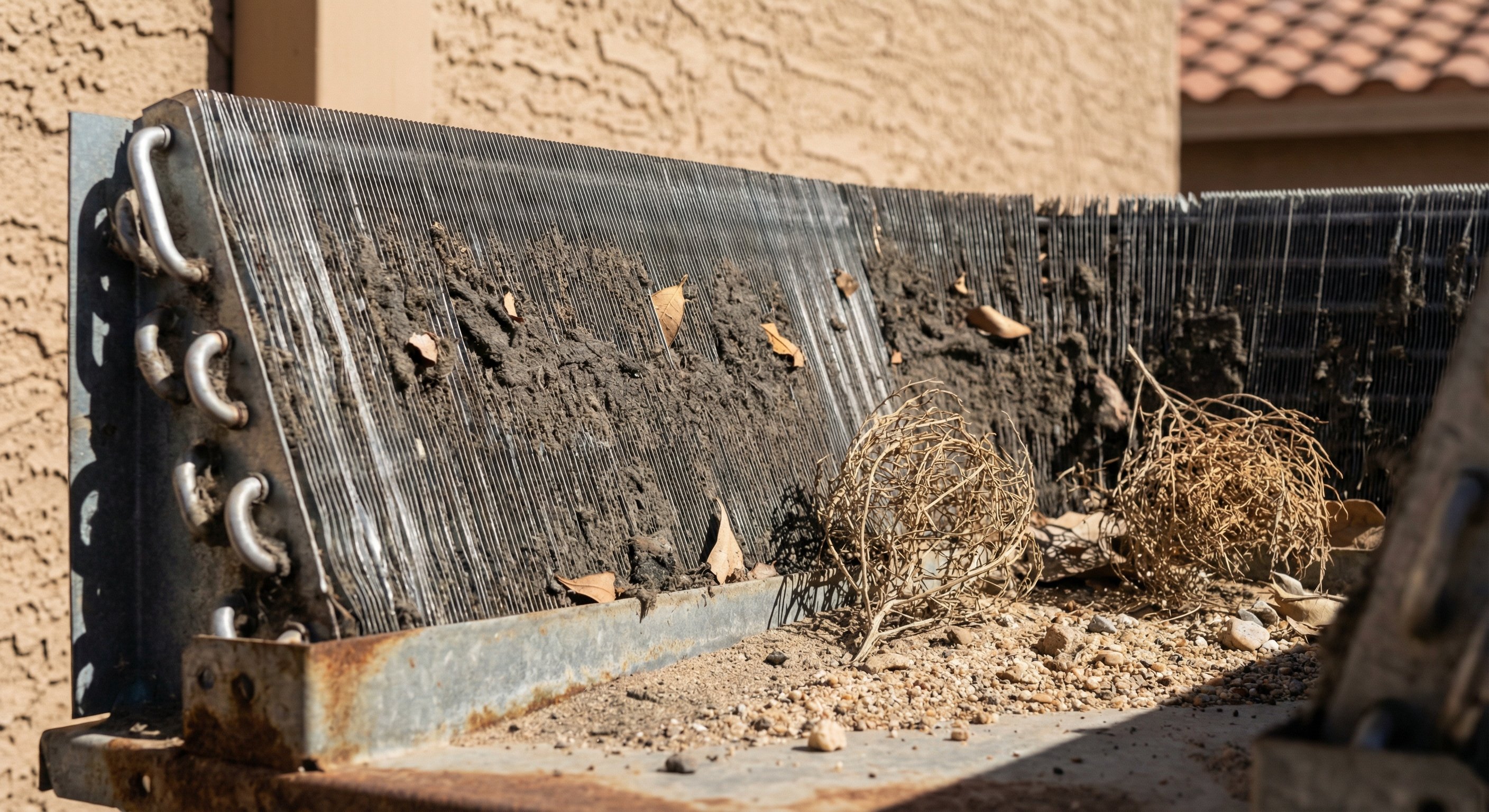
In Phoenix, when temperatures exceed 105°F, the compressor draws 30-40% more current than it does at 85°F. At 115°F, it draws its maximum sustained load. If the condenser coil has any dust accumulation (and in Phoenix, it always does), heat rejection drops further, and the compressor begins its slow failure.
Signs of a struggling compressor include a clicking noise on startup, the outdoor unit running hot enough that you can feel heat radiating from the cabinet, and the system taking longer and longer to reach your thermostat setting.
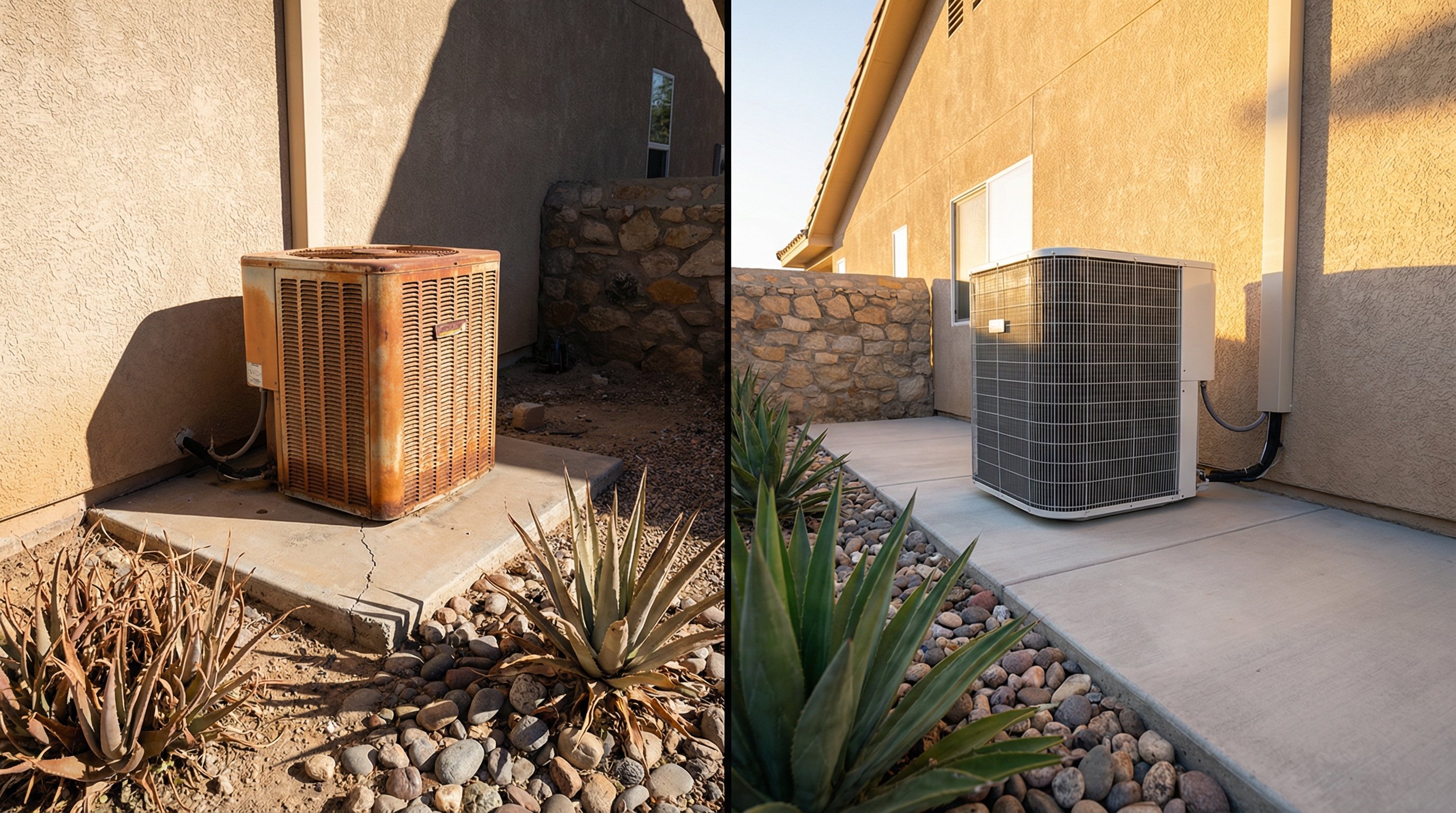
Compressor replacement runs $3,500-$5,500 installed in Phoenix. Most contractors will tell you to replace the whole system instead, because a new compressor on an old system carries the same risk of the next component failing next year. At that cost, a full replacement is often the better call for systems over 10 years old.
Capacitor Failure
The run capacitor is a cylindrical battery mounted inside the outdoor unit that stores electricity and delivers the extra surge needed to start the compressor and outdoor fan motor. It is one of the most heat-sensitive components in any AC system, and it is mounted inside a metal cabinet that sits in direct Arizona sun all day.
Manufacturer-rated maximum operating temperature for most capacitors is 131°F. The metal cabinet of your outdoor unit can reach 150°F in direct Phoenix sun. The capacitor sits inside that cabinet. It is not a question of if it weakens early in Phoenix, it is when.
A failing capacitor shows up as a humming outdoor unit that will not start, warm air coming from your vents, or the outdoor fan spinning slowly before stopping. Capacitor replacement is one of the cheapest repairs in HVAC at $150-$350 for the part and labor, which is exactly why some contractors try to upsell you to a full system replacement the moment they see an aging unit behind the capacitor problem.
The key question to ask when a contractor recommends a full replacement for a capacitor-level problem: what is the age and condition of the rest of the system? If your unit is 7 years old and everything else looks healthy, replace the capacitor. If it is 13 years old with a history of repairs, seriously consider the replacement.
Evaporator Coil Freeze-Ups
This one surprises most Phoenix homeowners. Ice on the coil? In Phoenix?
Yes. Here is why: the evaporator coil inside your air handler is supposed to get cold, but not freezing cold. Its job is to cool and dehumidify the air moving across it. When airflow is restricted (dirty filter, closed vents, undersized ductwork), the refrigerant inside the coil stays too cold for too long, and the coil surface temperature drops below freezing. Moisture in the air condenses and freezes on the coil fins.
In humid climates, this happens slowly and is usually caught early. In Phoenix, the dry air masks the problem because you do not feel the humidity loss the way you would in Houston. The system keeps running on a frozen coil for days while you wonder why it is not cooling. By the time you call a contractor, the ice has damaged the coil, caused refrigerant pressure imbalances that stress the compressor, or both.
The most common trigger in Phoenix homes is a dirty filter that has not been changed in 3-4 months during cooling season. Phoenix filters clog faster than national averages because of desert dust, pet dander, and construction debris that becomes airborne during dry windy months. Changing your filter every 30-60 days during summer is not being overly cautious. It is being appropriate for the local conditions.
When Repair Makes Sense vs. When to Replace
This is the decision every Phoenix homeowner with an aging system faces, usually in July, usually at the worst possible time.
The 50% rule is a practical framework: if the cost of repairs exceeds 50% of the replacement cost, replace. For a Phoenix home with a 3-ton system, replacement runs $8,000-$12,500 depending on the efficiency tier you choose. Fifty percent of that is $4,000-$6,250. If your compressor failed and the quote says $4,800 to replace it, you are one other failure away from a total loss on a system that is already halfway through its effective Phoenix lifespan.
There are two situations where repair almost always wins. First, if your system is under 10 years old and the problem is isolated to one component (capacitor, fan motor, contactor), repair it. You still have years of life left, and a targeted fix is the right call. Second, if you have a documented maintenance history showing the system has been cleaned and serviced annually, its effective age may be significantly lower than its calendar age, and repair makes financial sense.
Replacement almost always wins if your system is 12 or more years old, you have had two or more significant repairs in the past three years, or your summer electric bills have climbed steadily despite normal usage. Old systems simply run less efficiently, and the repair-treadmill cost eventually exceeds the replacement cost within 3-5 years.
Skip the dealer markup
See What a New AC Actually Costs in Phoenix, AZ
AC Rebel shows you the real equipment price — no sales pitch, no inflated quote. Get matched with a licensed installer and keep $3,000–$5,000 in your pocket.
Get My Direct Price →The Maintenance Steps That Actually Matter in Phoenix
Here is the honest list. Most of what you read about AC maintenance is written for homes in Ohio. Phoenix has its own maintenance reality.
Rinse the condenser coil twice per year. Use a garden hose with a soft spray nozzle and run water through the fins from the inside out to push debris outward. Do this once in April before summer and once in September after the worst heat. This alone can extend compressor life by 2-3 years in Phoenix because the condenser can actually do its job instead of choking on dust.
Change your filter every 30-60 days from May through September. Phoenix cooling season is long, and our dust loads are genuinely higher. A $15 fiberglass filter changed frequently is better than a $60 high-MERV filter changed every six months. Restricted airflow is the primary driver of evaporator freeze-ups in this climate.
Clear 24 inches of clearance around the outdoor unit. If your condenser is pushing air into a block wall, a hedge, or a fenced enclosure without adequate ventilation, it recirculates its own exhaust heat. That is the same as running 10°F hotter than the actual ambient temperature.
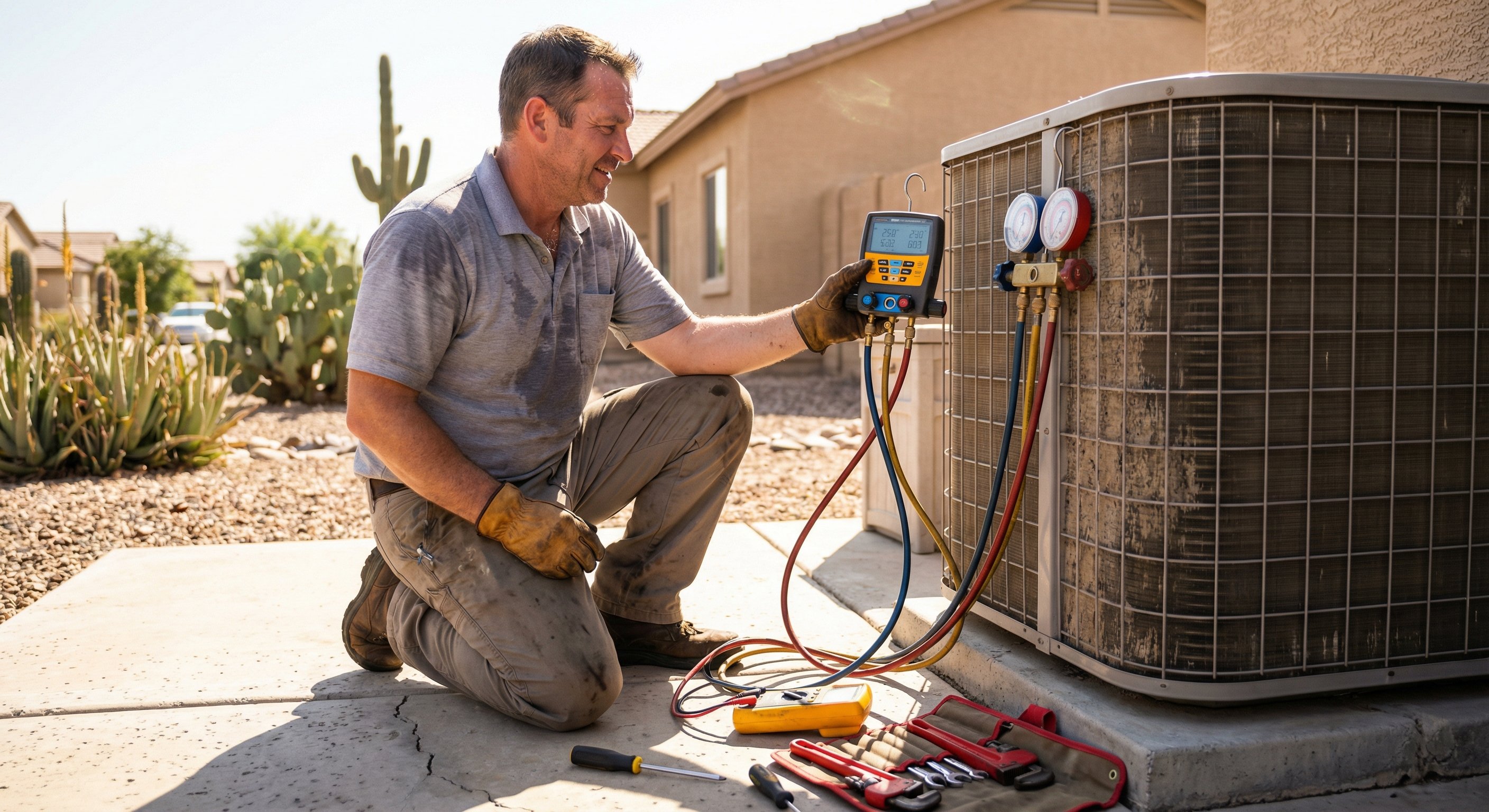
Get a preseason tune-up in April. A contractor who checks refrigerant charge, measures capacitor health, cleans the condensate drain, and tests the contactor in April gives you a clean bill of health before the system faces its hardest months. An April repair is always cheaper than a July emergency.
The Bottom Line
Phoenix ACs fail sooner because the environment is genuinely harder on the equipment. A system that is perfectly maintained in Scottsdale still works harder in July than the same system would in Seattle on the hottest day of their year.
The good news is that Phoenix homeowners who understand this have options. A new system with a higher SEER rating pays back faster here than anywhere else in the country because the efficiency gains compound during our 6-month cooling season. A 14 SEER unit replacing a 10 SEER unit in a 2,200-square-foot Phoenix home typically cuts summer electric bills by 20-30%.
If you are already in the situation where your AC is aging and you are weighing repair against replacement, the math is almost always cleaner than your contractor presents it. Get the itemized quote. Ask what specific component failed and what else the contractor checked. Compare that to the cost of a new unit with a 10-year warranty before signing anything.

Get a free instant quote at acrebel.com and see exactly what a new system costs in your neighborhood without talking to a single contractor on the phone.
Frequently Asked Questions
Why do AC units in Phoenix fail faster than in other states?
Phoenix heat directly stresses every component in an AC system in ways that do not apply to milder climates. When outdoor temperatures exceed 105°F, the compressor draws significantly more current and the condenser coil loses its ability to reject heat efficiently. This causes faster wear on the compressor, capacitor, and coils. National average lifespans are based on milder summer conditions and do not reflect what Phoenix puts equipment through.
What is the average lifespan of an AC unit in Phoenix?
Most Phoenix homeowners get 8-12 years from a central AC system with reasonable maintenance. Units that are not maintained typically fail between 8 and 10 years. Systems that receive semiannual coil cleaning, regular filter changes, and an annual tune-up may reach 12-15 years, but 15-20 years as quoted in national averages is rare in the Phoenix metro area.
Does maintenance actually extend AC life in Phoenix?
Yes, and two specific tasks matter more here than anywhere else. Rinsing the condenser coil twice per year prevents dust buildup from choking the compressor. Changing filters every 30-60 days during cooling season prevents evaporator freeze-ups, which damage compressors in Phoenix homes. These two tasks cost under $50 per year and are the highest-return maintenance steps available.
When should I replace my AC instead of repairing it in Phoenix?
Use the 50% rule: if a repair costs more than 50% of what a full replacement would cost, replace. For Phoenix, this typically means replacing instead of repairing once your system is over 10-12 years old and you face a major component failure. If your unit is under 10 years old with an isolated problem and no prior repair history, fixing it is usually the right call.
Does a higher SEER rating make more sense in Phoenix than in other climates?
Yes. Higher SEER units produce more cooling per unit of electricity, and this advantage is amplified in Phoenix because the cooling season is longer and hotter. A 16 SEER system in a typical Phoenix home typically cuts summer electric bills by 20-30% compared to a 10 SEER unit, and the savings compound year after year.
Ready to stop overpaying?
See Your Direct AC Price in 2 Minutes
Skip the dealer. Buy your AC unit at direct pricing and pay a vetted local installer only for the installation. No sales calls. No hidden markup. Most homeowners save $3,000–$5,000+ compared to a traditional quote.
Get My Direct Price — No Credit Card2-minute quote · Licensed installers · 10-year warranty options