
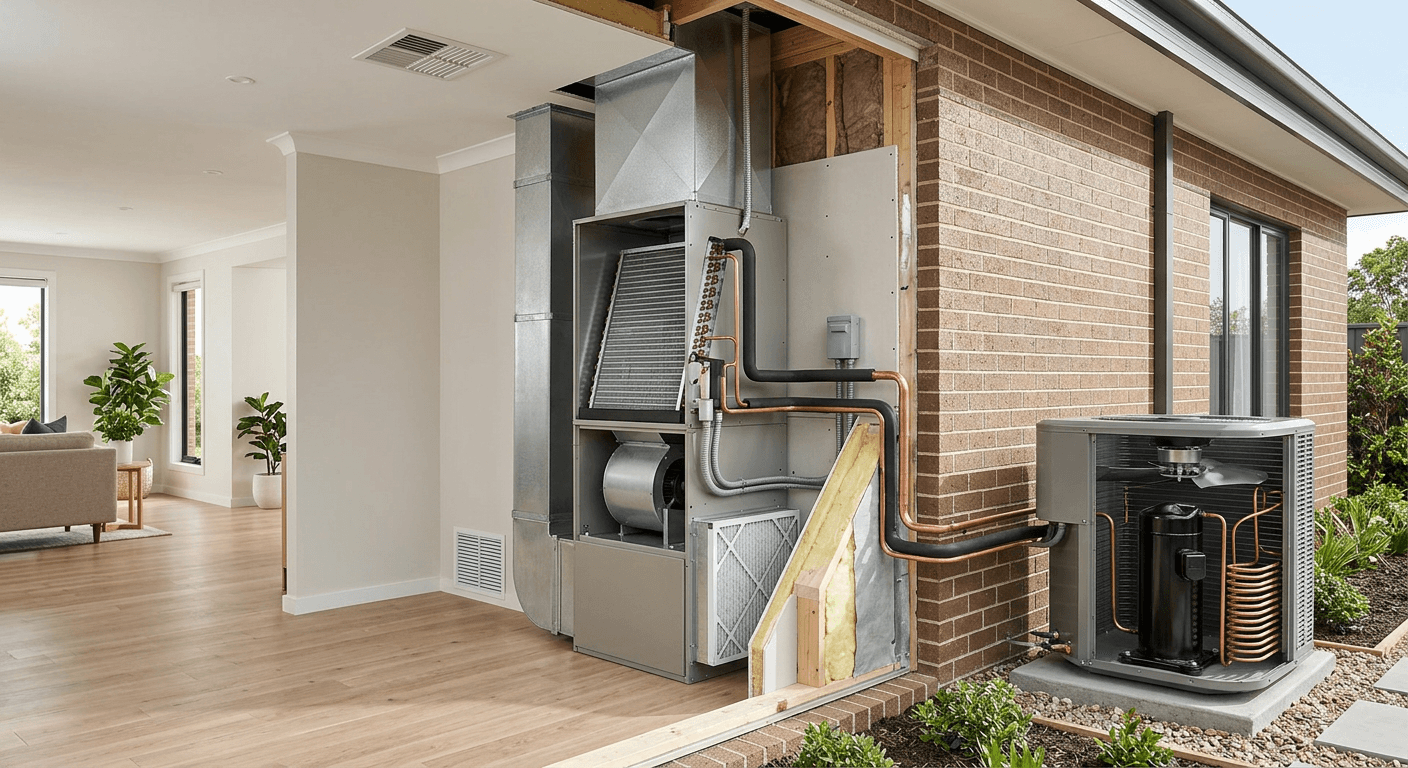
How HVAC Actually Works
No jargon. No sales pitch. Just what you need to know to make a smart decision and save money.
How Your AC Actually Works
Your air conditioner doesn't create cold air. It removes heat from the air inside your home and dumps it outside. That's it. The entire system is built around moving heat from one place to another using a chemical called refrigerant.
The cycle in four steps:
- 1Evaporator coil (inside) absorbs heat from your indoor air as refrigerant evaporates from a liquid to a gas.
- 2Compressor (outside) pressurizes the refrigerant gas, raising its temperature even higher.
- 3Condenser coil (outside) releases that heat into the outdoor air as the refrigerant condenses back into a liquid.
- 4Expansion valve drops the pressure so the refrigerant cools down again, and the cycle repeats.
Your thermostat is the brain. It tells the system when to start and stop based on the temperature you set. The blower fan pushes air across the evaporator coil and through your ductwork to cool every room.
Why this matters to you:
Understanding the basics helps you have smarter conversations with contractors and avoid being oversold on things you don't need. Knowledge is your best defense against a bad deal.
Why AC Rebel Saves You Money
The traditional HVAC buying process is broken. You call a company, a salesman comes to your house, and you get a quote that includes massive markups on the equipment itself. The same unit that costs a distributor $1,800 might show up on your invoice at $4,500.
Traditional HVAC Company
- Showroom and office overhead
- Commissioned sales team
- TV and radio advertising
- 2-3x equipment markup
AC Rebel
- Online-only, minimal overhead
- No salespeople, no commissions
- Direct from distributor pricing
- Transparent, flat-rate pricing
We buy equipment at distributor pricing and sell it to you with a fair, transparent margin. Then we connect you with a top-rated local installer who does quality work at honest rates. The result? The same system, the same warranty, for $3,000+ less.
The bottom line:
You're not getting a cheaper product. You're getting the same product without the middleman markup. That's how we save the average customer $3,000 or more.
See your savings with a free quoteWhat SEER Ratings Mean for Your Electric Bill
SEER stands for Seasonal Energy Efficiency Ratio. Think of it like miles per gallon for your AC. A higher SEER number means the unit uses less electricity to produce the same amount of cooling. The minimum allowed in the southern US is now 15 SEER for new installations.
Annual cooling cost comparison (2,000 sq ft home in Arizona):
Upgrading from a 10 SEER to a 16 SEER saves you $480/year. Going to 17 SEER saves $545/year.
Estimates based on average Arizona electricity rates and typical summer cooling loads. Actual costs vary by usage, home insulation, and utility rates.
Upgrading from an old 10 SEER unit to a 21 SEER system could save you around $690 per year on electricity. Over 10 years, that adds up to nearly $7,000 in savings, which often offsets the higher upfront cost of a premium system.
That said, higher SEER isn't always the best value for everyone. If you're on a tight budget, a 16 SEER unit is still a major upgrade from an aging system and delivers solid savings immediately.
How to pick the right SEER for you:
If you plan to stay in your home for 5+ years, investing in a higher SEER unit usually pays for itself through lower bills. If budget is the priority, our Good tier at 16 SEER is reliable, affordable, and still a big improvement.
Compare our system tiersSplit System vs Package Unit
There are two main types of residential AC setups. Which one you have (or need) depends on your home's layout and where your equipment lives.
Split System
Two separate components: a condenser unit outside and an air handler (with evaporator coil) inside, usually in a garage, attic, or closet. Connected by refrigerant lines. This is the most common setup.
- Most common residential type
- Higher efficiency options available
- Quieter indoor operation
Package Unit
Everything in one box, usually sitting on a concrete pad beside or behind your home. Air gets distributed through ductwork connected to the single unit. Common in manufactured homes and some older builds.
- Single unit, simpler install
- Good for homes without indoor space
- Typically lower upfront cost
Most homes in Arizona and the Southwest use split systems. If you're not sure which type you have, look for a large metal box outside (that's the condenser) and a separate unit inside your home (that's the air handler). If they're in two different locations, you have a split system.
Not sure what you have?
No worries. Our quote questionnaire asks about your setup, and if you're not sure, we'll help you figure it out. You don't need to be an HVAC expert to get a great deal.
Start your free quote5 Signs It's Time to Replace Your AC
Your unit is 10-15+ years old
AC units last about 15 years in Arizona's extreme heat. If yours is approaching that age, it's running on borrowed time. Even if it still works, it's far less efficient than modern systems and a breakdown could leave you without cooling in 115-degree weather.
Your electric bills keep climbing
If your summer electricity costs are higher each year even though your usage hasn't changed, your AC is losing efficiency. Worn compressors, degraded refrigerant levels, and aging components all force the system to work harder for the same result.
Some rooms won't cool down
Hot spots in your home can mean your AC can no longer handle the load, or that ductwork has developed leaks. Either way, if your system can't keep your whole house comfortable, it's time to evaluate whether repair or replacement makes more sense.
Frequent repairs are adding up
A $300 repair here, a $500 repair there. Once your AC needs service more than once a year, those costs start approaching the price of a new, reliable system that won't break down. The general rule: if a repair costs more than 50% of a new unit, replace it.
Strange noises, smells, or short cycling
Grinding, squealing, rattling, or musty smells are signs of serious component failure. Short cycling (turning on and off rapidly) means the system can't maintain proper operation. These issues typically get worse, not better.
Sound familiar? Don't wait for a breakdown.
Replacing your AC on your schedule is always better (and cheaper) than an emergency replacement in July. AC Rebel can have a new system installed within 48 hours. Get a free quote today and see how affordable a new system can be.
Get your free quote nowYou're Not Paying for Your AC Unit. You're Paying for Everyone Who Touched It Before You.
The traditional HVAC industry runs on a chain of markups — each layer adding cost before a unit ever reaches your home. AC Rebel cuts that chain. You get the same equipment, direct, for thousands less — or as low as $89/month with financing.
Traditional HVAC Chain
The Old Way — You Pay Every Markup
Builds the unit at cost.
Buys in bulk, stores it, marks it up.
Sells to local contractors. Another cut.
Quotes you the job. Biggest cut — plus commission.
You absorb every markup above. Four layers of profit, none of it your comfort.
The AC Rebel Way
One Line. No Markup Stacking.
Builds the same Carrier, Lennox, or Trane unit.
We cover facility cost only — no distributor, no supplier, no commission.
Delivered to your home. No markup chain. No hidden fees.
$4,800
vs. $8,000–$14,000+ the traditional way
Same equipment. Same warranty. Zero markup chain.
Now You Know the Basics. Ready to See Your Price?
Get a free quote in under 2 minutes — no sales call, no callback.
Get My Free Quote