
Why Is My AC Tripping the Breaker in Phoenix? Here's What's Actually Wrong

Why Is My AC Tripping the Breaker in Phoenix? Here's What's Actually Wrong
TL;DR: If your AC trips the breaker in Phoenix, the three most common causes are a failing run capacitor, an oversized unit pulling excessive starting current, or a locked-up compressor. A bad capacitor is the cheapest fix at $200 to $400. A failing compressor can run $1,500 to $3,500 to replace. Resetting the breaker once is fine. If it trips again within an hour, stop resetting it and call a licensed HVAC contractor. Continuing to reset it risks electrical fire.
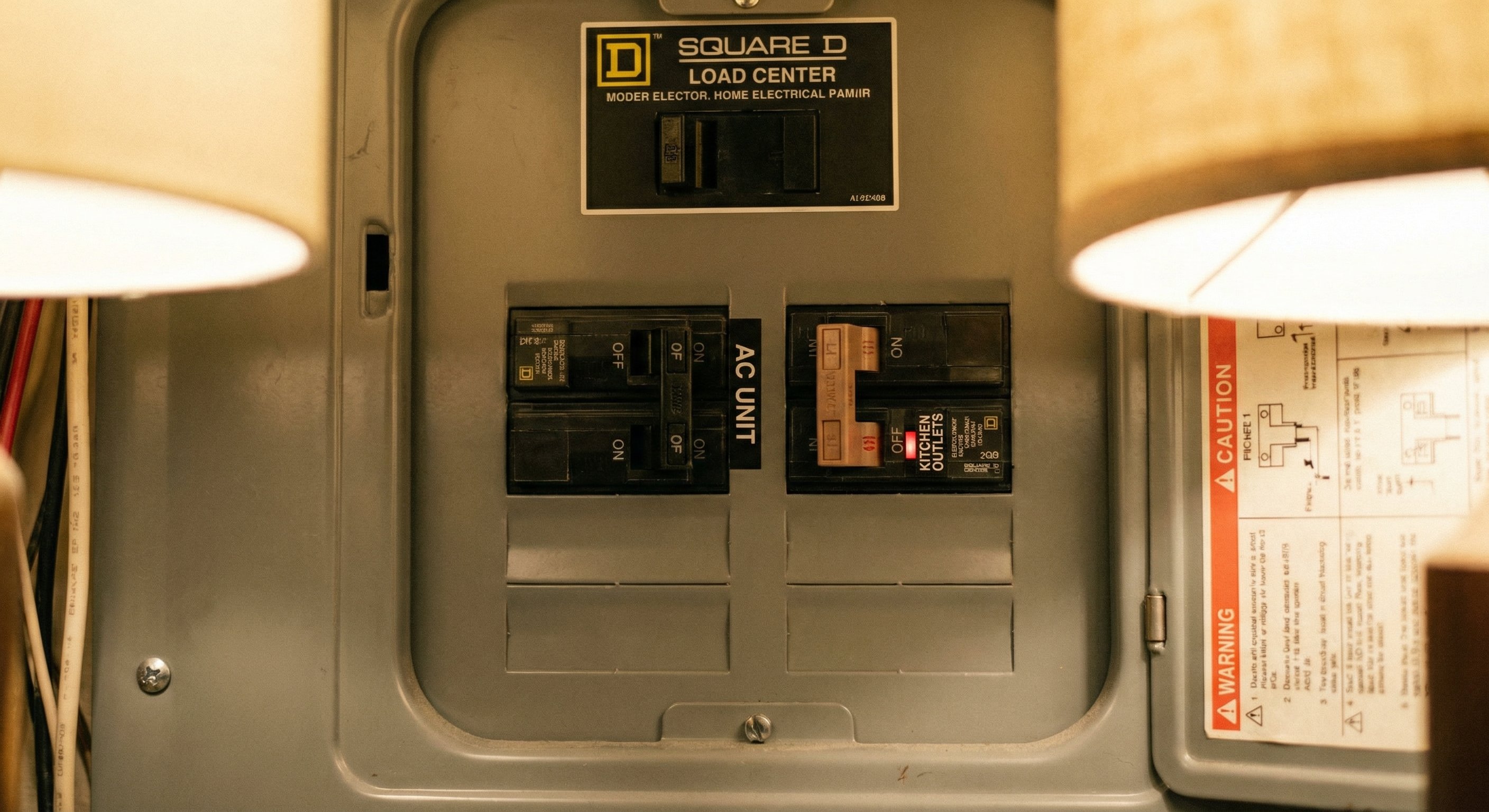
You reset the breaker. The AC kicks on. Five minutes later, the house goes quiet again. That warm feeling creeps back in. You are now standing in your kitchen in 103-degree Phoenix wondering if you are about to spend $10,000 on a new system or if this is something you can fix for a few hundred dollars.
That is the question every Phoenix homeowner asks the first time their AC trips the breaker. Here is the honest answer.
Why Phoenix Makes This Problem Worse
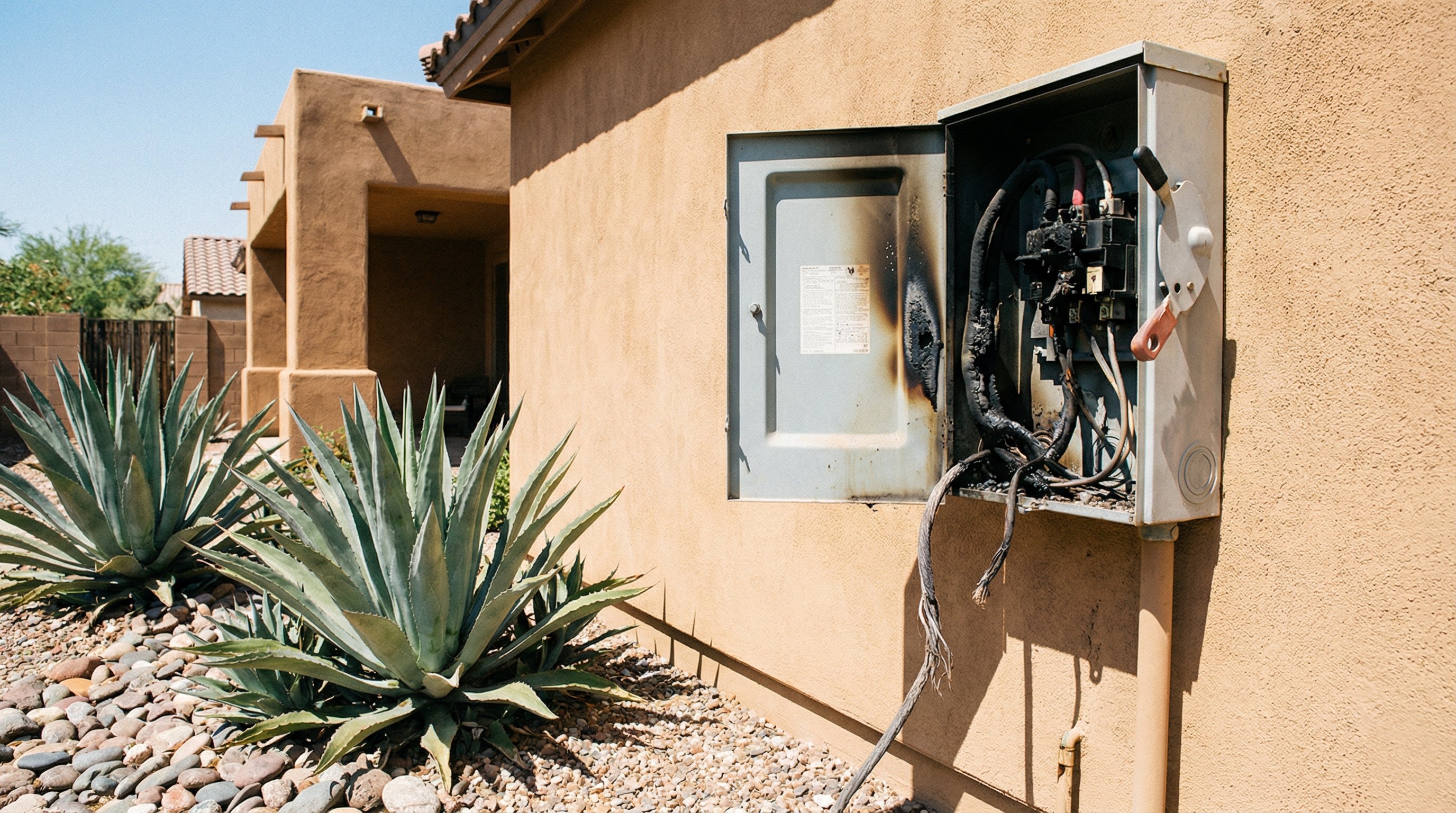
Your AC tripping a breaker is an electrical problem. The circuit breaker is doing exactly what it is supposed to do: protecting your home from wires that are getting hot. When a breaker trips, something is drawing more electricity than the circuit was designed to handle. The breaker trips before the wires heat up enough to start a fire.
In Phoenix, this problem has unique characteristics. The combination of extreme heat, dust, and hard water puts unusual stress on AC components. Capacitors fail faster here than in milder climates. Compressors work harder. The electrical system in your outdoor unit is under more strain for more months of the year.
Most Phoenix homes run their AC from April through October, non-stop. That is six to seven months of continuous load. In a climate where summer ends in September and the AC gets to rest, capacitors last 15 to 20 years. In Phoenix, you are doing well to get 8 to 12 years out of one.
The Three Most Common Causes of a Tripping AC Breaker
1. Failing Run Capacitor
This is the most common cause of an AC tripping its breaker in Phoenix, and the good news is it is usually the cheapest to fix.
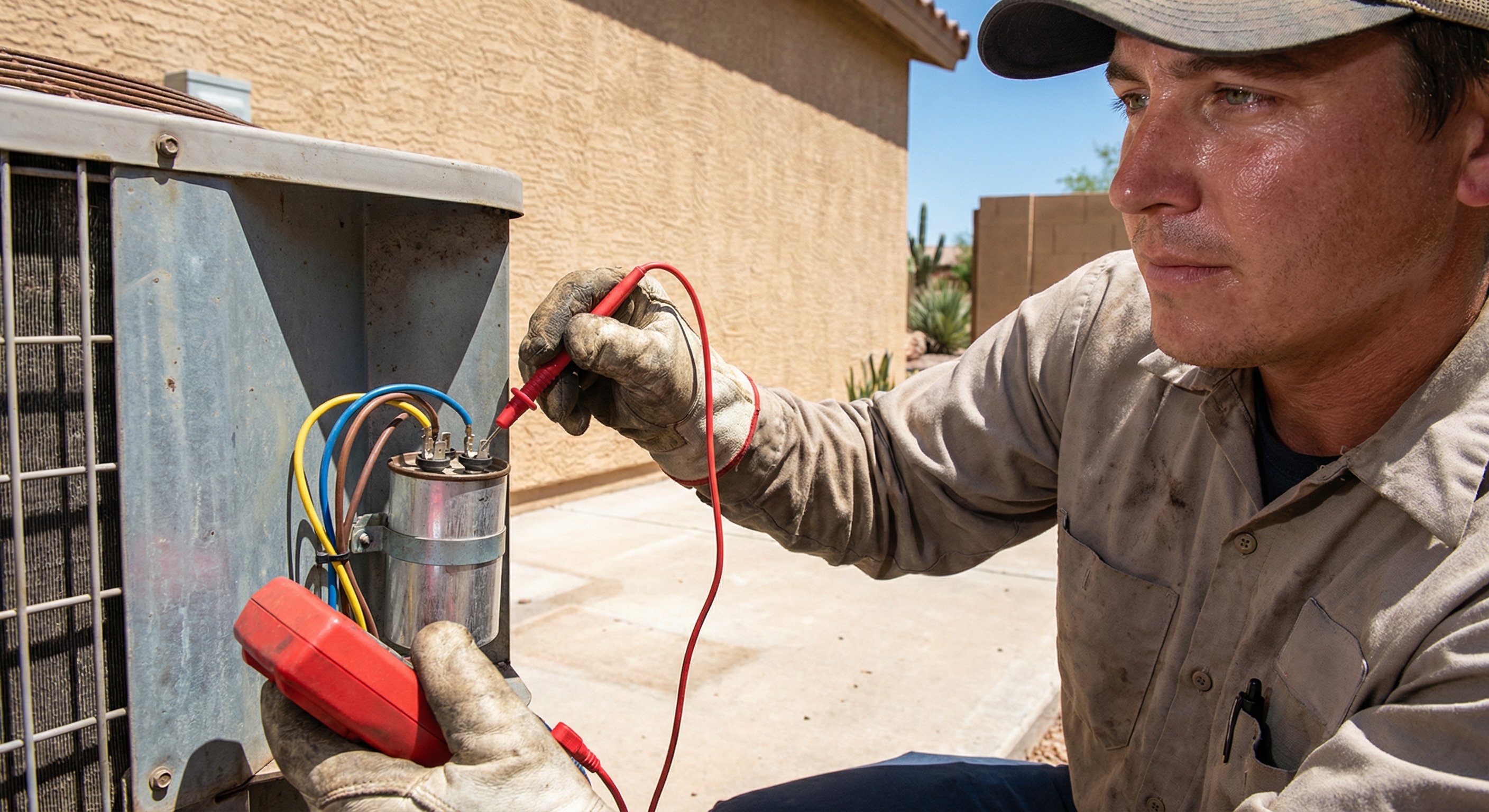
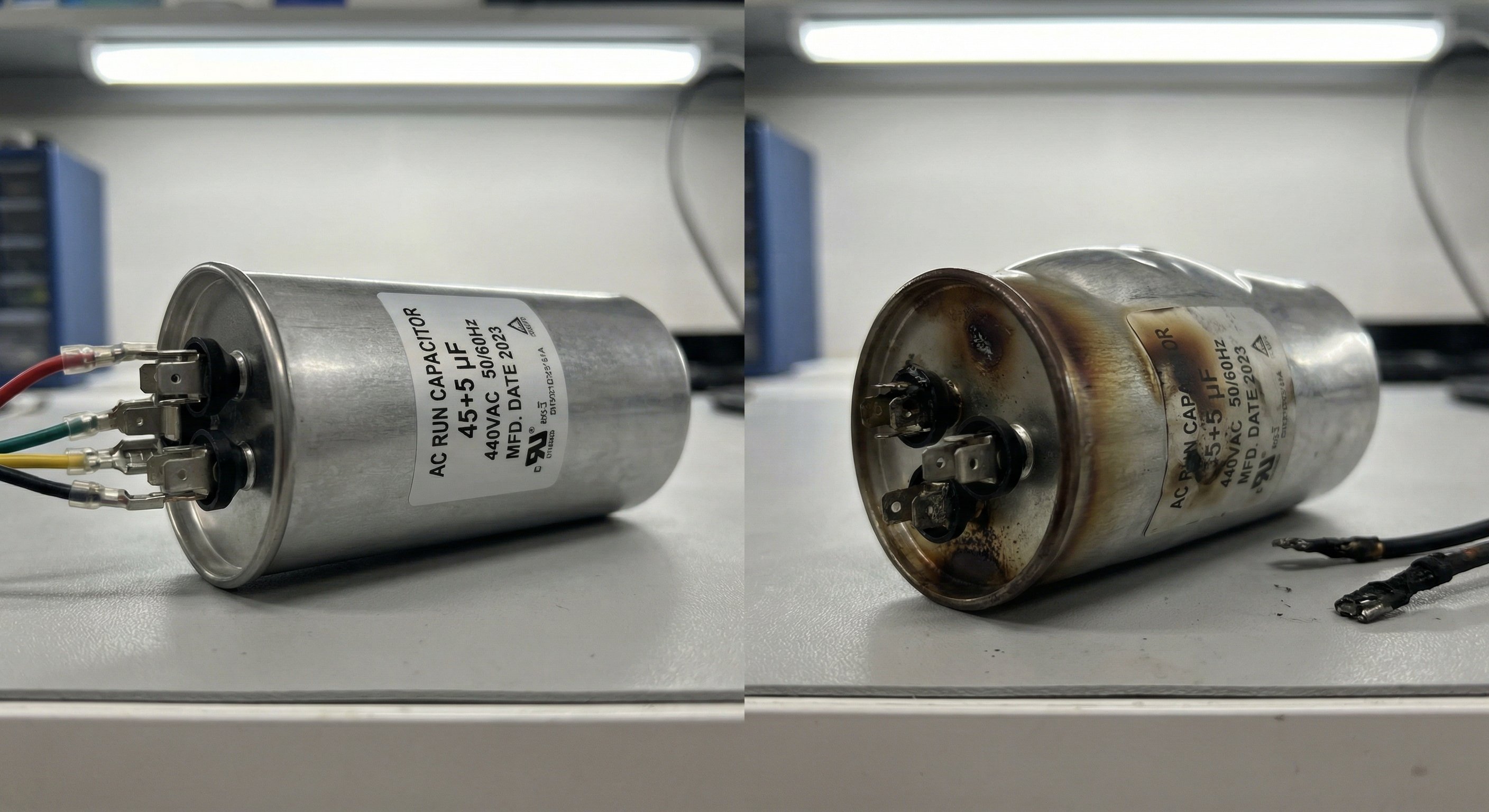
A run capacitor is a small cylindrical component in your outdoor unit that stores electricity and helps the compressor and fan motor start and run efficiently. Without it, the compressor has to draw significantly more current to do the same work. That extra current is what trips the breaker.
Phoenix homeowners see capacitor failures for two reasons specific to this climate. Desert dust coats the outdoor coils and forces the system to work harder, which stresses the capacitor. Hard water leaves mineral deposits on the coil that create hot spots, and those hot spots accelerate capacitor failure.
A failing capacitor often gives warning signs before it trips the breaker. The AC takes an extra second to start. The outdoor fan motor sounds slower than normal. On hotter days when the system is working harder, the breaker trips. If it has been more than 8 years since your last replacement, a failing capacitor should be near the top of your suspect list.
2. Oversized Unit Pulling Excessive Amps
When an air conditioning system is oversized for the home it is cooling, it short-cycles. It turns on, cools the house quickly, and turns off before the system has had time to stabilize. Those startup surges are hard on the compressor and hard on your electrical system.
Every time the compressor starts, it draws a burst of current significantly higher than its running current. A correctly sized unit might draw that startup surge 6 to 8 times per hour. An oversized unit draws that same surge 15 to 20 times per hour. The cumulative electrical stress is what eventually trips the breaker.
In older Phoenix neighborhoods, particularly homes built before 1990, it was common to oversize AC units as a selling point. A 4-ton unit on a 1,800-square-foot home is not unusual in older Arcadia or Coronado neighborhoods. If your home is in that category and you are having breaker problems, have an HVAC contractor verify that your unit is correctly sized for your home, not just for the square footage on paper.
3. Locked-Up Compressor
A locked-up compressor is the most serious cause of a tripping breaker. When a compressor locks up, the motor tries to spin but the mechanical internal components have seized. The motor draws maximum current trying to turn the compressor and never succeeds. That sustained high-draw current trips the breaker quickly and repeatedly.
A locked-up compressor requires full system replacement in most cases. The compressor is sealed inside the outdoor unit. If the compressor has seized mechanically, you cannot repair it, only replace it along with the matching refrigerant charge and associated components.
If your AC breaker trips immediately every time you reset it, within 30 seconds of the unit starting, that is the signature of a locked compressor. Call an HVAC contractor that same day. Do not keep resetting it.
What You Can Check Before Calling Anyone
Here is what you can safely look at yourself, from inside your home, without touching anything electrical.
Check the air filter. A clogged filter restricts airflow, which makes the system work harder, which increases electrical draw. If your filter has not been changed in more than 60 days during summer, change it first. If the breaker was tripped by high electrical draw and the filter was the culprit, a fresh filter reduces the load enough that the system may stabilize. This is not a diagnosis, but it is a $0 fix worth trying before you pay a service call.
Check what else is on the same circuit. If your AC is on a shared circuit with other high-draw appliances, running the microwave, a space heater, or several lights at the same time as your AC can push the shared circuit over its limit. Check your panel label to see if the AC breaker shares a circuit with anything else in the house. Running high-draw appliances separately from your AC during hot weather is a practical workaround while you arrange a repair.
Note when it trips. Does it happen 10 minutes after the AC starts or 30 seconds after? The timing tells you a lot. A 30-second trip almost always points to a locked compressor or a direct short. A 10-minute-plus trip usually points to a failing capacitor or the system overheating under sustained load.
Skip the dealer markup
See What a New AC Actually Costs
AC Rebel shows you the real equipment price — no sales pitch, no inflated quote. Get matched with a licensed installer and keep $3,000–$5,000 in your pocket.
Get My Direct Price →When It Is an HVAC Problem vs. an Electrical Problem
There is a gray area between HVAC problems and electrical problems that confuses Phoenix homeowners. Here is how to think about it.
If the AC unit itself is drawing too much current because of an internal component failure, that is an HVAC problem. An HVAC contractor diagnoses and fixes it.
If the electrical panel, the wiring to the outdoor unit, or the breaker itself is faulty or undersized, that is an electrical problem. A licensed electrician fixes it.
The complication is that a bad HVAC component can make a good breaker appear bad. If a failing capacitor is drawing double the normal current, the breaker trips not because the breaker is faulty but because it is doing its job. Replacing the breaker without fixing the capacitor would just cause the new breaker to trip.
Reputable HVAC contractors will check the capacitor and the electrical connections before recommending a breaker replacement. If someone shows up and says the breaker is bad without checking your outdoor unit, get a second opinion.
What These Repairs Actually Cost in Phoenix
Here are real numbers for the Phoenix metro area in 2026. These are for the repair component alone, not for full system replacement.
Run capacitor replacement: $200 to $400. This includes the part and labor. Capacitors themselves are $15 to $50 retail, but the labor to diagnose and safely discharge the system before replacing it is what drives the cost. This is the most common and least expensive fix.
Hard-start capacitor kit: $150 to $350. If your unit is slightly undersized for your ductwork or is older, a hard-start kit gives the compressor extra torque to start. This is sometimes used when the capacitor is weak but not fully failed, or as a preventive measure on older systems in the Phoenix heat.
Compressor replacement: $1,500 to $3,500 for the compressor itself, plus labor to recover the old refrigerant, replace the compressor, recharge the system, and test it. On older R-22 systems, the refrigerant recovery cost alone can add $500 to $1,200. Total compressor replacement on a pre-2000 Phoenix home with R-22 refrigerant can approach $4,000 to $6,000 installed.
Circuit breaker replacement: $150 to $350 if done by an electrician. This is straightforward wiring labor. If the breaker itself tests as good and the problem is in the outdoor unit, replacing the breaker is a waste of money unless the breaker itself is genuinely faulty.
Full AC replacement: $8,200 to $14,500 installed in the Phoenix metro area, depending on system size, efficiency rating, and whether ductwork modifications are needed. If you are facing compressor failure on a unit older than 12 years in Phoenix, replacement is often the better long-term financial decision compared to putting $3,000 into a system that may have other failures coming.
How to Buy the Right Fix
If your AC is tripping the breaker and you have diagnosed it as a capacitor issue, you have a choice that most Phoenix homeowners never know they have. You can buy the AC unit yourself at direct pricing and only pay for installation separately.
Here is why that matters. The traditional HVAC supply chain adds a 40% to 60% markup on equipment before it reaches the contractor who installs it. That contractor then adds their own margin on top of their cost. By the time you see the invoice, the $40 capacitor replacement call has somehow become $400 not because the work changed but because the business model requires it.
When you buy the unit directly and arrange your own installation, you pay for the equipment at near-wholesale pricing and you choose the contractor yourself based on their license number, reviews, and actual track record. That is what AC Rebel offers. You see the direct price of the unit, and you get connected with vetted local contractors for installation only.
If your capacitor has failed, the diagnosis is straightforward enough that most licensed HVAC companies will confirm it with a multimeter test in under 10 minutes. Ask them to show you the reading. A healthy capacitor will read within 10% of its rated microfarad rating. Anything 20% or more below rating is failed. If the contractor cannot or will not show you the reading, call someone else.
Frequently Asked Questions
Q: Is it dangerous to keep resetting my AC breaker?
Yes. If the AC trips the breaker once and you reset it and it runs fine for the rest of the day, that is probably fine. If it trips again within an hour, stop resetting it. Each startup surge that trips the breaker is a sign that something inside the outdoor unit is drawing excessive current. That condition generates heat in your wiring. Continuing to force the issue risks a more serious electrical failure.
Q: Can a dirty air filter cause my AC to trip the breaker?
Indirectly, yes. A severely clogged filter restricts airflow, which causes the system to work harder to push air through the coils. That extra mechanical load increases electrical draw. On a borderline-healthy system, a clogged filter can be enough to push it over the edge and trip the breaker. Replace your filter. If the problem stops, you fixed it for $20. If it keeps tripping, you have a deeper problem.
Q: How do I know if my AC capacitor is failing?
The early signs are a delayed startup (the AC kicks on a second or two later than normal), a humming sound from the outdoor unit without the fan spinning, or the unit tripping the breaker on hot afternoons when the electrical load is highest. The only way to confirm it is with a multimeter test. HVAC companies do this in 5 to 10 minutes as part of a service call. Ask for the microfarad reading.
Q: Why does my AC trip the breaker more often in extreme Phoenix heat?
Because the electrical load on your system increases as outdoor temperatures rise. At 95°F outside, your system works harder than at 80°F. At 110°F, it works significantly harder. The capacitor has to work harder to deliver the same output, and the compressor draws more current. If your system is already borderline, the hottest days of a Phoenix summer are when the weak component fails.
Q: Should I replace the capacitor or just replace the whole AC unit?
If your AC is less than 10 years old, replacing the capacitor is almost always the right call. It is a $200 to $400 repair on a system with years of life remaining. If your AC is 12 years or older and you are having capacitor failures, that is usually a sign that the system is winding down. An honest HVAC contractor will tell you whether the math makes sense. A new 3-ton system installed in the Phoenix metro in 2026 runs $8,200 to $12,500 depending on efficiency tier.
Q: Can I replace the AC capacitor myself?
Technically yes if you are comfortable working with electrical components. Practically, no, for two reasons. First, capacitors store electricity even after the power is off and need to be safely discharged before handling. Second, the EPA requires EPA Section 608 certification to handle refrigerant. Most homeowners should pay for a licensed HVAC technician. The cost difference between a DIY attempt gone wrong and a professional repair is significant.
Q: How long does it take to fix a tripping AC breaker?
For a capacitor replacement, most contractors finish in 30 to 60 minutes. For a compressor replacement, plan for a full day. Electrical panel work by a licensed electrician typically takes 1 to 2 hours. If the diagnosis is unclear, the troubleshooting itself may take a service call to resolve.
The Short Version
Your AC is tripping the breaker because it is drawing more electricity than the circuit can safely handle. In Phoenix, the most common cause is a failing run capacitor, which is also the cheapest fix at $200 to $400. The next most common is an oversized unit that is drawing excessive startup current too frequently. The most serious is a locked-up compressor, which usually means full system replacement.
Reset once. Watch it. If it trips again within the hour, stop resetting it and get a licensed HVAC contractor out to do a multimeter diagnosis. The diagnosis itself takes 10 minutes and should be included in any reasonable service call fee. Ask for the microfarad reading. If they will not show you the test result, call someone who will.
Phoenix summers are too hot and too long to mess around with an electrical problem in your cooling system. Get it diagnosed. Get a real number. Then decide whether to fix it or replace it on your terms, not on the terms of whoever shows up first with a truck and a invoice in hand.
Get a free instant quote at acrebel.com and see what a new system costs without the dealer markup. You might be surprised how competitive the direct pricing is compared to what you were quoted last summer.
Ready to stop overpaying?
See Your Direct AC Price in 2 Minutes
Skip the dealer. Buy your AC unit at direct pricing and pay a vetted local installer only for the installation. No sales calls. No hidden markup. Most homeowners save $3,000–$5,000+ compared to a traditional quote.
Get My Direct Price — No Credit Card2-minute quote · Licensed installers · 10-year warranty options