
AC Compressor Replacement Cost in Phoenix (2026 Pricing Guide)

AC Compressor Replacement Cost in Phoenix (2026 Pricing Guide)
TL;DR: AC compressor replacement in Phoenix typically costs $1,800 to $4,500 depending on your unit's size and brand. The compressor is the heart of your system and the most expensive single component to replace. Most Phoenix homeowners facing a failed compressor should consider full system replacement instead, especially if your unit is over 8 years old. New compressors come with 5-10 year manufacturer warranties, but labor warranties vary by contractor.
Your AC just started making a noise like a washing machine full of rocks. The air coming out is lukewarm. Worst of all, the first contractor who showed up muttered something about the compressor and quoted you a number that made your stomach drop.
Welcome to compressor failure season in Phoenix. It happens every spring when dormant units get fired up after months of sitting idle through our "winter." And it always happens at the worst possible time.
The compressor is the literal heart of your air conditioning system. It's the component that pressurizes refrigerant and makes the whole cooling cycle possible. When it fails, nothing else matters because your AC becomes an expensive outdoor fan.
Here's what you actually need to know about compressor replacement costs in Phoenix, when repair makes sense versus replacement, and why contractors often push full system swaps (sometimes for legitimate reasons, sometimes not).
What Does an AC Compressor Actually Do?
Before we talk money, you need to understand what you're paying for.
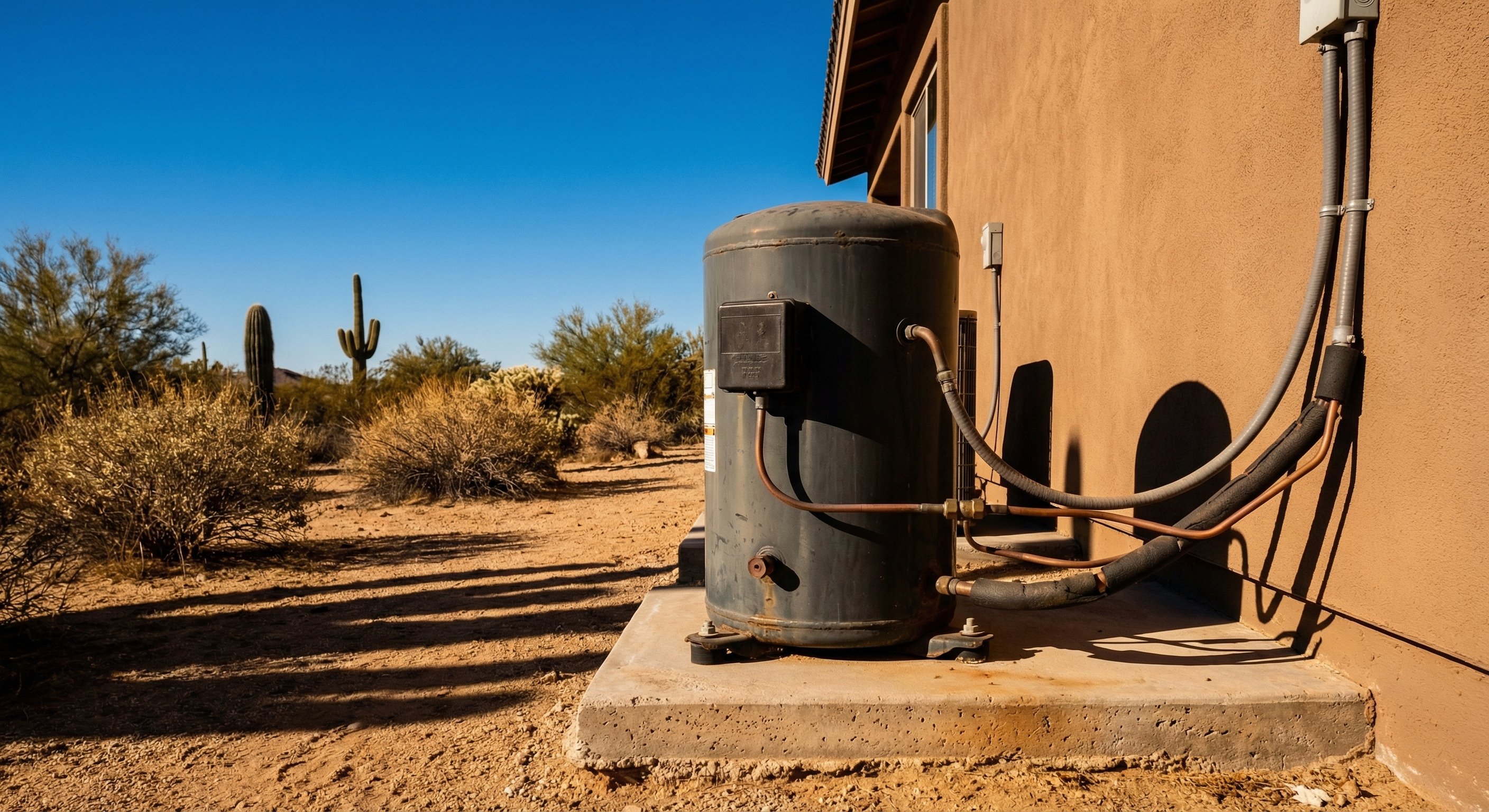
The compressor sits inside your outdoor condenser unit. It's a sealed, cylindrical component (usually black) about the size of a large cooler. Its job is simple in concept, complex in execution: compress low-pressure refrigerant gas into high-pressure hot gas. This compression is what moves heat from inside your home to the outside.
Without a functioning compressor, refrigerant doesn't circulate. No circulation means no heat transfer. No heat transfer means you're paying to run a fan that recirculates warm air.
In Phoenix, compressors work harder than almost anywhere else in the country. Our summer temperatures routinely hit 115°F, which means your compressor is operating at the outer edge of its design envelope for months at a time. Combine that with dust storms coating condenser coils and hard water causing scale buildup, and you have a recipe for premature failure.
How Much Does AC Compressor Replacement Cost in Phoenix?
Here's the reality: compressor replacement isn't cheap. It's the single most expensive repair your AC system can need.
2026 Phoenix compressor replacement costs:
| Unit Size | Compressor Part Cost | Total Installed Cost |
|---|---|---|
| 1.5-2 tons | $800-$1,200 | $1,800-$2,800 |
| 2.5-3 tons | $1,000-$1,600 | $2,400-$3,500 |
| 3.5-4 tons | $1,400-$2,200 | $3,200-$4,500 |
| 5+ tons (commercial) | $2,000-$3,500 | $4,500-$7,000+ |
These prices assume a standard single-stage compressor. If you have a two-stage or variable-speed unit (increasingly common in newer Phoenix homes), expect to pay 30-50% more for the compressor itself.
What Drives the Price Difference?
Several factors determine where you'll land in these ranges:
Brand and tier: A basic contractor-grade compressor costs less than a premium Carrier or Trane unit. Your existing system determines which compressor you need. You can't just swap in whatever's cheapest.
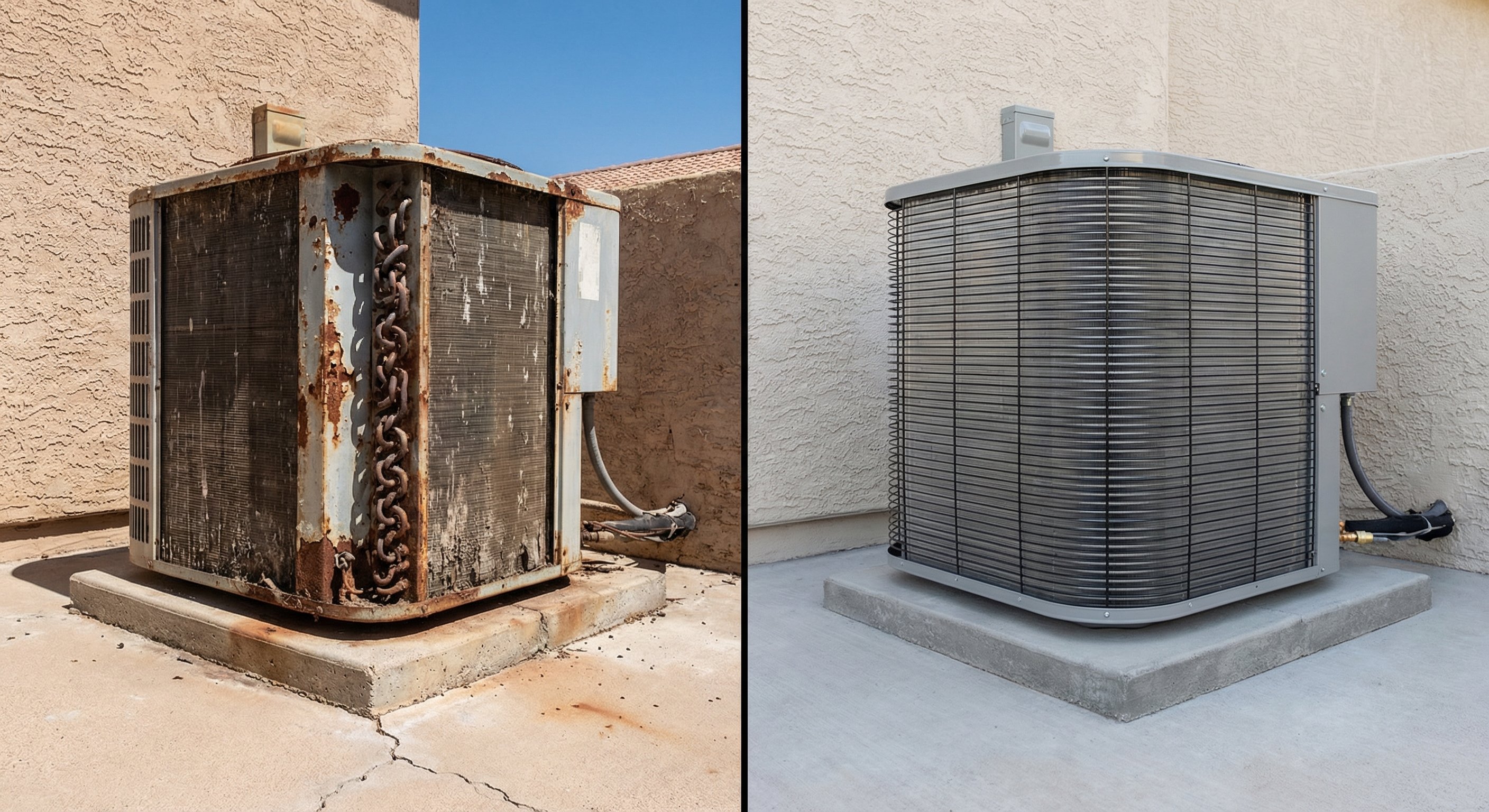
Refrigerant type: If your unit uses R-22 (Freon), you're facing additional complications. R-22 was phased out in 2020, and remaining supplies are expensive. Compressor replacement on an R-22 system often requires a full system replacement because retrofitting for modern refrigerant isn't cost-effective.
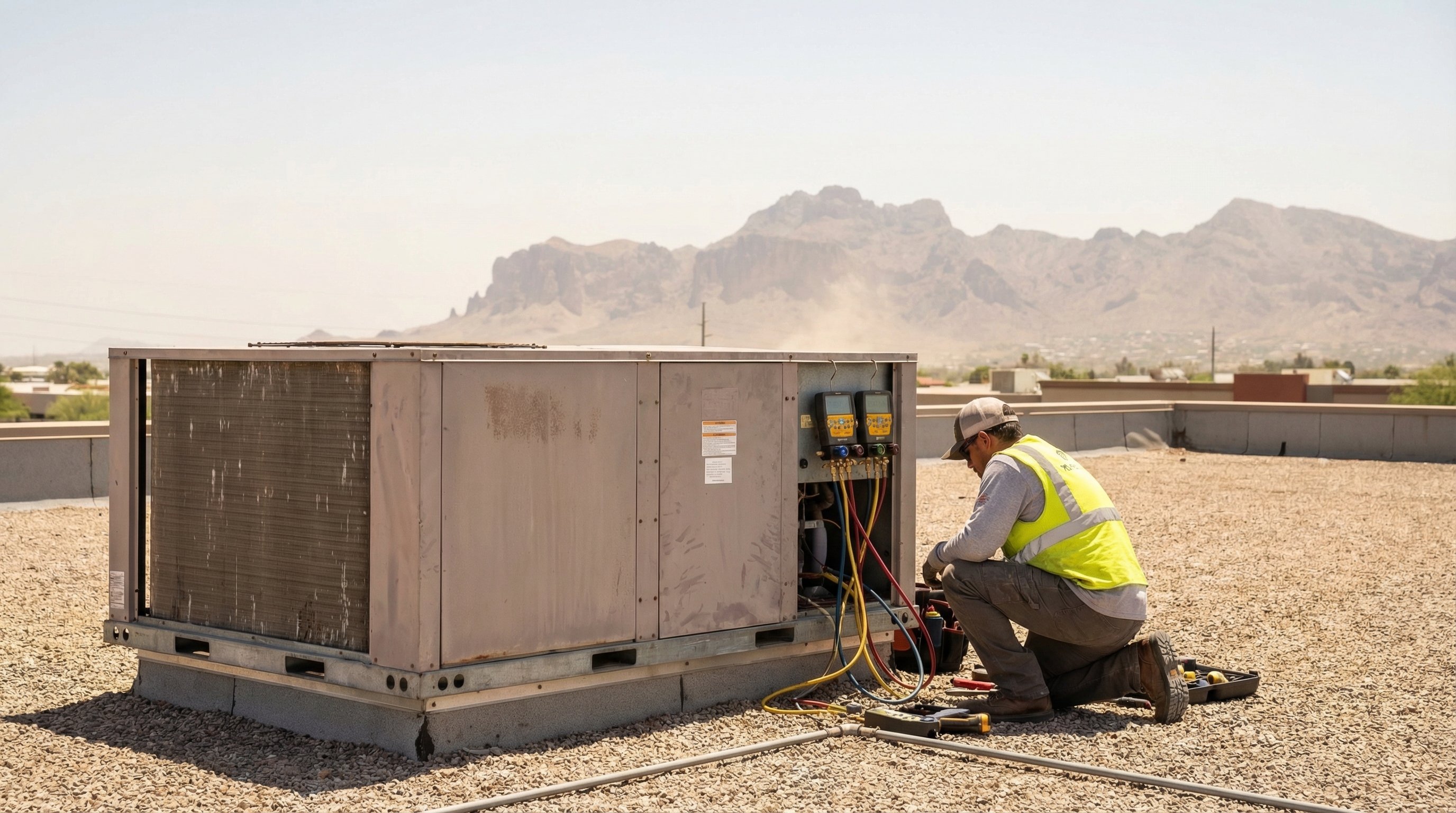
Accessibility: Compressors in rooftop package units (common in many Phoenix neighborhoods) are easier to access than split-system compressors squeezed into side yards with minimal clearance. More labor time equals higher cost.
Warranty status: If your compressor is under 10 years old, it might still be covered by manufacturer warranty. You'll pay only for labor ($400-$1,200 depending on complexity). But there's a catch (detailed in the warranty section below).
Signs Your AC Compressor Is Failing
Not every AC problem is the compressor. But these symptoms strongly suggest compressor issues:
Circuit breaker keeps tripping: Compressor electrical faults can cause breaker trips. If your AC repeatedly shuts down the same breaker, the compressor motor may be drawing excessive current due to internal damage.
Outdoor unit runs but no cool air: When the condenser fan spins but the compressor doesn't kick in, you'll get lukewarm air. The fan noise can fool you into thinking the system is working.
Clicking or grinding noises: A healthy compressor makes a smooth humming sound. Clicking, grinding, or rattling indicates mechanical failure, usually internal component damage that's irreversible.
Refrigerant leaks around the compressor: The compressor housing itself shouldn't leak. If you see oil stains or refrigerant residue around the compressor base, the seal has failed. This typically requires compressor replacement.
Unit shorts cycles: If the compressor starts but shuts off quickly (before reaching thermostat temperature), it may be overheating due to internal damage. This puts massive stress on electrical components.
Vibrating condenser unit: Excessive vibration when the compressor runs suggests internal mechanical failure. The compressor's piston or scroll mechanism is likely damaged.
One note: capacitor failure mimics compressor failure. The capacitor provides the electrical boost to start the compressor. If it dies, the compressor won't start even though it's fine. A capacitor replacement costs $150-$300, not $2,000+. Always ask your contractor to verify it's actually the compressor, not just the capacitor.
Skip the dealer markup
See What a New AC Actually Costs in Phoenix, Arizona
AC Rebel shows you the real equipment price — no sales pitch, no inflated quote. Get matched with a licensed installer and keep $3,000–$5,000 in your pocket.
Get My Direct Price →Repair vs Replace: The Decision Framework
This is the big question every Phoenix homeowner faces with a failed compressor. Here's how to think about it:
Replace the compressor if:
- Your unit is under 5 years old
- The compressor is covered by manufacturer warranty (you pay only labor)
- The rest of the system is in excellent condition (clean coils, good ductwork, proper refrigerant charge)
- You plan to sell the home within 2 years and need the quickest, cheapest path to functional AC
Replace the entire system if:
- Your unit is over 8 years old (compressor warranty likely expired)
- The system has needed other major repairs in the past 2 years
- Your energy bills suggest the system is running inefficiently
- The indoor coil also needs replacement (common with compressor failures caused by refrigerant issues)
- You have an R-22 system (compressor replacement rarely makes financial sense)
Here's the math most contractors won't explain clearly: A new 3-ton system in Phoenix costs $6,500-$9,500 installed. A compressor replacement on an aging system costs $3,000-$4,000. For an additional $3,000-$5,500, you get a new system with 10-year warranty, modern efficiency (saving $30-$80/month on APS or SRP bills), and peace of mind.
If your current unit is 10+ years old, compressor replacement is usually throwing good money after bad. The new compressor will outlast the rest of your aging system, and you'll likely face another major repair within 2-3 years.

Understanding Compressor Warranties
Manufacturer warranties on compressors can save you thousands, but they come with conditions you need to understand.
Standard manufacturer warranty: Most compressors come with 5-10 year manufacturer warranties. The warranty covers the compressor part itself, not labor. If your compressor fails at year 7, the manufacturer ships you a free compressor. You still pay $800-$1,500 for installation labor.
Labor warranties: These are separate and provided by the installing contractor. Standard labor warranties range from 1-2 years. Premium contractors may offer 5-year labor warranties on compressor replacements. Always ask specifically about labor warranty terms.
Registration requirements: Many manufacturers require online registration within 60 days of installation to activate the full warranty period. Unregistered units often default to 5 years instead of 10. If you're buying a home with an existing AC, check whether the previous owner registered the equipment.
Transfer limitations: Some warranties are non-transferable between homeowners. If you're considering compressor replacement on a unit installed by the previous owner, verify warranty transferability with the manufacturer.
Proof of maintenance: Manufacturers may deny warranty claims if you can't demonstrate annual professional maintenance. Keep records of every service visit. Phoenix's harsh climate makes this especially important, and manufacturers know it.
Why Phoenix Compressors Fail Faster
Compressor life expectancy is 10-15 years under ideal conditions. In Phoenix, the reality is often 8-12 years. Here's why:
Extreme heat cycling: A compressor in Minneapolis might run 500 hours per year. In Phoenix, that same compressor runs 2,500+ hours annually. More runtime equals more wear.
Head pressure stress: When outdoor air hits 115°F, your condenser struggles to release heat. The compressor has to work harder to achieve the same refrigerant pressure, increasing mechanical stress and electrical draw.
Dust and debris: Our desert environment coats condenser coils with fine dust. Dirty coils reduce heat transfer, forcing the compressor to run longer and hotter. Regular coil cleaning is essential in Phoenix but often neglected.
Power fluctuations: Summer storms and grid stress cause voltage fluctuations that damage compressor motors. A single significant voltage spike can destroy a compressor's electrical components.
Hard water scale: Phoenix's hard water causes mineral scale buildup on evaporator coils. Reduced airflow across the indoor coil forces the compressor to work longer to achieve the same cooling, shortening its life.
This is why manufacturer warranties are so important in Phoenix. You're more likely to use them here than in milder climates.
Getting Fair Quotes: What to Ask
When you're facing a $3,000+ repair, getting multiple quotes is smart. But not all quotes are comparable. Ask these specific questions:
"Is this quote for compressor replacement or full system replacement?" Some contractors reflexively quote full system replacement because it's more profitable. Others push compressor-only replacement because it's faster. Understand what you're actually getting quoted for.
"What brand and model compressor are you proposing?" Get the specific model number, not just "a new compressor." Research it independently. Some contractors install rebuilt or generic compressors that won't last.
"What's your labor warranty?" Manufacturer warranty covers the part. Labor warranty covers the installation. A 1-year labor warranty means you pay again if the installation was faulty and fails at month 14.
"Will you verify warranty status with the manufacturer?" If your unit might be under warranty, the contractor should verify before ordering parts. Don't assume based on installation date alone.
"What's included besides the compressor?" A proper compressor replacement includes new refrigerant (not recovered old refrigerant), new filter drier, system evacuation, and leak testing. Cut-rate quotes skip steps that matter for longevity.
"Why did the compressor fail?" A good contractor diagnoses the root cause, not just the symptom. If your compressor failed due to a refrigerant leak or electrical issue, replacing the compressor without fixing the underlying problem guarantees premature failure of the new one.
The R-22 Problem
If your system uses R-22 refrigerant (Freon), compressor replacement becomes a different calculation entirely.
R-22 was phased out in 2020 due to environmental regulations. No new R-22 is being manufactured. The only available R-22 is recycled stock, and prices have increased 5-10x since the phaseout began.
Here's the problem: You can't just swap in a new compressor designed for modern refrigerant (R-410A or R-32) into an R-22 system. The oils are incompatible, and the system pressures are different. The indoor coil, line set, and metering device would also need replacement.
By the time you've converted everything to work with a new refrigerant, you might as well install a new system. For R-22 systems with compressor failure, full system replacement is almost always the right answer.
You can identify R-22 systems by the manufacturing date (before 2010 almost certainly R-22, 2010-2015 possibly R-22) or by checking the nameplate on the outdoor unit, which lists the refrigerant type.
Making the Final Decision
Here's the framework I use when helping homeowners think through this decision:
Start with the warranty status. If the compressor is under manufacturer warranty, the math changes dramatically. A $700 labor bill to get 3-5 more years from a system is often worth it.
Next, consider the system's age. Under 8 years, compressor replacement can make sense. Over 12 years, it rarely does. Between 8-12 years, it depends on the system's overall condition and your plans for the home.
Think about your energy costs. Old systems (especially those predating 2015 efficiency standards) cost significantly more to operate. A new 16 SEER system can reduce your summer APS or SRP bills by 20-40% compared to a 12-year-old unit. Over 5 years, those savings add up to thousands of dollars.
Finally, consider your risk tolerance. Compressor replacement on an aging system is a calculated gamble. The new compressor will work fine, but you're still one failure away from another major repair. Full system replacement eliminates that uncertainty for a decade.
Most Phoenix homeowners find that if their system is over 8 years old and the compressor isn't under warranty, full replacement is the smarter financial decision long-term.
Key Takeaways: Compressor Replacement in Phoenix
Pricing: $1,800-$4,500 installed depending on unit size, with most 3-ton residential systems falling in the $2,400-$3,500 range.
Decision matrix: Under warranty or under 5 years old? Replace the compressor. Over 8 years old without warranty? Consider full system replacement.
The R-22 factor: If your system uses Freon, compressor replacement rarely makes sense. Budget for full system replacement instead.
Energy savings matter: Phoenix's extreme heat makes system efficiency critical. A new system can save $30-$80 monthly on summer utility bills.
Get multiple quotes: Compressor replacement costs vary significantly between contractors. Three quotes can save you $1,000+.
Need help deciding between compressor repair and full system replacement? Get pricing on both options at acrebel.com and see how much you can save with direct-to-you pricing that cuts out the dealer markup.
Frequently Asked Questions
Q: How long does an AC compressor replacement take?
Most compressor replacements take 4-6 hours for a standard split system. Rooftop package units may take 6-8 hours due to access requirements. Emergency or same-day service may add 2-3 hours to the timeline depending on parts availability.
Q: Can I replace just the compressor myself to save money?
No. Compressor replacement requires EPA refrigerant certification, specialized recovery equipment, vacuum pumps, and precise refrigerant charging. It's not a DIY project. Attempting it yourself voids warranties, violates federal environmental regulations, and can be dangerous.
Q: Why do I need a new filter drier with compressor replacement?
The filter drier removes moisture and contaminants from the refrigerant system. Compressor failure often releases metal particles and debris into the system. Installing a new compressor without a new filter drier guarantees premature failure of the replacement unit.
Q: Will a new compressor make my AC more efficient?
Not significantly. Compressor efficiency hasn't changed dramatically in the past decade. If your goal is lower energy bills, you need a complete system replacement with modern condenser and indoor coil technology, not just a new compressor.
Q: How can I tell if my compressor is still under warranty?
Check the outdoor unit nameplate for the model and serial number, then contact the manufacturer directly with this information. Most major brands (Carrier, Trane, Lennox, Goodman) have online warranty lookup tools. You'll also need proof of original installation date, usually found on the building permit or original contractor invoice.
Q: What's the difference between a scroll compressor and a reciprocating compressor?
Scroll compressors use orbiting spiral plates to compress refrigerant. They're quieter, more reliable, and more common in modern systems. Reciprocating compressors use pistons (like a car engine) and are found in older or budget systems. Scroll compressors last longer and have fewer moving parts.
Q: Can a bad capacitor destroy my compressor?
Yes. A failing capacitor provides weak or inconsistent starting power. The compressor struggles to start, draws excessive current, and overheats. Eventually this causes electrical damage to the compressor motor. Replacing a $20 capacitor promptly can prevent a $3,000 compressor replacement.
Sources:
- U.S. Department of Energy: Air Conditioner Efficiency Standards
- EPA Section 608 Technician Certification: Refrigerant Handling Requirements
- Air-Conditioning, Heating, and Refrigeration Institute (AHRI) Performance Standards
AC Rebel provides direct-to-consumer AC units at transparent pricing, cutting out the traditional dealer markup that adds $3,000-$5,000 to typical Phoenix installations. Get your instant quote at acrebel.com.
Ready to stop overpaying?
See Your Direct AC Price in 2 Minutes
Skip the dealer. Buy your AC unit at direct pricing and pay a vetted local installer only for the installation. No sales calls. No hidden markup. Most homeowners save $3,000–$5,000+ compared to a traditional quote.
Get My Direct Price — No Credit Card2-minute quote · Licensed installers · 10-year warranty options