
AC Replacement Cost in Apache Junction, AZ (2026 Real Numbers)

AC Replacement Cost in Apache Junction, AZ (2026 Real Numbers)
TL;DR: In Apache Junction, a full AC replacement typically costs $7,000–$11,500 installed through a traditional contractor. Most AJ homes need a 2.5-ton or 3-ton system — smaller footprints than the newer subdivisions in Gilbert or Chandler. With Apache Junction's older housing stock and many R-22 systems still running, a lot of homeowners are staring at a replacement decision sooner than they'd like. The unit itself (what a contractor pays wholesale) runs $2,800–$5,200 depending on the brand and efficiency rating. Everything on top of that is markup, labor, and profit margin. There are ways to pay a lot less.
Your AC just quit. Or you got a quote that made your eyes water. Either way, you're trying to figure out what a fair price looks like in Apache Junction — and you're not finding great answers online.
Most HVAC pricing content on the internet is written for the national average. Apache Junction isn't average. It's a community with a distinct mix of housing stock — older stick-built homes from the 1980s and 1990s, manufactured homes, and a wave of newer builds pushing east toward the Superstition Mountains. The AC needs in a 1986 double-wide off Idaho Road are completely different from a 2019 build in Superstition Springs.
Here's what the numbers actually look like in 2026 — and what drives them up or down.
What a New AC System Costs in Apache Junction
The biggest variable is your home's square footage. That determines what size system you need, and system size is the single largest cost driver.
Here are real installed price ranges for Apache Junction homeowners in 2026:
| Home Size | Typical System | Installed Cost Range |
|---|---|---|
| Under 1,200 sq ft | 2-ton or 2.5-ton | $6,200–$8,800 |
| 1,200–1,800 sq ft | 2.5-ton or 3-ton | $7,000–$10,200 |
| 1,800–2,400 sq ft | 3-ton or 3.5-ton | $8,200–$11,500 |
| 2,400+ sq ft | 4-ton | $10,500–$14,000 |
These are full replacement costs — new unit, installation labor, refrigerant, permits, and disposing of the old system. What you're NOT seeing is the significant range within each tier based on brand and efficiency rating. A 3-ton Goodman at 14 SEER2 costs dramatically less than a 3-ton Trane at 18 SEER2. Both will keep your house cool in June. One costs about $3,000 more.
What contractors pay wholesale for the unit alone: $2,200–$4,800 depending on brand and efficiency. By the time it hits your quote, that unit has been marked up by the distributor AND the contractor. That's just how the traditional supply chain works.
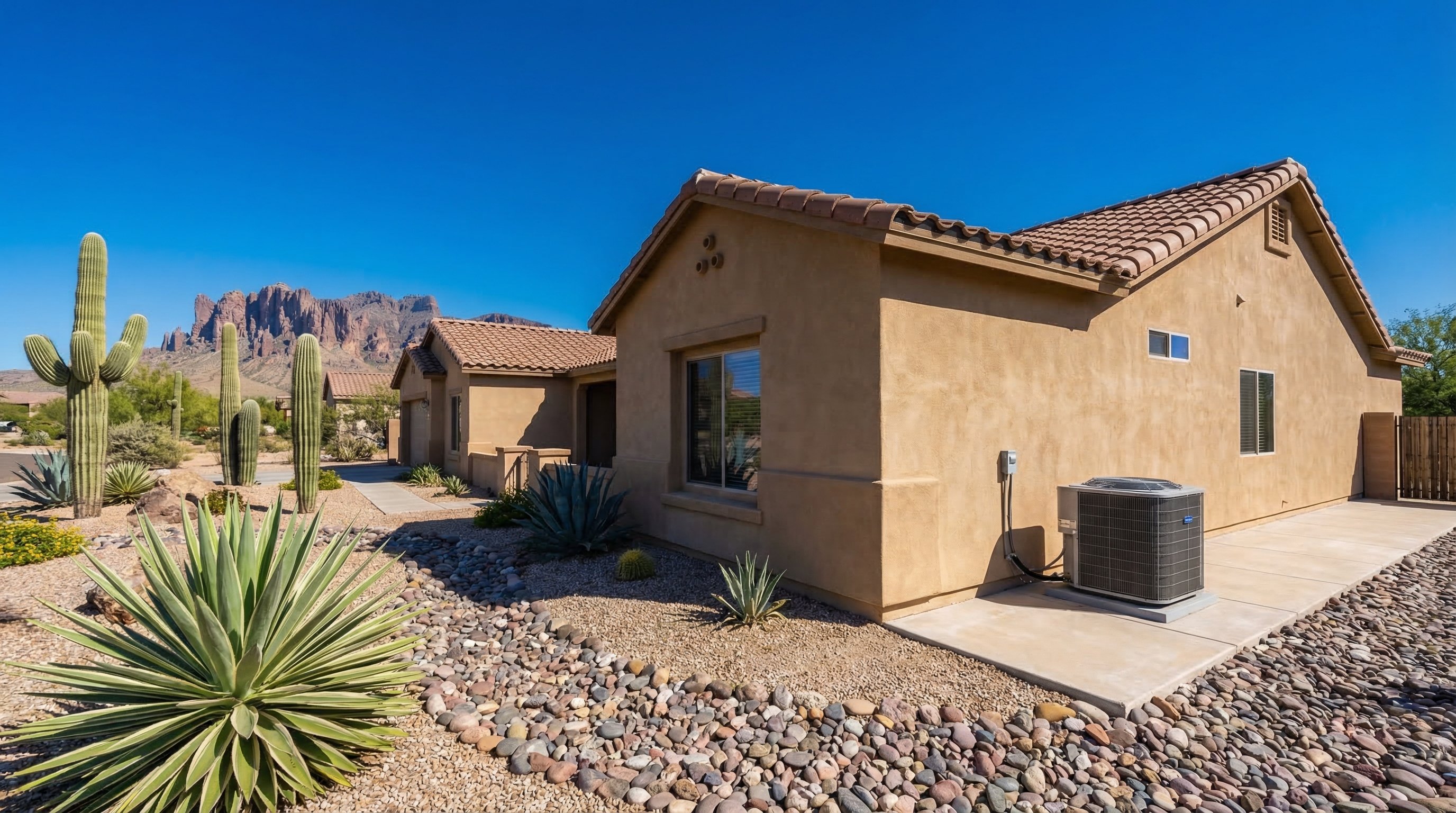
Apache Junction Homes Are Different — And That Affects Pricing
If you've read the generic "how much does a new AC cost?" articles, you've seen ranges like $5,000–$12,000 with zero context. Here's the context that actually matters for Apache Junction:
Older Housing Stock Means More Complications
A significant portion of AJ homes were built between 1975 and 2000. That means your ductwork, electrical panel, and possibly your existing equipment may not be up to current standards. When a contractor finds undersized ducts or a panel that needs an upgrade to support a modern unit, expect $500–$2,000 in additional work.
That's not a scam — it's a real issue in older homes. But it IS something that varies wildly in how honestly it's communicated upfront. Always ask: "Is there anything about my home's current setup that would add cost, and can you show me what you're seeing?"
Manufactured Homes Have Different AC Systems
Apache Junction has a higher percentage of manufactured housing than most Phoenix metro communities. Manufactured homes often use:
- Package units (combination heating/cooling in a single outdoor cabinet) rather than split systems
- Smaller tonnage (1.5-ton to 2.5-ton is common)
- Different ductwork configurations that require specific replacement equipment
If you're in a manufactured home, make sure any contractor you talk to has specific experience with mobile and manufactured HVAC — not every tech does, and getting it wrong is expensive.
R-22 Systems Are Still Common Here
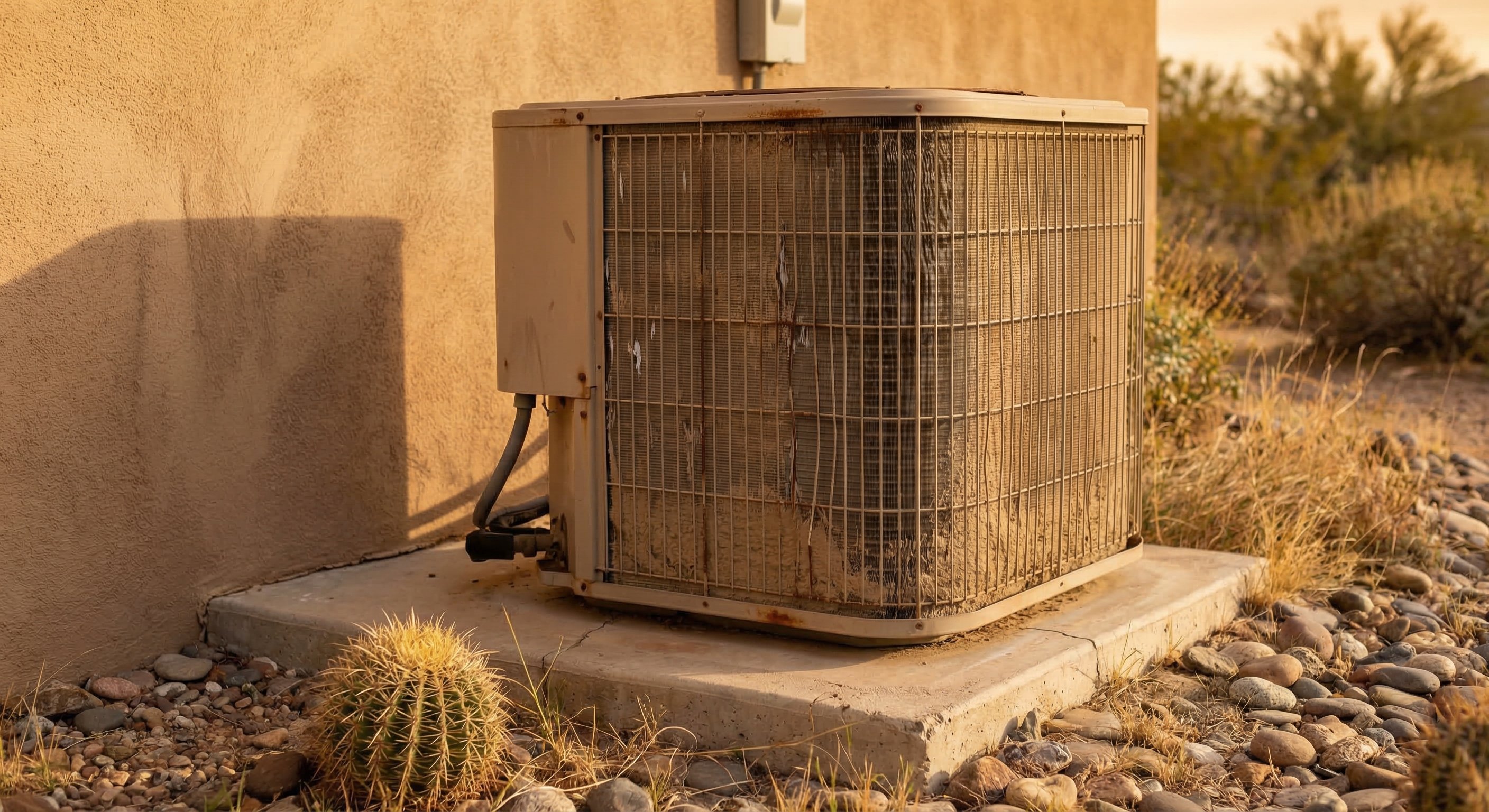
Homes built before 2010 often have systems running R-22 refrigerant (the old Freon). R-22 was phased out of production in 2020, and it now costs $300–$500 per pound to recharge — assuming you can find a tech with stock.
If your AC is running R-22 and leaking refrigerant, the math almost always points to replacement. A recharge that costs $800–$1,500 today buys you maybe one more summer before the next leak. That money is gone forever. The same $1,500 toward a down payment on a new system actually gets you somewhere.
What Drives the Price Up (And What Doesn't Have To)
What legitimately increases your cost:
Larger system size. Every half-ton step up in capacity adds roughly $400–$700 to the total. Get a Manual J load calculation done — it's a proper heat load analysis that determines what size system your home actually needs. Don't accept a contractor who just matches your old system size without checking whether it was right to begin with.
Higher SEER2 rating. The minimum in Arizona is 14 SEER2 (effective 2023). Units rated 16–18 SEER2 are more efficient but cost $1,500–$3,000 more upfront. For Apache Junction homeowners on SRP, rebates can offset some of this — SRP offers up to $250 for qualifying high-efficiency systems. That doesn't make SEER always worth it, but it changes the math.
Two-stage or variable-speed compressors. Single-stage units are either full blast or off. Two-stage and variable-speed systems modulate output, run more consistently, and handle humidity better during monsoon. They cost $800–$2,000 more. In a home that sits empty during the day, the efficiency gains are real.
Ductwork modifications or repairs. Older homes with damaged, undersized, or improperly insulated ducts will lose much of what a new system produces before it reaches the vents. This is worth fixing — but it should be itemized separately and clearly explained.
What shouldn't inflate your price:
The brand markup. Trane and Carrier are well-built systems, but a mid-tier Lennox or Rheem performs comparably in Arizona heat. The major compressor manufacturers largely produce components across multiple brand names. You're paying for the nameplate, not fundamentally different hardware. If a contractor pushes you hard toward a premium brand, ask what the actual performance difference is in a 115°F desert environment.
The "we're the best" premium. Every HVAC company in the valley claims to be best-in-class. The difference in installation quality between a competent mid-tier company and a premium-priced one is real but often smaller than the price gap suggests. Ask for the license number and pull it on Arizona ROC. Check BBB. Read the actual reviews — not the ones on their own website.
Skip the dealer markup
See What a New AC Actually Costs in Apache Junction, AZ
AC Rebel shows you the real equipment price — no sales pitch, no inflated quote. Get matched with a licensed installer and keep $3,000–$5,000 in your pocket.
Get My Direct Price →The Apache Junction Timing Reality
Here in the east valley, summer heat is relentless from late May through October. Apache Junction regularly hits 110°F+ in June and July, and the monsoons bring their own stress — humidity spikes combined with pre-existing heat load can push marginal systems over the edge.
The problem with waiting until June to make an AC decision: every other homeowner in Maricopa County is doing the same thing. Contractor schedules fill up. Wait times stretch to 2-3 weeks. Some companies charge premium rates for emergency calls. And you're making a $10,000+ decision under heat-induced stress with a one-day deadline.
March through early May is the ideal window. Contractors have availability. You can get multiple quotes without rushing. There's no price pressure, and if you're financing, you can structure the install around your budget rather than desperation.
If your system is 12+ years old and limping, make the decision now, on your terms.
Getting Multiple Quotes — What to Actually Compare
The number most people compare is the total price. That's useful, but it's not enough.
Compare these four things:
The unit itself — make, model, and SEER2 rating. A quote for a 3-ton Goodman 14 SEER2 at $8,200 is not the same as a quote for a 3-ton Trane 16 SEER2 at $9,400. Different equipment.
What's included in labor — does it include refrigerant? Permit? Disposal of old unit? These can be $200–$600 each, and contractors handle them differently in quotes.
Warranty terms — manufacturer warranty on the equipment is standard (usually 10 years with registration). But what's the contractor warranty on installation? One year is minimum. Two to five years from a confident installer is better.
The contractor's license and insurance — Arizona ROC requires HVAC contractors to be licensed. Check the license at azroc.gov. This takes 60 seconds and tells you instantly if the company is legitimate.
Three quotes is the minimum. If two quotes are close and one is dramatically lower, find out why. If two are close and one is dramatically higher, find out what they're claiming justifies it.
How the Markup Gets Built In (And How to Work Around It)
The standard HVAC supply chain: manufacturer sells to distributor, distributor sells to contractor at wholesale, contractor marks it up 40-60% and sells to you. That markup — often $2,000–$4,000 on a single system — is built into every traditional contractor quote you receive.
It's not dishonest. It's how the business model has worked for 40 years. The contractor needs to cover trucks, insurance, training, overhead, and profit. The markup is how that gets paid.
The alternative that's changed the math for some Apache Junction homeowners: buying the unit separately at direct pricing, then paying a vetted contractor only for installation labor. When the contractor isn't sourcing the unit, they charge labor only — typically $1,500–$3,000 depending on complexity — versus $3,000–$5,000 all-in markup on the full package.
Most Phoenix metro contractors who aren't in the business of selling equipment are happy to do labor-only installs. Ask upfront. Some won't, and those usually have higher overall quotes for a reason.
AC Rebel is one way to shop the unit at near-wholesale pricing. You browse the catalog, see the actual unit cost, and get matched with vetted local contractors for the installation. Worth seeing what direct pricing looks like on your specific system before you accept whatever a contractor quotes you.
See direct AC pricing for Apache Junction homeowners → AC Rebel
Financing Your New AC in Apache Junction
If spending $8,000–$12,000 cash isn't in the cards right now, you're not alone. Most homeowners finance HVAC replacement, and there are good options available.
GreenSky financing through AC Rebel: payments as low as $47/month for qualifying systems. Terms range from 12 to 84 months. Rates vary by credit profile, but for many homeowners the monthly payment math is more manageable than a lump sum.
APS/SRP rebates: If you're on SRP power (most of Apache Junction is in SRP territory), ask about their HVAC rebate program. Up to $250 for qualifying high-efficiency systems. Small in the context of a $10,000 project, but free money you'd otherwise leave on the table.
Tax credits: The Inflation Reduction Act created a 30% tax credit (up to $600) for qualifying ENERGY STAR heat pump systems through 2032. If you're considering a heat pump rather than a straight AC, the federal incentive matters.
Always get the financing terms in writing before you commit to any contractor. Watch for deferred-interest promotions — these can turn a "0% for 18 months" deal into a retroactive high-interest charge if you don't pay it off in time.

What a Reasonable Apache Junction AC Quote Looks Like
Based on current market rates for the east valley, here's a reference point:
3-ton system, mid-tier brand (Rheem or Lennox), 16 SEER2, standard installation on a single-story 1,600 sq ft home:
- Fair range: $8,200–$10,800 fully installed
- Under $7,000: Ask what's missing (labor-only? stripped-down unit?)
- Over $12,500: Ask specifically what justifies the premium
2.5-ton system, entry-level brand (Goodman), 14 SEER2, standard installation:
- Fair range: $6,800–$8,500 fully installed
These aren't guarantees — ductwork repairs, electrical work, or unusual access can legitimately add cost. But they're solid anchors for what a straightforward job should land near.
If your quotes are consistently coming in $3,000–$4,000 above these ranges, you're either in a high-complexity situation (worth asking about specifically), or you're dealing with a high-margin company that relies on homeowners not comparison shopping.
Frequently Asked Questions
How much does AC replacement cost in Apache Junction, AZ in 2026?
Most Apache Junction homeowners pay $7,000–$11,500 for a complete AC replacement installed. The range is driven by system size (2-ton to 4-ton), brand tier, and efficiency rating. Smaller homes and manufactured homes often fall in the $6,200–$9,000 range. Larger stick-built homes with complex installations can reach $13,000+.
What size AC do I need for my Apache Junction home?
Most Apache Junction homes need a 2.5-ton or 3-ton system. The proper way to size your system is a Manual J load calculation — a heat load analysis based on your home's square footage, insulation, window orientation, and local climate data. Don't let a contractor size by guessing or simply matching your old unit.
Is it worth replacing my AC before summer in Apache Junction?
Yes — and March through April is the best window. Contractor schedules are open, there's no emergency premium, and you can take your time comparing quotes. If your system is 12+ years old, struggling to keep up in spring heat, or running R-22 refrigerant, a proactive replacement on your timeline beats an emergency call at 108°F in July.
Do Apache Junction homes qualify for SRP HVAC rebates?
Most of Apache Junction is in SRP territory. SRP offers rebates of up to $250 for qualifying high-efficiency HVAC systems. Check SRP's current rebate schedule at srpnet.com before purchasing — rebate programs change periodically, and the specifics depend on SEER2 rating and equipment type.
Why is my AC quote so much higher than the national average I see online?
Several factors push Arizona quotes above national averages: higher system capacity requirements (Phoenix heat loads run higher than moderate climates), premium installation demand in peak season, and the cost of operating HVAC businesses in a high-demand desert market. Apache Junction quotes can also run slightly higher than inner-valley cities due to travel time for some contractors. Getting three quotes from east valley-based companies helps — you want techs who are already working your area, not driving from Tempe.
Ready to see what your Apache Junction AC system actually costs without the dealer markup? Check direct pricing on AC Rebel — 2-minute quote wizard, real prices, vetted local contractors for installation.
Ready to stop overpaying?
See Your Direct AC Price in 2 Minutes
Skip the dealer. Buy your AC unit at direct pricing and pay a vetted local installer only for the installation. No sales calls. No hidden markup. Most homeowners save $3,000–$5,000+ compared to a traditional quote.
Get My Direct Price — No Credit Card2-minute quote · Licensed installers · 10-year warranty options