
AC Unit Leaking Water in Mesa? Here's What's Actually Wrong

AC Unit Leaking Water in Mesa? Here's What's Actually Wrong
TL;DR: An AC unit leaking water is almost always caused by a clogged condensate drain line, a frozen evaporator coil, a cracked drain pan, or low refrigerant. In Mesa's desert heat, drain line clogs are the #1 culprit — dust, algae, and mineral buildup from our hard water block the line fast. Most clogs are a DIY fix with a wet-vac. A frozen coil or refrigerant issue needs a licensed tech. If water is pooling around your indoor unit or dripping from the ceiling, stop the AC and read this first.
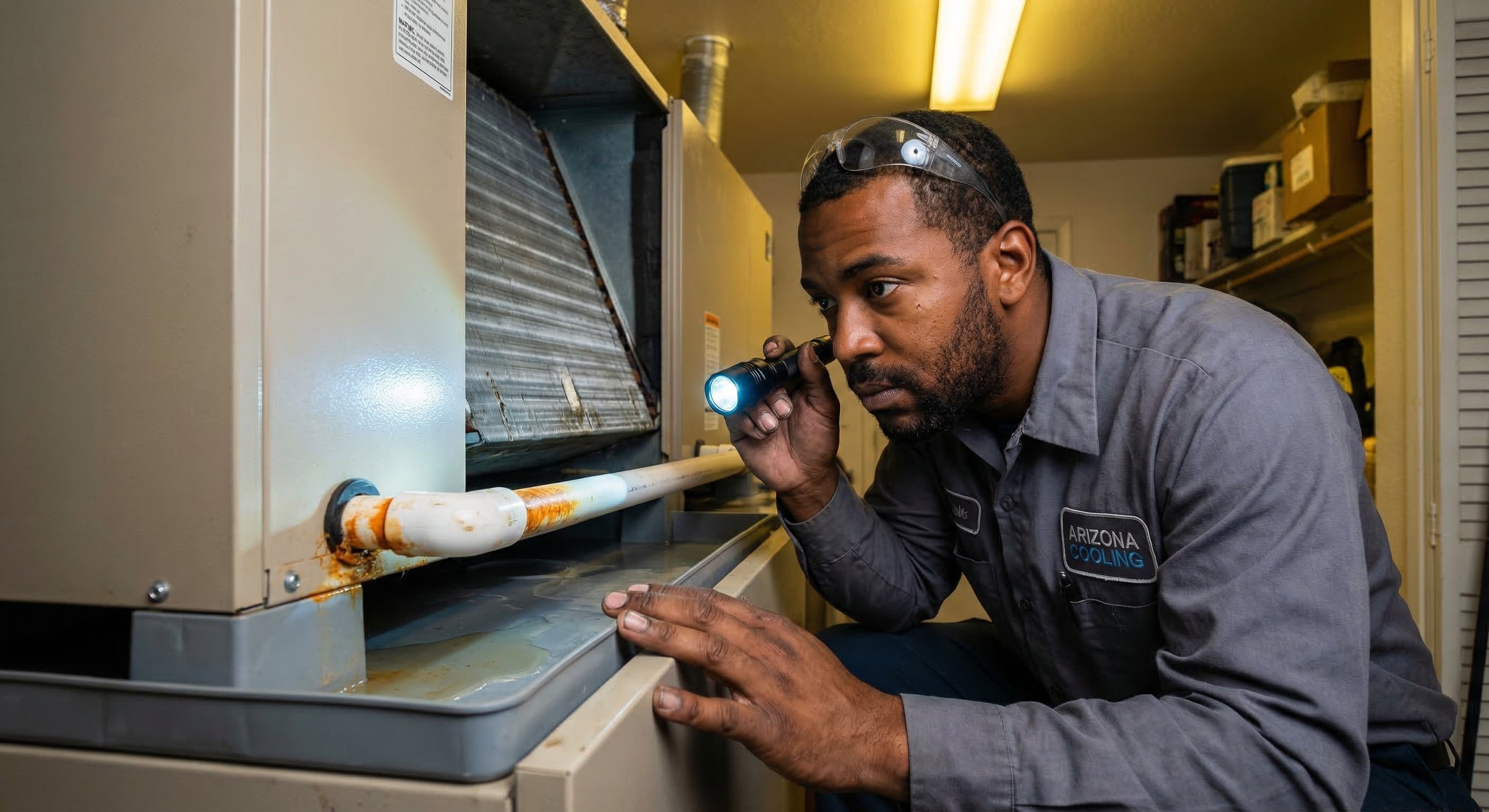
You walk through your hallway in Mesa and notice water pooling on the floor near your air handler. Or maybe there's a wet spot on the ceiling below your attic unit. Your first reaction: panic.
Relax. An AC leaking water is one of the most common HVAC calls we see across the East Valley — and in most cases, it's fixable fast. Sometimes you can fix it yourself in 20 minutes. Sometimes you need a tech. This article will tell you exactly which one.
Why AC Units Produce Water in the First Place
Before diagnosing the leak, it helps to understand where that water comes from.
Your AC doesn't just cool air — it dehumidifies it. When warm, humid air passes over the cold evaporator coil inside your air handler, moisture from the air condenses on the coil (just like a cold drink "sweats" on a hot day). That water drips into a drain pan and flows out through a condensate drain line — usually a PVC pipe that exits to the side of your house or into a floor drain.
In Phoenix and Mesa, this process is intense. During monsoon season (July–September), outdoor humidity spikes from our normal 10-15% up to 50-60%, which means your AC is pulling a LOT more water out of the air. We're talking 5-20 gallons per day on a typical 3-ton system during a humid stretch.
That's a lot of water flowing through a drain line. And when that line clogs — which it does — the water has nowhere to go.
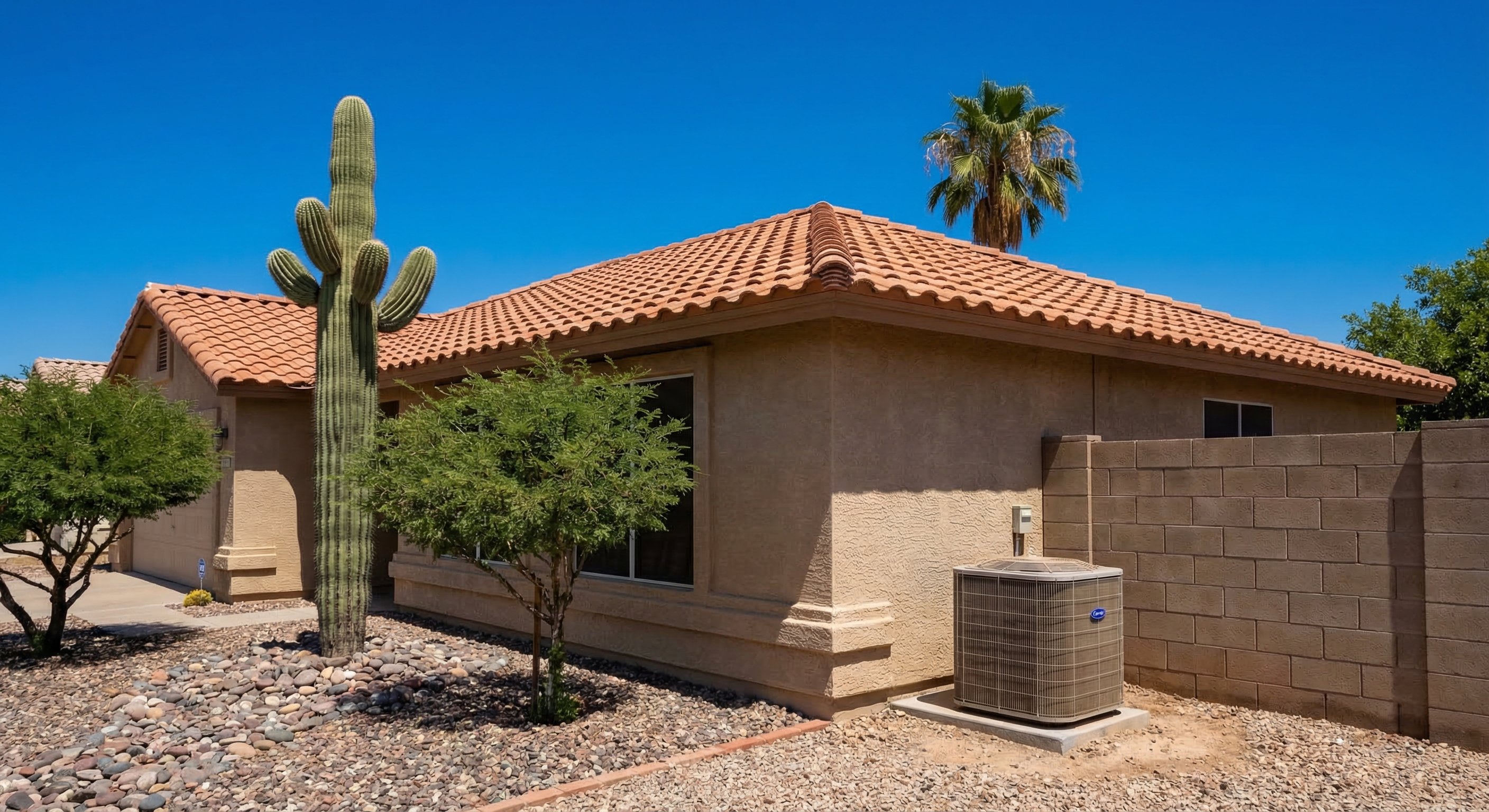
The 5 Most Common Causes of AC Water Leaks in Mesa
1. Clogged Condensate Drain Line (By Far the Most Common)
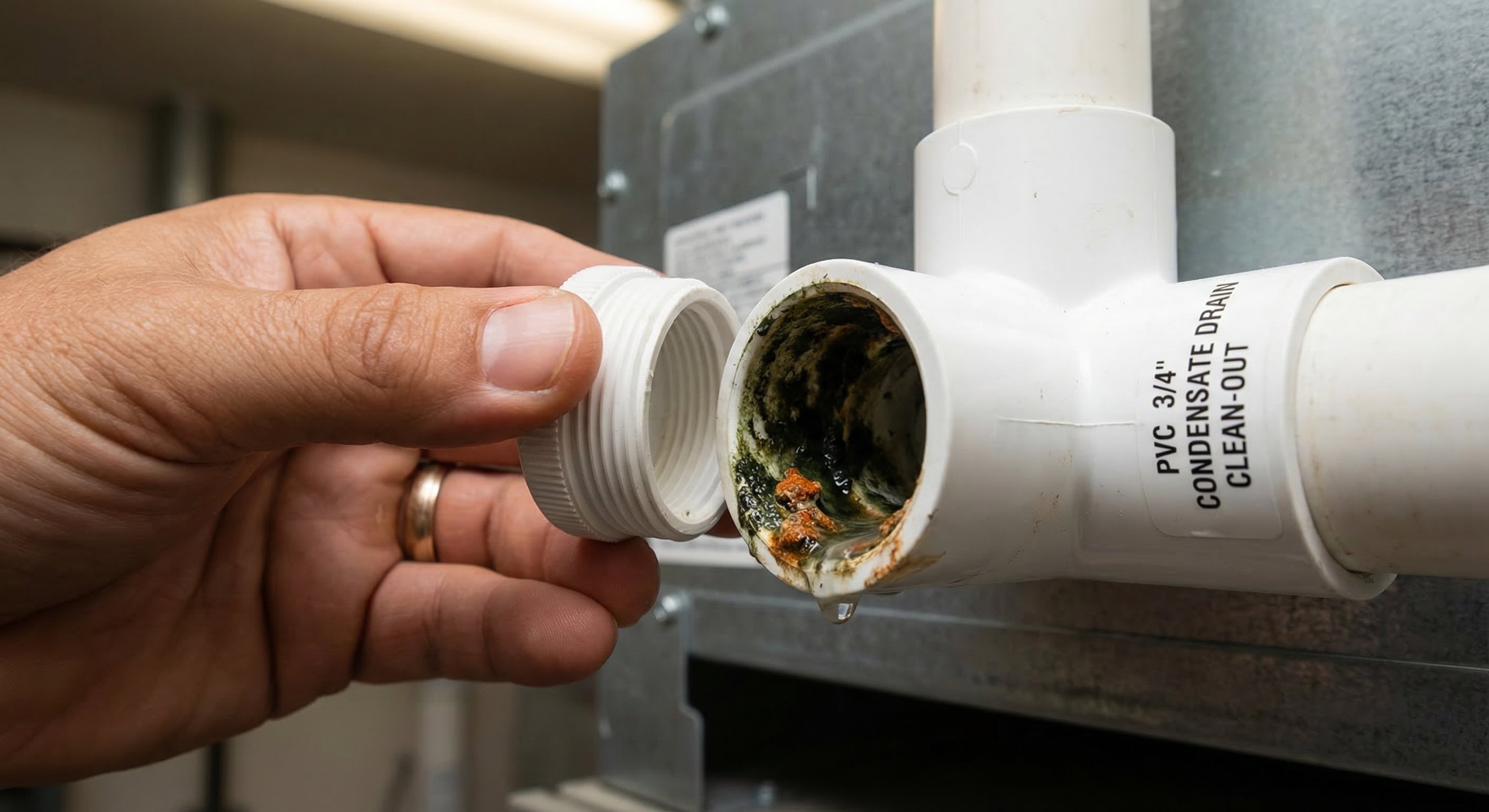
This is the culprit in 70-80% of the water leak calls we see in Mesa and the East Valley. Over time, your drain line accumulates:
- Algae and mold — the dark, moist interior is a perfect breeding ground
- Dust and debris — Mesa's notorious dust (remember that 2023 haboob that coated everything in red silt?) gets sucked into your system and settles in standing water
- Mineral deposits — Mesa's water is notoriously hard (averaging around 300 mg/L of total dissolved solids). When water evaporates in the line, it leaves calcium and magnesium buildup behind
When the line clogs, water backs up into the drain pan. Most systems have a safety float switch that shuts off the AC when water gets too high — so if your AC suddenly stopped working AND there's water around the unit, a clogged drain triggered the shutoff. That's actually your system working correctly.
How to tell it's this: Water around the indoor air handler, AC may have shut itself off, no other symptoms.
2. Frozen Evaporator Coil Thawing
When your evaporator coil freezes and then thaws, it dumps a lot of water at once — more than the drain pan can handle quickly. You'll see a puddle that appears suddenly, often after the AC has been running hard.
Coils freeze for three reasons:
- Dirty air filter — restricted airflow causes the coil to get too cold
- Low refrigerant — insufficient refrigerant drops coil pressure and temperature below freezing
- Blocked vents — closing too many supply vents restricts airflow the same way a dirty filter does
How to tell it's this: Ice visible on the copper lines or coil, reduced airflow from vents, system struggling to cool, water appearing in bursts rather than a slow drip.
3. Cracked or Rusted Drain Pan
Your primary drain pan sits directly under the evaporator coil. In Arizona, with our extreme temperature swings — 115°F attic summers and occasional freezing nights in January — drain pans can crack over time, especially plastic ones. Older metal pans rust through.
Most systems also have a secondary drain pan (the larger pan the whole air handler sits in) with its own drain or float switch as a backup. If you're seeing water in the secondary pan, the primary pan has failed.
How to tell it's this: Water appears even after you've cleared the drain line, visible cracks or rust in the pan during inspection.
4. Improper Installation or Slope
Your air handler needs to be level, or very slightly tilted toward the drain outlet. If a unit was installed out of level — which happens more often than it should, especially on rushed installs — water pools on the wrong side of the drain pan and eventually overflows.
This is especially common with attic installations in Mesa's older neighborhoods like Dobson Ranch and Las Sendas, where attics are tight and installs get rushed.
How to tell it's this: Slow, chronic dripping that's always been there since a new install; water pooling on the opposite side from the drain outlet.
5. Low Refrigerant (Serious — Call a Tech)
When refrigerant levels drop due to a leak, your evaporator coil runs at abnormally low pressure and temperature. The coil freezes. When the system cycles off or you turn it off, the ice melts and floods the drain pan.
Low refrigerant also means your AC can't cool effectively — so you'll usually notice the house not getting cold enough alongside the water leak. This is not a DIY fix. Refrigerant work requires an EPA 608 certification to handle legally in Arizona.
How to tell it's this: AC running but not cooling well, ice on refrigerant lines, water leak combined with warm air from vents.
What You Can Fix Yourself (Right Now)
Clear a Clogged Drain Line — The 20-Minute DIY
You'll need: a wet-vac, white vinegar, and maybe a bottle brush.
Step 1: Turn off your AC at the thermostat and the breaker. Safety first.
Step 2: Find your drain line. It's typically a white PVC pipe, either exiting through your exterior wall near the air handler or running to a floor drain. There's usually a PVC clean-out cap on the line — a T-shaped fitting with a removable cap.
Step 3: Remove the cap and check for visible gunk. You'll often see slimy black buildup right at the opening.
Step 4: Place the wet-vac hose over the end of the drain line outside your house (where it exits) and seal it as tightly as you can with your hand or duct tape. Run the wet-vac for 2-3 minutes. This suctions out the clog from the outside end.
Step 5: Pour 1 cup of white distilled vinegar into the clean-out opening. This kills algae and helps break up mineral deposits. Let it sit for 30 minutes.
Step 6: Pour a cup of water into the clean-out and watch if it drains freely. If it does, you're clear. If it backs up, you may need a drain line snake or a plumber's blow-gun attachment on a wet-vac.
Step 7: Clear the water from the drain pan with the wet-vac, then replace the cap and restore power.
Pro tip: Pour 1/4 cup of vinegar into your drain line clean-out every 3 months to prevent future clogs. Set a phone reminder. This one habit eliminates probably 80% of drain line calls.
Replace a Dirty Air Filter (Prevents Frozen Coils)
If your filter hasn't been changed in more than 60 days in Arizona, change it now. We recommend 1-inch filters rated MERV 8-11 in Phoenix metro — they catch dust without restricting airflow. Change every 45-60 days during heavy use months (June-September).
A clean filter won't fix an already-frozen coil, but it prevents the freeze from happening again.
Reset the Float Switch
If your AC shut itself off and there's water in the secondary pan, there's likely a float switch (a small device in the drain pan with a wire connected to it) that triggered the shutoff. After you've cleared the drain and dried the pan, the float switch should reset automatically once the water level drops. If your AC still won't come on after you've cleared everything, check that the float switch float mechanism has dropped back to its resting position.
Skip the dealer markup
See What a New AC Actually Costs
AC Rebel shows you the real equipment price — no sales pitch, no inflated quote. Get matched with a licensed installer and keep $3,000–$5,000 in your pocket.
Get My Direct Price →When to Call a Pro (Don't Wait on These)
Some water leak causes require a licensed HVAC tech. Don't DIY these:
Call immediately if:
- You see ice on refrigerant lines (frozen coil / possible refrigerant leak)
- The AC isn't cooling the house despite running constantly
- Water is dripping from the ceiling or into walls — this is now a water damage emergency
- You've cleared the drain line and the leak continues
- The water has a yellowish or chemical odor (refrigerant leak warning)
Don't let this sit. Water damage in Mesa homes is serious. Drywall soaks it up fast, and in our climate, mold can establish in 24-48 hours in wet drywall — especially in attics and interior walls where it's warm. A $150 drain clearing service call is a lot cheaper than drywall replacement and mold remediation.
Get a free instant quote at acrebel.com — we'll tell you upfront what the issue is and what it'll cost to fix. No upsells, no markup.
How Mesa's Climate Makes This Worse
Most of the country's HVAC tips are written for Atlanta or Dallas climates. Mesa is different in a few key ways:
Hard water: APS and SRP service areas in Mesa pull from the Salt River and Colorado River systems. Both have high mineral content. Your drain line sees all that mineral-laden condensate every day. Buildup happens faster here than almost anywhere in the country.
Dust: Between Phoenix's frequent haboobs and Mesa's agricultural neighbors in Queen Creek and the East Valley, particulate in our air is high. That dust gets pulled through your return vents, and the fine stuff makes it past even good filters and into your drain pan. This is why we recommend checking your drain line visually every spring, even if you've been religiously pouring vinegar.
Volume of condensate: While Tucson and Las Vegas are drier, the Phoenix metro's July-September monsoon season generates serious humidity. A 3.5-ton system in a 2,000 sq ft Mesa home can produce 12-18 gallons of condensate per day during a humid monsoon week. That's a lot of drainage demand on a system that may have a partially blocked line.
Extreme heat loads: When it's 112°F outside and your AC is running 16+ hours a day, every system component is under more stress. Drain pans warp. Float switches wear faster. We see more failures per system per year in Mesa than anywhere else we operate.
Preventive Maintenance: Don't Wait for a Leak
The best water leak is one that never happens. Here's the AC Rebel maintenance schedule for Mesa homeowners:
| Task | Frequency | DIY or Pro |
|---|---|---|
| Change air filter | Every 45-60 days (June-Sept) | DIY |
| Pour vinegar in drain line | Every 3 months | DIY |
| Inspect drain pan for cracks | Annually (spring) | DIY |
| Check secondary drain pan | Before monsoon season | DIY |
| Full AC tune-up (coil cleaning, refrigerant check, electrical) | Annually (March-April) | Pro |
| Drain line blow-out | Annually with tune-up | Pro |
A spring tune-up in March or April — before the heat hits in May — is the single best investment a Mesa homeowner can make. Your tech will clean the drain line, check refrigerant levels, clean the coil, and inspect the drain pan all at once. After that, quarterly vinegar keeps the line clear until the next tune-up.
Key Takeaways
- Most AC water leaks are clogged drain lines — a DIY fix you can do today with a wet-vac and vinegar
- Frozen coil = restricted airflow or refrigerant issue — check your filter first, then call a tech
- Mesa's hard water and dust accelerate drain line buildup — quarterly vinegar prevents 80% of calls
- If there's ice anywhere on your system, turn it off immediately and call a tech — don't try to thaw it with heat
- Water in walls or ceiling = urgent — get a tech same day to prevent mold and structural damage
- Refrigerant work requires a licensed pro — it's illegal to handle without EPA 608 certification
Frequently Asked Questions
Q: Is it normal for an AC unit to drip water?
A small amount of condensation near the outdoor condenser unit is normal — that's just humidity in the air condensing on the cold lines. What's NOT normal: water pooling around or under your indoor air handler, wet spots on ceilings or walls, or your AC shutting itself off. Any of those mean there's a drainage problem that needs attention.
Q: How much does it cost to fix an AC water leak in Mesa?
A clogged drain line cleared by a tech runs $75-$150, though you can DIY it for free with a wet-vac. A cracked drain pan replacement is $100-$300 depending on the pan and whether it's easily accessible. A refrigerant leak repair (find the leak, patch it, recharge) can run $300-$1,200 depending on severity. Water damage remediation from a leak that went unaddressed is a separate cost that can reach thousands — which is why acting fast matters.
Q: My AC shut itself off and there's water by the unit. What do I do?
First, check the secondary drain pan — if it has water, your float switch triggered. Turn off power at the breaker, clear the drain line (see the DIY steps above), dry the pan with a wet-vac, and restore power. The system should come back on. If it doesn't restart, the float switch may need to be reset manually or replaced — call a tech.
Q: Can I use bleach instead of vinegar to clean my AC drain line?
Some techs recommend bleach; AC Rebel recommends vinegar. Bleach can degrade PVC pipe over time and is harsh on some float switch components. White distilled vinegar works just as well for algae and biofilm, and it's safe for the entire drain line. A cup of undiluted white vinegar every 90 days is our preferred maintenance schedule.
Q: Why is my AC leaking water only when it rains or during monsoon season?
High outdoor humidity during monsoon season dramatically increases condensate production — your unit is pulling far more water from the air. A drain line that's 60% clogged might handle normal dry-season condensate fine, but it overflows when monsoon season doubles the water load. This is a good sign your line needs a cleaning. Do it in late June before the rains start.
Q: Could AC water damage cause mold in my Mesa home?
Yes, and faster than you'd think. Arizona's summer attic temperatures — which can exceed 140°F — combined with moisture from a water leak create conditions where mold can establish in drywall within 24-48 hours. If a leak has been dripping into a wall cavity or ceiling for more than a day, get a water damage assessment along with your HVAC repair. Don't just fix the AC and patch the drywall without checking for moisture.
Q: I replaced my AC last year. Why is it already leaking?
New unit, old drain line. This is a common problem. When contractors install a new air handler, they often reuse the existing drain line — which may already have years of buildup. A fresh install with a clogged or improperly pitched old drain line will leak from day one. If your new unit is leaking, call the installer back and ask them to flush and inspect the drain line. If they did the job right, it's covered.
Water leaks are one of those problems that feel scary but usually aren't — as long as you act quickly. The DIY drain clear takes 20 minutes and costs nothing. Get a free instant quote at acrebel.com if you'd rather have a tech handle it, or if you're seeing any of the warning signs that point to a more serious issue.
Your neighbor across the street in Mesa who "happens to know HVAC" would tell you the same thing: don't let it sit. A $150 service call now beats a $3,000 mold remediation next month.
Ready to stop overpaying?
See Your Direct AC Price in 2 Minutes
Skip the dealer. Buy your AC unit at direct pricing and pay a vetted local installer only for the installation. No sales calls. No hidden markup. Most homeowners save $3,000–$5,000+ compared to a traditional quote.
Get My Direct Price — No Credit Card2-minute quote · Licensed installers · 10-year warranty options