
AC Not Cooling Your Phoenix Home? Here's Why (and What to Do)

AC Not Cooling Your Phoenix Home? Here's Why (and What to Do)
TL;DR: If your AC is running but not cooling your Phoenix home, the most likely culprits are a dirty air filter, low refrigerant, a frozen evaporator coil, or a system that's simply undersized for Arizona's extreme heat. Some issues — like a clogged filter — you can fix yourself in minutes. Others, especially refrigerant leaks or compressor problems, require a licensed HVAC tech. This guide walks through every major cause, in order of likelihood, and tells you exactly what to do next.
It's 108°F outside. Your AC has been running for three solid hours. And your thermostat still reads 84°F.
If that sounds familiar, you're not alone. Every summer in Phoenix, this is the call every HVAC company in the Valley gets hundreds of times a day: "My AC is running but the house won't cool down." The good news: some causes are cheap and fast. The bad news: others mean your system is on its last legs.
Let's go through exactly what's happening — and what to do about it.
Why Phoenix ACs Struggle More Than Anywhere Else
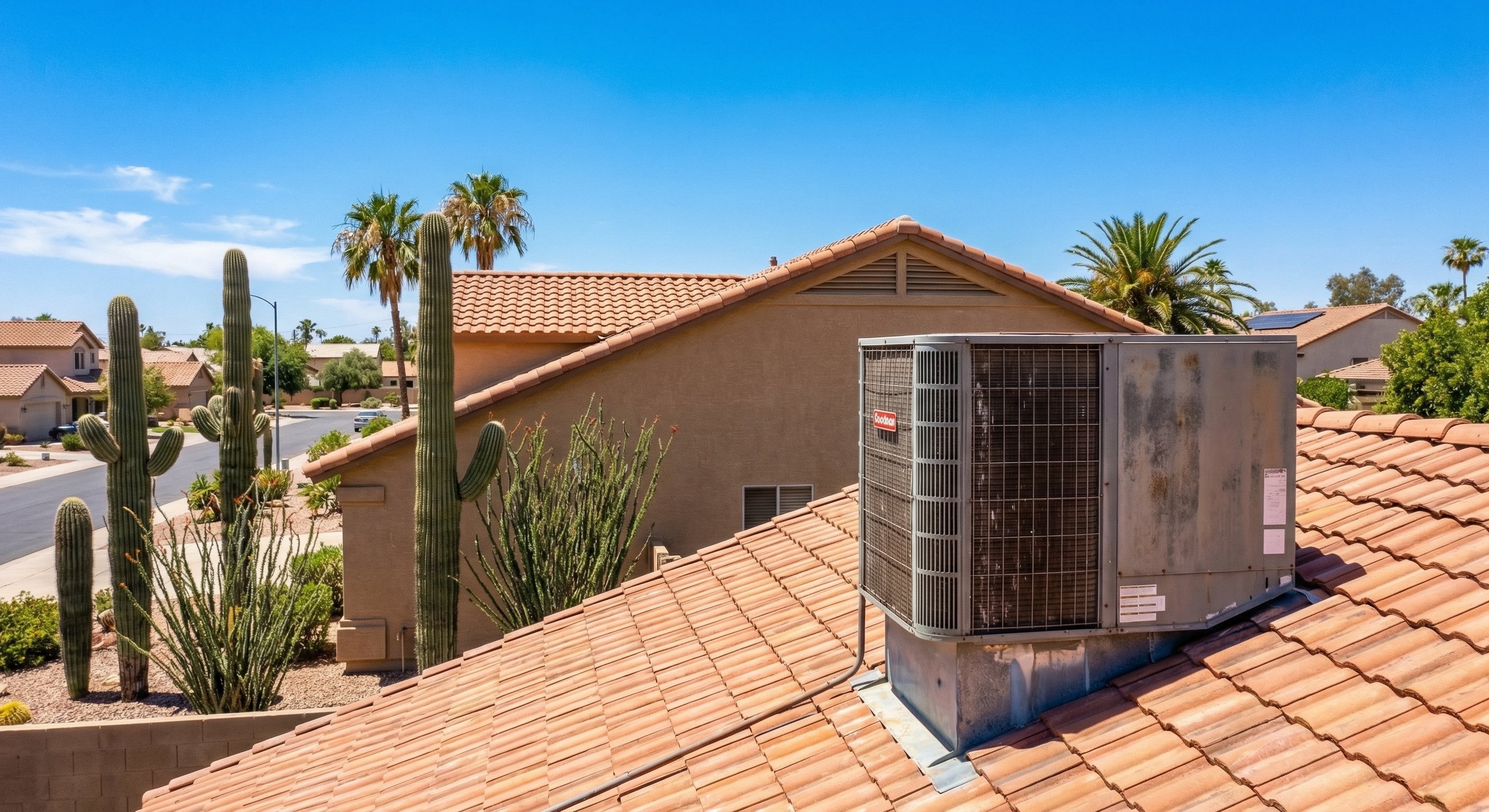
Before we get into specific causes, let's be real about what Phoenix asks of an HVAC system. Most AC equipment is rated and tested at 95°F outdoor conditions — that's the industry standard used by AHRI (Air Conditioning, Heating, and Refrigeration Institute). But in the Valley, we routinely see 110°F, 112°F, even 115°F in July and August.
At those temperatures, your AC works significantly harder to maintain the same indoor setpoint. The system's effective cooling capacity drops. A unit that's perfectly sized for 95°F becomes borderline undersized at 115°F. And a system that's already struggling — old age, dirty filter, low refrigerant — can fall apart entirely.
This is why "AC not cooling" complaints spike in Phoenix way before they do in Dallas or Atlanta. The system isn't always broken. It's often just getting beaten by heat it was never fully designed to handle.
That said, there are specific causes — and most of them are fixable. Let's start with what you can check yourself right now.
Check These 5 Things Before You Call Anyone
1. Your Air Filter (Most Common Culprit)
A choked air filter is the single most common reason an AC loses cooling performance. When the filter is packed with dust — and in Arizona that happens fast, especially after a haboob — your system can't pull enough air across the evaporator coil. Less airflow means less heat transfer means your house stays warm.
Go check your filter right now. If it looks like a gray felt blanket, replace it. Done. In Phoenix, plan on changing 1-inch filters every 30-45 days during summer. Thicker 4-inch media filters can stretch to 3-4 months.
A $12 filter swap can literally fix your cooling problem. Check this first.
2. Your Thermostat Settings
This sounds too obvious to mention — but verify your thermostat is set to "cool" (not "fan only") and the temperature is set below what your house actually is. If you have a smart thermostat, check the schedule — Phoenix homeowners have been caught off guard by a schedule that reverted after an app update. Also swap the batteries if they're low; a dying battery can cause erratic readings.
3. Your Outdoor Unit
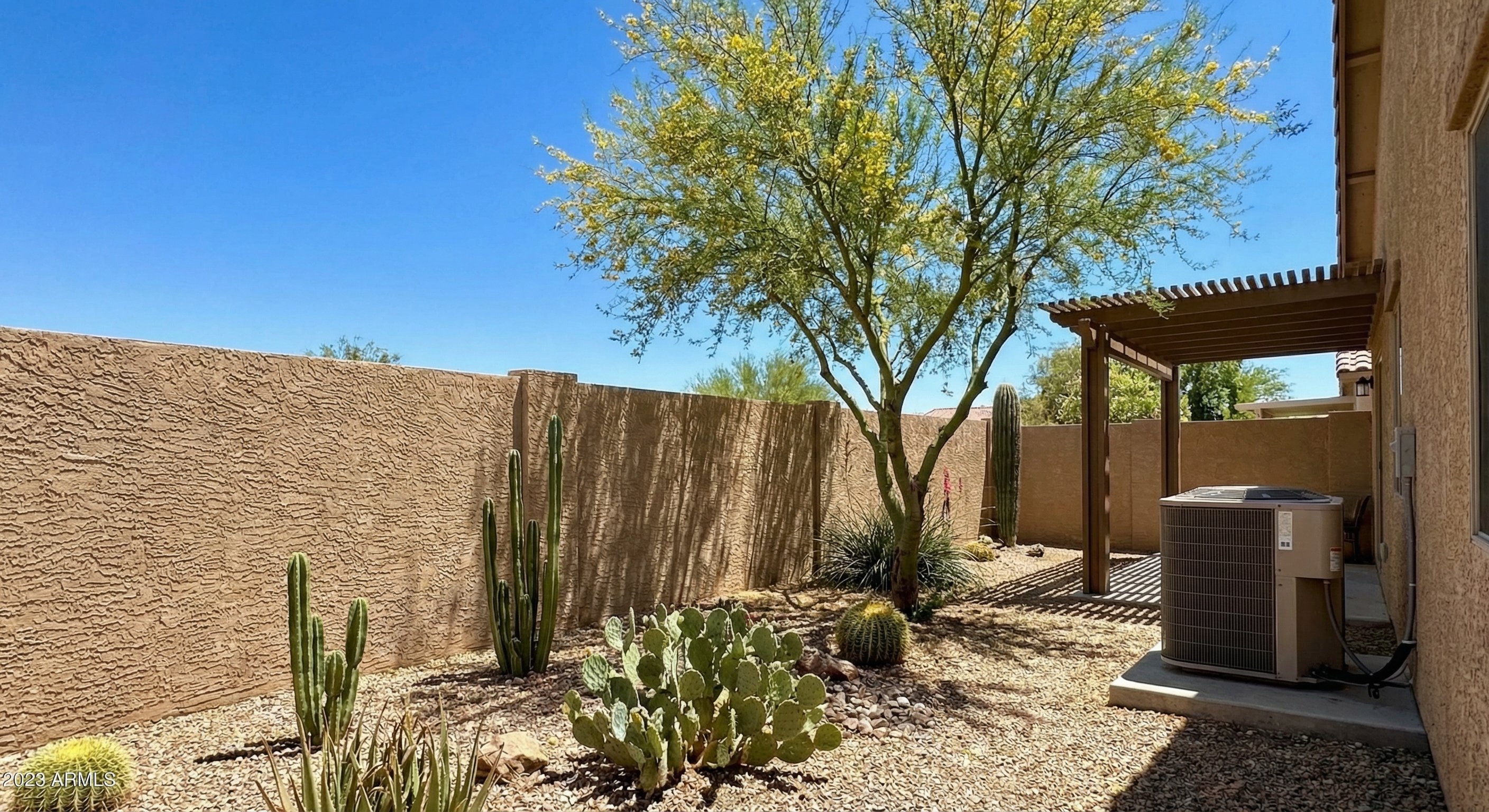
Walk outside and look at your condenser (the big box unit outside). Is it running? Fan spinning? If your indoor air handler is running but the outdoor unit is completely silent and still, you have a problem — tripped breaker, failed capacitor, or compressor issue. That needs a tech.
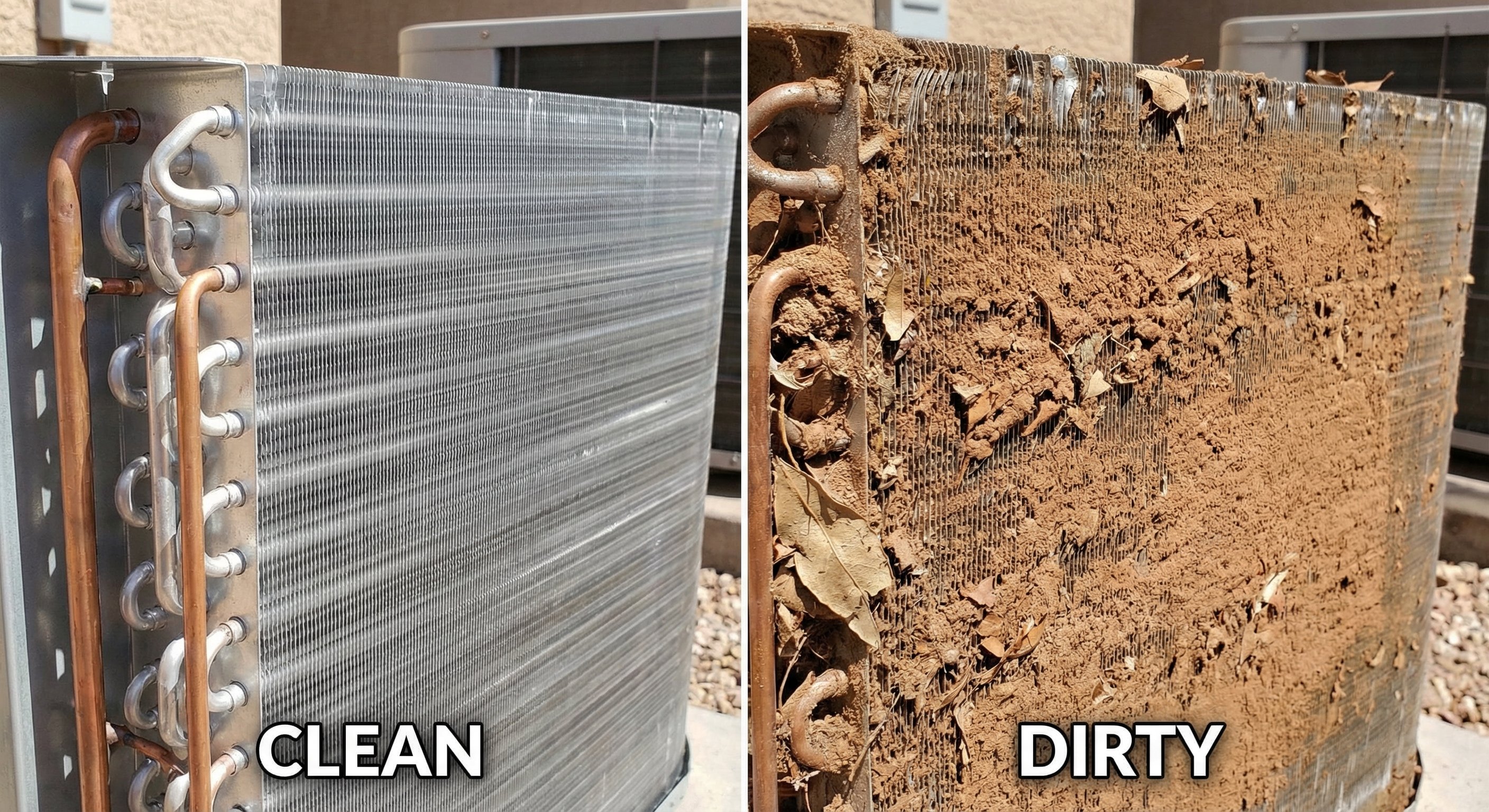
Also eyeball the condenser coil fins around the outside of the unit. If they're caked with dust, cottonwood fluff, or dead leaves, your unit can't reject heat efficiently. A rinse with a garden hose (power OFF first) can help. A professional coil cleaning goes deeper.
4. Your Vents and Returns
Walk through the house. Are all your supply registers open? Closing vents in unused rooms doesn't save energy — it unbalances your system's airflow and creates pressure problems. Also check that nothing is blocking your return air grilles: furniture pushed against them, rugs, or curtains all reduce airflow and performance.
5. Your Breakers
Your AC system has two breakers — one for the indoor air handler, one for the outdoor condenser. Check your electrical panel. If one tripped, you might have an indoor fan blowing unconditioned air while the outdoor unit does nothing. Reset a tripped breaker once. If it trips again immediately — stop. You have an electrical issue and need a licensed tech before you touch it again.
The More Serious Causes That Need a Pro
If you've checked all five items above and your AC is still not cooling, here's what you're likely dealing with:
Low Refrigerant / Refrigerant Leak
This is one of the most common calls after a clogged filter. Refrigerant doesn't get used up like gas in a car — if your levels are low, you have a leak somewhere in the system. And until that leak is found and repaired, adding refrigerant is just a temporary band-aid.
Signs of low refrigerant in a Phoenix home:
- AC blows air that's mildly cool but never cold enough
- System runs continuously without reaching setpoint
- Ice forming on the copper lines near the indoor air handler
- Electric bills spiking without explanation
Leaks can be in the evaporator coil, the condenser coil, or the copper line set connecting them. Small leaks can sometimes be patched. Larger leaks — especially in older systems — make replacement the more economical choice.
One important note: if your system uses R-22 refrigerant (systems installed before 2010 typically do), adding refrigerant has become extremely expensive since R-22 was phased out under EPA regulations. We covered this in detail in our post on R-22 refrigerant costs in Arizona — the short version is that R-22 systems usually make more financial sense to replace than to repair.
Frozen Evaporator Coil
It sounds backwards, but your AC can literally freeze up on a 115°F Phoenix afternoon. When airflow across the evaporator coil is restricted — dirty filter or low refrigerant — the coil surface drops below freezing. Ice builds up on the coil and completely blocks airflow. The system keeps running but delivers nothing.
Symptoms:
- Ice visible on the copper lines near your indoor unit
- Warm air blowing from vents even though everything sounds like it's running
- Water dripping or puddling near the air handler (as the ice melts)
The fix: switch the thermostat to "fan only" (no cooling) and let the coil thaw — usually 1-4 hours. Replace your filter. If it freezes again, you likely have a refrigerant leak. Call a tech.
Failed Capacitor
Capacitors are small cylindrical components that help start and run the motors in your AC system. They're among the most common failure points in Phoenix — the relentless heat degrades them faster than anywhere else in the country.
A failed run capacitor can cause:
- The condenser fan to spin slowly or not at all
- The compressor to strain and underperform
- A humming sound from the unit with no cooling output
The good news: capacitors are inexpensive parts ($15-80) and a quick swap for any qualified tech. This typically runs $150-300 as a repair and is one of the better-value fixes you can make.
Dirty Evaporator or Condenser Coils
Arizona dust is relentless. Over time, your indoor evaporator coil and outdoor condenser coil accumulate a layer of grime that insulates them and reduces heat transfer. The system has to run longer and longer to achieve the same cooling output — and eventually, it can't keep up at all.
Professional coil cleaning typically runs $100-250 and can dramatically restore your system's performance. This is also why an annual spring AC tune-up before the Phoenix heat season hits is genuinely worth doing.
Undersized or Aging Compressor
If your system is 12-15 years old, compressor efficiency has declined significantly from what it was new. Paired with Phoenix's extreme summer heat load, an aging compressor may simply not have enough capacity left to cool your home on a 115°F afternoon — even if nothing is technically "broken."
Also ask yourself: has anything changed about your home? A room addition, enclosed patio, or converted garage could mean your original system is now undersized for the actual square footage it's being asked to cool.
At this point, the honest conversation is repair vs. replacement.
Skip the dealer markup
See What a New AC Actually Costs
AC Rebel shows you the real equipment price — no sales pitch, no inflated quote. Get matched with a licensed installer and keep $3,000–$5,000 in your pocket.
Get My Direct Price →Repair vs. Replace: The Honest Framework
Use the 5,000 Rule. Multiply the age of your system (in years) by the estimated repair cost (in dollars). If the result exceeds $5,000, replacement is almost always the better financial decision.
Real examples:
- 8-year-old system, $350 capacitor repair → $2,800 → repair it
- 13-year-old system, $1,600 refrigerant leak repair → $20,800 → replace it
- 11-year-old system, $550 coil cleaning → $6,050 → borderline — get a replacement quote
Additional factors that push toward replacement:
- R-22 system (pre-2010): refrigerant costs make most repairs economically irrational
- Second major repair in two years: the system is failing, not just aging
- SEER rating below 14: ENERGY STAR research shows modern high-efficiency units can cut cooling costs 20-40% vs. older low-SEER systems — in Phoenix, that's hundreds of dollars per year
Also factor in utility rebates. Both SRP and APS offer rebates on qualifying high-efficiency HVAC replacements — currently in the $300-700 range depending on equipment and program. Check SRP's current rebate page before you buy. These rebates close the gap on replacement cost significantly.
What a Legitimate Diagnostic Visit Looks Like
When you call an HVAC company for an "AC not cooling" call in Phoenix, here's what a proper diagnostic should include:
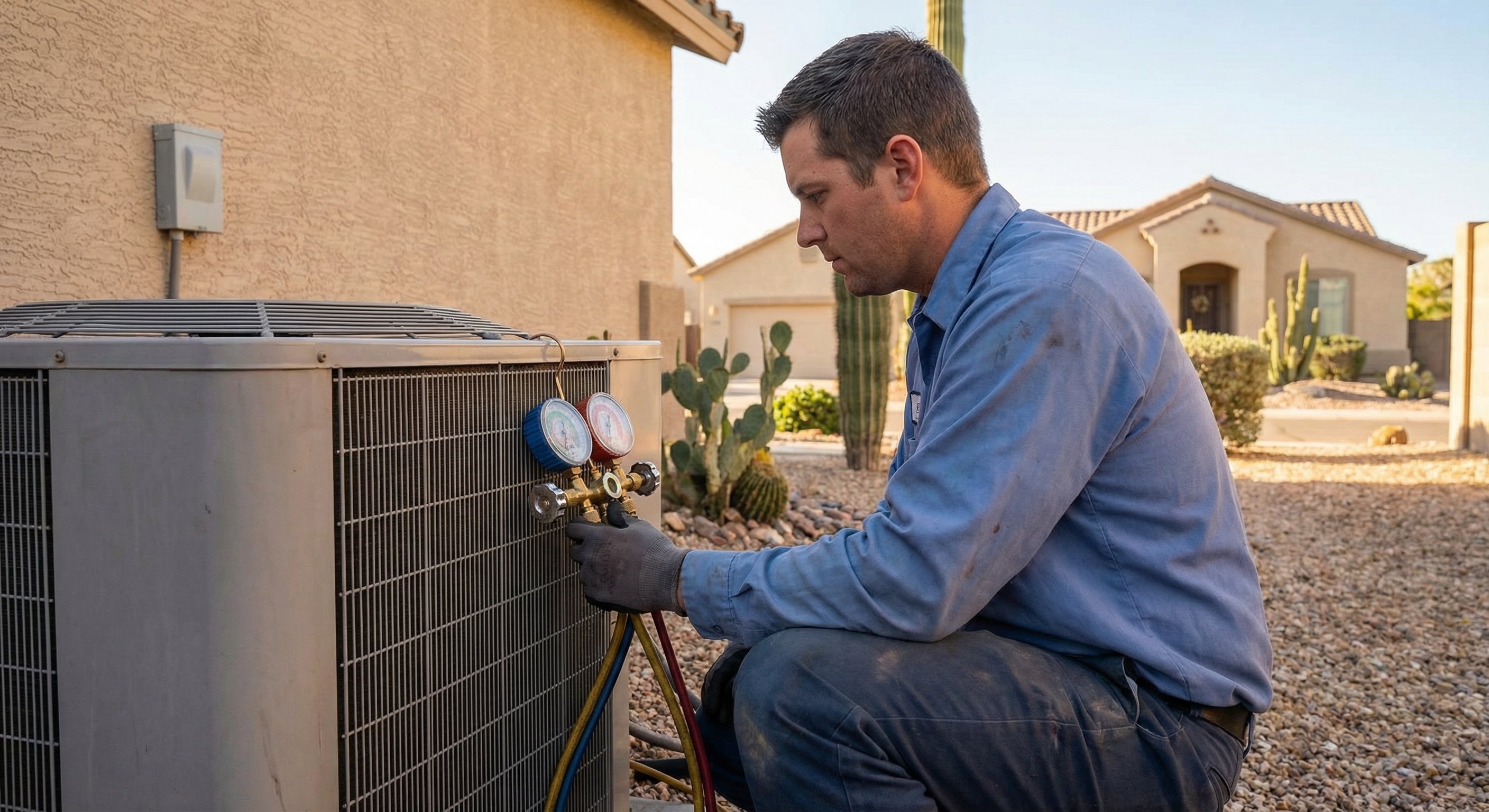
- Refrigerant pressure check — with actual gauges, not guessing
- Capacitor test — multimeter reading, not visual inspection only
- Airflow measurement — static pressure test, duct evaluation
- Coil condition check — both indoor and outdoor
- Electrical connection inspection — loose wiring causes intermittent failures
- Written itemized quote — parts and labor listed separately, no mystery charges
If a tech wants to charge $800 without explaining what's wrong, or pushes adding refrigerant without finding the leak first — those are red flags. A good HVAC technician explains what they found, why it happened, and what it's going to cost, in plain English.
Get a free instant quote at acrebel.com — straight numbers on repair vs. replacement, no pressure tactics.
Key Takeaways
- Check first: Filter, thermostat, outdoor unit, registers, breakers — before calling anyone
- Easy DIY wins: Clogged filter and frozen coil can often be resolved without a tech
- Most common pro issues: Low refrigerant (leak), failed capacitor, dirty coils, aging compressor
- R-22 systems: In most cases, repair cost makes replacement the smarter move
- The 5,000 Rule: Age × repair cost. Over $5,000 → replace
- Rebates exist: SRP and APS both offer cash back on qualifying high-efficiency replacements
- Phoenix factor: Systems here work harder than almost anywhere — sizing and SEER rating matter more than in cooler climates
Frequently Asked Questions
Q: Why does my AC run all day but never cool the house below 80°F?
A: In Phoenix during extreme heat (110°F+), this is sometimes a capacity issue — the system is undersized or too old to overcome the heat load. It can also stem from poor attic insulation, air leaks around windows and doors, low refrigerant, or dirty coils. If your system held 78°F last summer under similar temperatures, the difference this year almost certainly points to a system problem, not a sizing issue.
Q: How much does it cost to fix an AC that's not cooling in Phoenix?
A: Costs vary widely based on the cause. A capacitor replacement runs $150-300. A refrigerant recharge (including leak repair) typically runs $400-900+. Coil cleaning runs $100-250. Compressor replacement can reach $1,500-2,500 — at that price point, replacement often makes more financial sense for systems over 10 years old. Always get a diagnostic before authorizing major repairs.
Q: Can I recharge my own AC refrigerant?
A: No. EPA Section 608 regulations require EPA certification to purchase and handle refrigerants. Doing it without certification is illegal, and improper refrigerant handling is hazardous. This job belongs to a licensed HVAC technician.
Q: My AC blows cold in the morning but warm air by afternoon. What does that mean?
A: This is a classic sign of a system struggling under peak heat load. Possible causes: low refrigerant (the system works fine until heat builds up), a failing compressor that loses efficiency as temperatures climb through the afternoon, or an undersized system overwhelmed by 3-4 PM peak temperatures. Have a tech check refrigerant levels and compressor performance — ideally during the hottest part of the day.
Q: How often should I clean my AC coils in Arizona?
A: In Phoenix's dusty conditions, annual coil cleaning is the baseline recommendation. If you're near agricultural areas, construction sites, or had a heavy monsoon season with dust, more frequent cleaning may help. Dirty coils are one of the top causes of reduced cooling efficiency and directly show up in your electric bill.
Q: Will a bigger AC unit cool my house better?
A: No — and oversizing creates its own problems. An oversized unit short-cycles (turns on and off too rapidly), which means it never runs long enough to dehumidify properly, creates hot and cold spots, wears out faster, and can cause humidity issues. Proper sizing via a Manual J load calculation is critical, especially in Phoenix where heat loads vary significantly based on home orientation, insulation quality, window area, and square footage.
Q: My AC is 13 years old and not cooling well. Repair or replace?
A: At 13 years in Arizona — where systems work significantly harder than in cooler climates — you're past average expected lifespan. Run the 5,000 Rule: 13 × repair cost estimate. If the repair quote is over $385, replacement math starts winning. Factor in current APS or SRP rebates, the electricity savings from a higher-SEER system, and the avoided risk of the next repair. Get quotes on both before deciding.
Bottom Line
An AC that's running but not cooling is one of the most stressful things a Phoenix homeowner can deal with — especially when it's 112°F and climbing. Work through the basics first: filter, thermostat, outdoor unit, registers, breakers. If those don't solve it, the issue is almost certainly refrigerant, a failed capacitor, dirty coils, or a system that's hit its end of life.
Don't let anyone sell you a $2,000 repair on a 15-year-old R-22 system without also getting a replacement quote. Get the full picture — what it costs to fix, what it costs to replace, and what rebates are on the table — then make the decision that actually makes financial sense.
Get a free instant quote at acrebel.com — we'll give you straight numbers on both options so you can make the call with real information, not sales pressure.
Sources: ENERGY STAR Heating & Cooling | EPA Section 608 Refrigerant Regulations | SRP Home Energy Efficiency Rebates
Ready to stop overpaying?
See Your Direct AC Price in 2 Minutes
Skip the dealer. Buy your AC unit at direct pricing and pay a vetted local installer only for the installation. No sales calls. No hidden markup. Most homeowners save $3,000–$5,000+ compared to a traditional quote.
Get My Direct Price — No Credit Card2-minute quote · Licensed installers · 10-year warranty options