
Why Is My AC Blowing Weak Air in Phoenix? Here's What's Actually Wrong

Why Is My AC Blowing Weak Air in Phoenix? Here's What's Actually Wrong
TL;DR: Weak AC airflow in Phoenix usually starts with a dirty filter or closed vents, both of which you can fix in minutes for free. If those are not the cause, you are likely looking at a failing blower fan motor ($250-$600 to replace), a ductwork leak in the attic ($300-$900 to seal), or in older homes, a refrigerant issue that signals a system approaching end of life. The first step is checking your filter. If that is clean and you still have weak airflow, call a contractor for diagnostics.

You set the thermostat to 74. The AC runs. But the air coming out of your vents does not feel like much. It might be cool, but it is not pushing. You hold your hand up to the vent and barely feel anything.
This is one of the most common service calls we see in Phoenix, and the frustrating part is that the cause ranges from free to fix to thousands of dollars. Before a contractor shows up and quotes you something expensive, there are a few things you can check yourself in about 10 minutes.
Check the Filter First. Seriously.
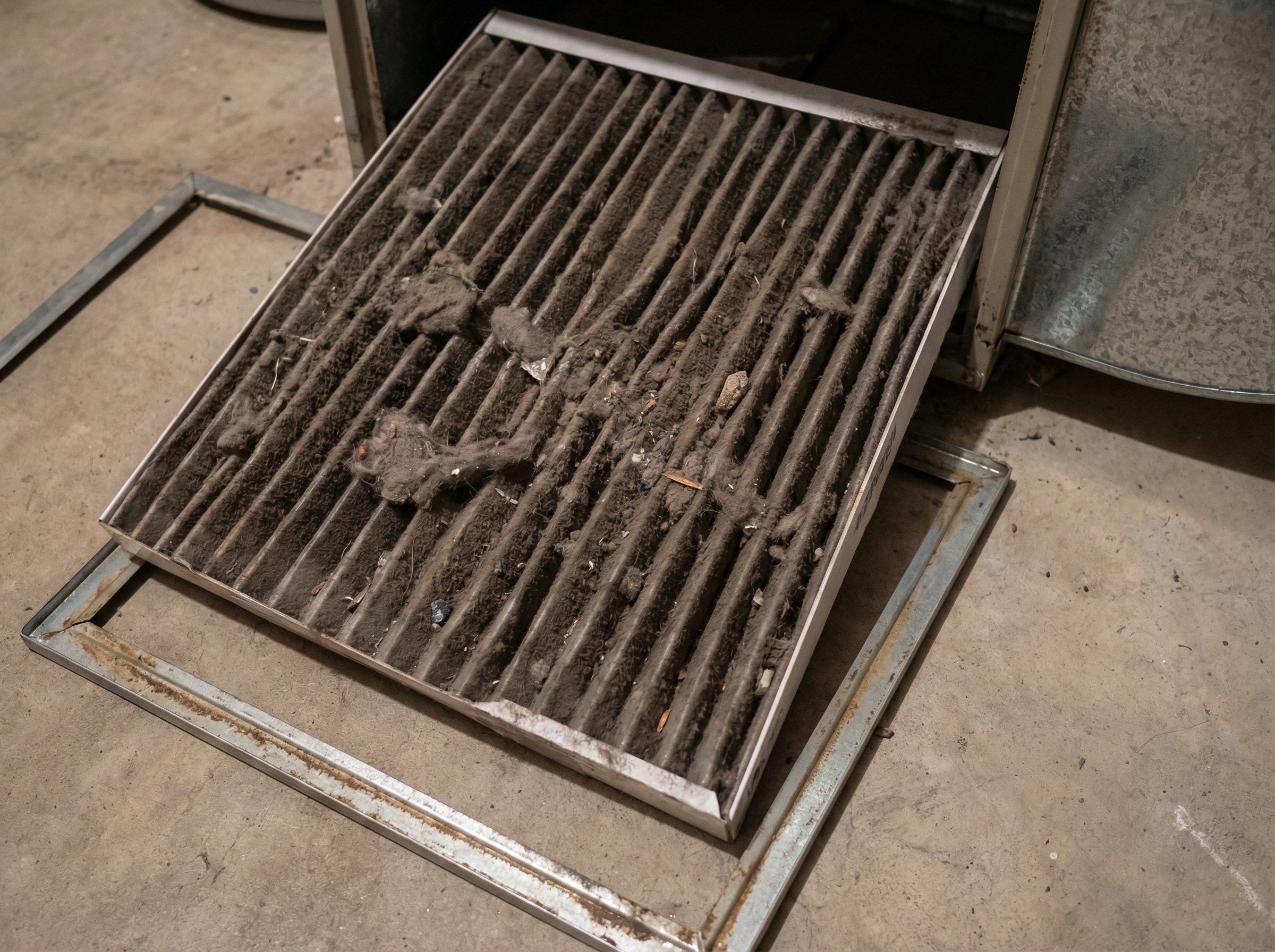
I know this sounds too simple. But a clogged air filter is the single most common cause of weak AC airflow in Phoenix homes, and most homeowners never think to look at it.
Your AC filter catches dust, pet hair, and debris from the air before it passes through the system. In Phoenix, filters get dirty faster than in other climates because of the dust, the dryness, and the months of constant AC use. A filter that looks slightly gray in January might be fully clogged by May.
When the filter is clogged, the blower fan works harder to push air through a blocked surface. The result is reduced airflow at every vent in your house. In extreme cases, the restricted airflow can cause the evaporator coil to freeze, which creates an entirely different problem on top of the weak airflow.
How to check it: Turn off your AC. Slide the filter out of its slot. Hold it up to a light. If you cannot see light through it clearly, it is clogged. A 1-inch pleated filter costs $15-$25 at any hardware store and takes 2 minutes to swap. This is the first thing to check before calling anyone.
Closed or Blocked Vents: The Secret Problem Nobody Thinks About
After the filter, the second most common cause of weak airflow is something even simpler: supply vents that are partially closed.
In many Phoenix homes, especially in older neighborhoods in Tempe, Glendale, and Chandler, rooms get closed off when they are not in use. A guest bedroom, a home office, a formal dining room. Closing the supply vent does not make the AC stop sending air there. It creates backpressure in the ductwork. That backpressure reduces the flow at every other vent in the house.
Blocked return vents are even worse. If a return vent is covered by a piece of furniture, a rug, or a curtain, the system cannot pull air efficiently, and the whole house suffers.
What to do: Walk through your home with the AC running. Check that every supply vent is fully open. Check that no return vents are blocked. Move any furniture, rugs, or curtains that might be covering a return.
The Blower Fan Motor: When the Problem Is Inside the Unit
If your filter is clean, all vents are open, and you still have weak airflow, the problem is likely inside the air handler. There are two components that fail in ways that cause weak airflow: the blower motor and the evaporator coil.
Blower motor problems: The blower motor is what actually pushes air through your ductwork. In Phoenix, these fail faster than anywhere else in the country because they run for months straight in extreme heat. A failing blower motor might run but not spin fast enough, or might make a grinding noise, or might run only at certain speeds.
A failing blower motor costs $250-$600 for the part and labor to replace. A full motor replacement including labor runs $450-$900. If your system is over 12 years old and the motor is failing, that is a signal to start comparing full replacement costs before pouring money into a system at the end of its life.
Evaporator coil contamination: The evaporator coil sits inside your air handler and is responsible for cooling the air that passes over it. In Phoenix, hard water creates mineral scale on the coil fins. That scale acts like an insulation layer, reducing the coil's ability to exchange heat. The air passing over a scaled coil does not get as cold.
A professional coil cleaning runs $150-$350. But if the coil is heavily scaled and the system is old, cleaning may only buy you another year or two before other problems surface.
Skip the dealer markup
See What a New AC Actually Costs
AC Rebel shows you the real equipment price — no sales pitch, no inflated quote. Get matched with a licensed installer and keep $3,000–$5,000 in your pocket.
Get My Direct Price →Ductwork Leaks: The Hidden Air Thief
Your ductwork runs through your attic, through your walls, and under your floors. In many Phoenix homes, particularly those built before 1995, the ductwork is held together with metal tabs and duct tape. Over time, connections separate, tape degrades, and sections develop leaks.
When ducts leak, the air that your blower motor is pushing never reaches your living rooms. Instead, it escapes into your attic, your crawlspace, or your walls. You can have a perfectly good AC unit and still have weak airflow at your vents because half the cool air is going nowhere.
According to the U.S. Department of Energy, leaky ducts can reduce HVAC efficiency by 20 to 40 percent. In a Phoenix summer, that is the difference between a $250 monthly electric bill and a $400 one.
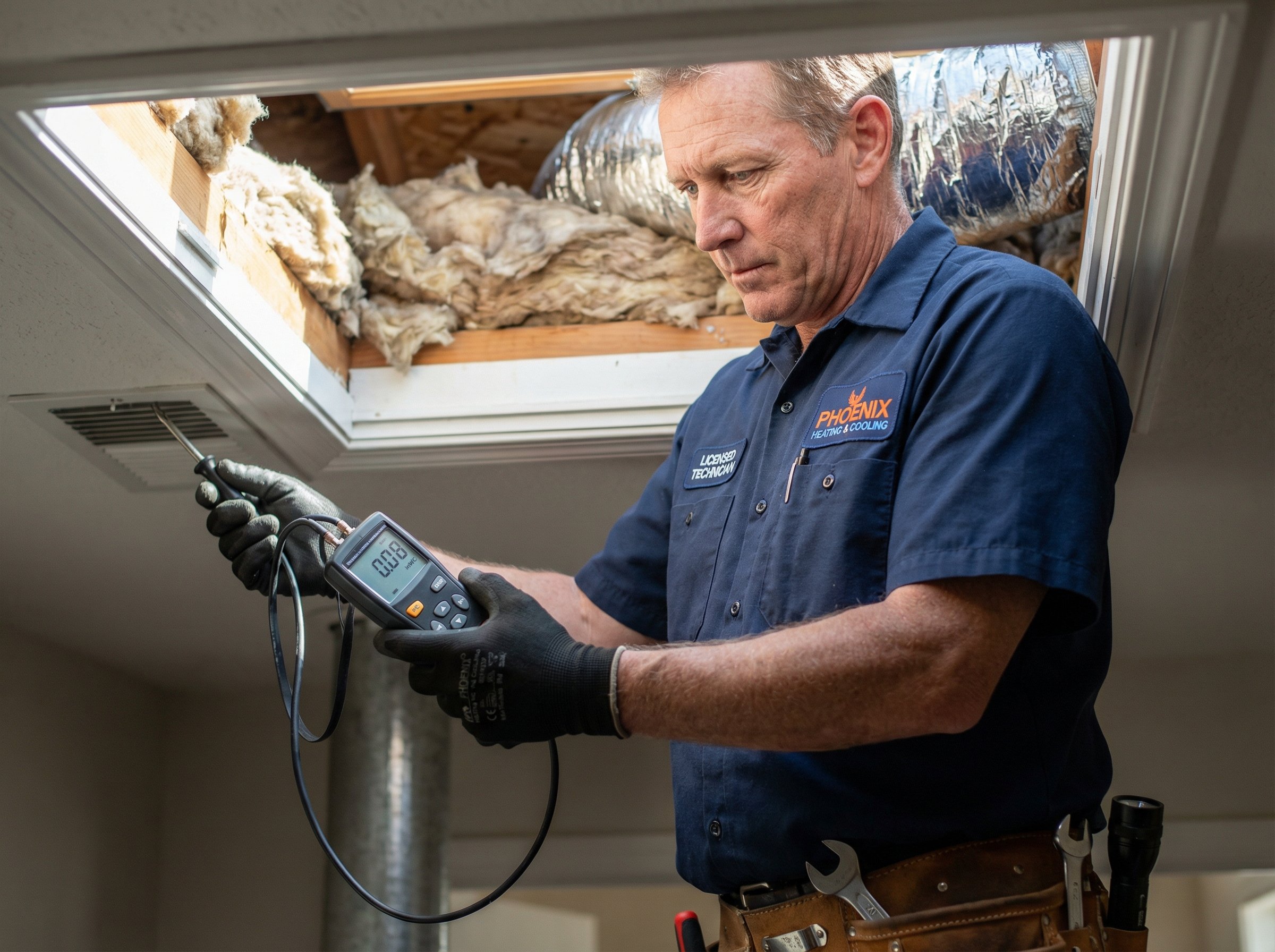
Signs you have a ductwork problem: Some rooms cool fine while others do not. Your electric bills are unusually high despite normal use. You can feel warm air coming from your ceiling or walls near the air handler. You hear hissing or whistling from your ductwork when the AC is running.
Ductwork sealing by a licensed contractor runs $300-$900 depending on how many leaks are found and how accessible they are. In an older Mesa or Chandler home with original ductwork, expect to pay toward the higher end.
Refrigerant Issues: The Symptom Nobody Expects
Your AC uses refrigerant to absorb heat from your home and release it outside. If the refrigerant charge is low, the system can still run, but it cannot cool properly. One of the signs of low refrigerant is weak airflow at the vents.
Low refrigerant is almost always caused by a leak somewhere in the system. The leak might be at a connection, at the evaporator coil, or at the condenser coil outside. Finding the leak is a diagnostic process that involves pressurizing the system and checking for pressure loss.
In an older system running R-22 refrigerant, a leak repair plus the cost of recharging can run $600-$1,500. If you have an R-410A system, refrigerant is less expensive, but the leak still needs to be found and sealed. A leak at the evaporator coil in a 12-year-old system often signals that replacement is a better investment than repair.
When the Weak Airflow Points to a Bigger Problem
Here is the thing about weak airflow: it is often the first symptom of a system that is struggling. If you have been ignoring it for a while, or if you have been told it is not a big deal, pay attention to what else is happening.
Is your electric bill higher than it used to be for the same usage pattern? Does the unit run constantly without reaching the temperature you set? Do you hear scraping, grinding, or clicking sounds from the air handler? Is there a burning smell when the system starts up?
All of these are escalation signals. A unit that is struggling to push air is a unit that is working harder than it should, burning more electricity, and approaching the point where a minor fix becomes a major emergency.
Phoenix homeowners with systems over 12 years old who are experiencing weak airflow should get a professional diagnostic before spending money on repairs. That diagnostic typically runs $75-$150 and tells you whether you are looking at a $250 fix or a $3,000 replacement quote.
FAQ: Weak AC Airflow in Phoenix
Why is the air coming out of my vents barely cool in Phoenix?
In Phoenix, weak airflow that is also warm usually points to one of four issues: a dirty filter blocking airflow, low refrigerant from a leak, a failing blower motor, or a refrigerant issue in an older system. The most common cause is a clogged filter. Check that first before calling a contractor.
Can a dirty filter really cause weak airflow?
Yes. A clogged 1-inch pleated filter can reduce airflow by 20 to 40 percent depending on how clogged it is. In Phoenix, where AC systems run for 6 to 8 months straight, filters clog faster than in other climates. Check and replace your filter every 1 to 3 months during cooling season.
How much does it cost to fix weak AC airflow in Phoenix?
The cost depends entirely on the cause. A new filter costs $15-$25 and takes 2 minutes. A blower motor replacement runs $250-$900. Ductwork sealing runs $300-$900. A refrigerant leak repair plus recharge runs $450-$1,500. Always get a diagnostic before committing to a repair on a system over 10 years old.
Is weak airflow in my AC a sign I need a new unit?
Not necessarily, but it can be. If your system is over 12 years old, the repair costs start to compete with replacement costs quickly. Weak airflow plus high electric bills, constant cycling, and warm air despite the unit running are signs that your system may be approaching the end of its useful life.
What is the fastest way to improve weak airflow myself?
Replace your air filter first. Open all supply and return vents. Make sure nothing is blocking your return vents. If the filter is clean and the problem persists, you need a professional diagnostic. Do not let a contractor sell you a repair without explaining what they tested and how they diagnosed the specific cause.
How often should I replace my AC filter in Phoenix?
Every 1 to 3 months during cooling season. Phoenix homes with pets, dust, or construction nearby may need to check monthly. A 1-inch pleated filter is the minimum standard. If you have a media filter cabinet with a larger filter, check it every 3 months and replace at least once per cooling season.
Your AC should push enough air that you feel it at chest level when you hold your hand in front of a vent. If it does not, something is throttling the system. In Phoenix, the most common culprits are quick fixes: a dirty filter, a closed vent, a blocked return. Check those first. If the problem is still there, you are looking at a component failure, and it is worth knowing exactly what you are fixing before you hand over any money.

Get a free instant quote at acrebel.com.
Ready to stop overpaying?
See Your Direct AC Price in 2 Minutes
Skip the dealer. Buy your AC unit at direct pricing and pay a vetted local installer only for the installation. No sales calls. No hidden markup. Most homeowners save $3,000–$5,000+ compared to a traditional quote.
Get My Direct Price — No Credit Card2-minute quote · Licensed installers · 10-year warranty options