
Ductless Mini Split vs. Central AC in Arizona: What Actually Makes Sense Here

Ductless Mini Split vs. Central AC in Arizona: What Actually Makes Sense Here
TL;DR: For most Arizona homes with existing ductwork, central AC wins on upfront cost and whole-home comfort. Mini splits make more sense for room additions, casitas, garages, or older homes with poor ducts — situations where central AC can't reach. Rooftop package units are a third (often overlooked) option specific to Arizona flat-roof homes. A 2-3 ton mini split in Phoenix runs $3,500–$6,500 installed; a comparable central AC system starts around $6,000. SRP and APS both offer rebates up to $300–$550 on qualifying high-efficiency systems.
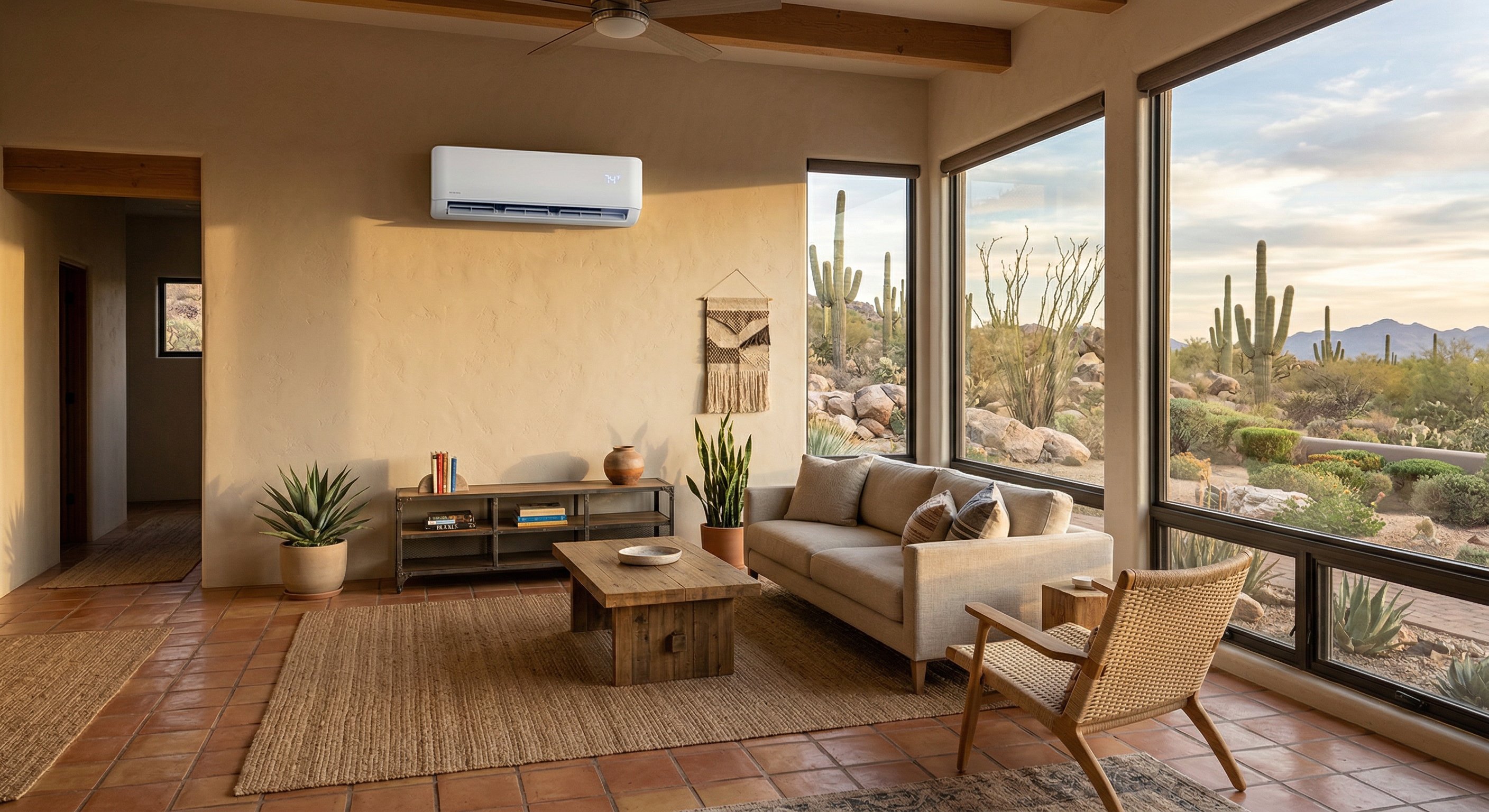
Here's the decision most Phoenix homeowners get wrong: they pick a system based on what their neighbor has, or what the first contractor recommends, without realizing the answer actually depends on their specific home situation.
A mini split that makes perfect sense in a 1970s Arcadia home with terrible ductwork is a terrible choice in a brand-new 2,800 sq ft Gilbert house. A central AC system that's the obvious call for a Peoria split-level becomes a money pit if you're cooling an unconditioned garage or a casita addition.
In Arizona, we also have a third option most comparison guides forget entirely: rooftop package units. They're common here because of our flat roofs, and they change the math.
Here's a straight look at all three, what they cost in Phoenix right now, and when each one actually makes sense.
How Each System Works (The Short Version)
Central AC uses a split system: one outdoor condenser unit (usually on a concrete pad on the side or back of your house) connected to an indoor air handler or furnace. Cooled air flows through ductwork to every room. One thermostat controls the whole home.
Ductless mini splits skip the ductwork entirely. An outdoor compressor connects via refrigerant lines through a small hole in the wall to one or more wall-mounted indoor units (called "heads"). Each head controls its own zone. A 3-bedroom house might have 3 or 4 heads on one outdoor unit.
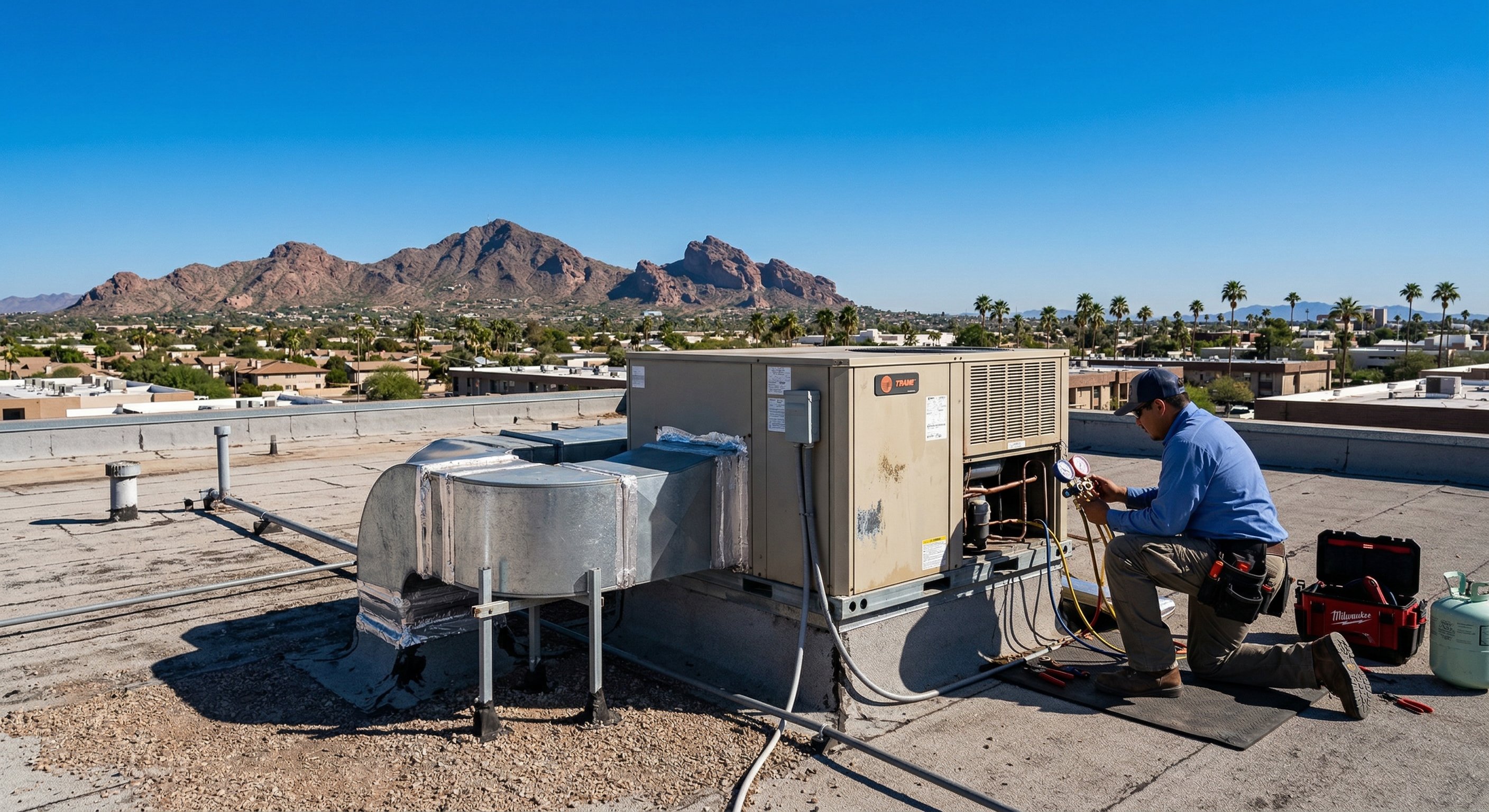
Rooftop package units are the Arizona wildcard. The entire system — compressor, air handler, evaporator — is in a single cabinet that sits on your flat roof. No split components. Conditioned air comes down through ductwork in the ceiling. If you've seen those boxy units on commercial buildings, same concept. Roughly 30–40% of Phoenix metro homes use them because of our flat-roof architecture.
The Real Cost Comparison for Arizona
This is where most guides give you ranges so wide they're useless. Here's what you're actually looking at in the Phoenix metro in 2026:
Ductless Mini Splits
| Configuration | System Size | Installed Cost (AZ) |
|---|---|---|
| Single-zone (1 room/area) | 9,000–12,000 BTU | $2,200–$3,800 |
| Single-zone (larger room) | 18,000–24,000 BTU | $2,800–$4,500 |
| Multi-zone (2 heads) | 2–3 ton equivalent | $4,500–$7,500 |
| Multi-zone (3–4 heads) | 3–4 ton equivalent | $6,500–$10,000+ |
Arizona-specific reality: at 115°F, mini splits work harder than in other climates. Make sure any unit you buy has an operating range rated for high ambient temperatures — look for systems rated to 122°F+ outdoor operation. Mitsubishi Hyper Heat and Daikin Aurora are good examples; cheaper off-brand units often derate significantly above 105°F.
Central AC (Split Systems)
| Home Size | System Size | Installed Cost (AZ, with existing ducts) |
|---|---|---|
| 1,000–1,600 sq ft | 2–2.5 ton | $5,500–$7,500 |
| 1,600–2,200 sq ft | 3 ton | $6,500–$8,500 |
| 2,200–3,000 sq ft | 3.5–4 ton | $7,500–$10,500 |
| 3,000+ sq ft | 4–5 ton | $9,500–$13,000+ |
No existing ductwork? Add $3,000–$8,000 for duct installation. That's the number that makes mini splits suddenly look a lot more attractive in older homes or additions.
Rooftop Package Units
For existing flat-roof Phoenix homes replacing a failed package unit, expect $5,500–$9,000 installed depending on size and efficiency. They're not always the cheapest option, but they're often the most practical when your home was designed for one.
Energy Efficiency: Where Mini Splits Have a Real Advantage
This is the one category where mini splits clearly win, and it matters a lot in Phoenix where your SRP or APS bill can hit $400–$500 in July.
Mini splits typically run 20–30+ SEER (Seasonal Energy Efficiency Ratio). A high-end central AC tops out around 21–24 SEER. Most homes are replacing 14–16 SEER systems, so either upgrade is a significant improvement — but mini splits have a ceiling that central AC can't match.
The second efficiency advantage is duct loss. In Arizona, ducts run through attics that routinely hit 150°F+ in summer. Even well-sealed ducts lose 20–30% of cooling capacity through attic heat gain. Mini splits deliver cold air directly to the room with no duct losses.
The math for a typical Mesa home: If you're spending $280/month on cooling with a 15-year-old 12 SEER central AC, a 20 SEER central AC system might bring that to $190–$210. A 25 SEER mini split system with good zoning might bring it to $140–$160. Over 10 years, that's a meaningful difference that helps offset the higher upfront cost.
SRP and APS rebates for 2026:
- SRP: Up to $550 rebate on qualifying central AC or heat pump systems (must be 15+ SEER2, with additional incentives at 18+ SEER2)
- APS: Up to $300 rebate on qualifying 15+ SEER2 systems
- Federal Tax Credit: 30% of the installed cost (up to $600 per year) under the Inflation Reduction Act for qualifying ENERGY STAR systems — applies to both mini splits and central AC
Check SRP's rebate portal and APS efficiency program for current program details — amounts and eligibility change seasonally.
Skip the dealer markup
See What a New AC Actually Costs in Phoenix Metro, AZ
AC Rebel shows you the real equipment price — no sales pitch, no inflated quote. Get matched with a licensed installer and keep $3,000–$5,000 in your pocket.
Get My Direct Price →The Five Arizona Scenarios: Which System Wins
Here's where the generic comparison breaks down and real local advice matters.
Scenario 1: Existing Ducted Home, Replacing a Failed System
Winner: Central AC (usually)
If your Phoenix home already has ductwork that's reasonably sealed, central AC is almost always the right call. Lower upfront cost, simpler operation, whole-home comfort. Have an HVAC tech inspect your ducts first — if they're leaking significantly or running unconditioned spaces, get them sealed or replaced before the new unit goes in.
Go up at least one SEER tier from your current system. If you're on 14 SEER, don't buy 15 — jump to 18+ and collect the rebate.
Scenario 2: Room Addition, Casita, or Garage Conversion
Winner: Mini split, no contest
This is the most common situation where mini splits dominate in Phoenix. Chandler and Gilbert are full of homes that added a casita, converted a garage to a game room, or added a sunroom — and the original central AC wasn't sized for the addition and can't reach it efficiently anyway.
A single-zone mini split at $2,200–$3,800 installed handles this perfectly. You get independent temperature control, no duct work, and you don't burden the existing AC system with a room it was never designed to cool.
Scenario 3: Older Home (Pre-1990) with Poor Ductwork
Winner: Mini split, depending on condition
Lots of Phoenix and Tempe homes built before 1990 have undersized or deteriorated ductwork that can't be easily replaced without major renovation. In these cases, a whole-home mini split system (2–4 heads) can outperform a new central AC connected to old ductwork that loses a third of its capacity in the attic.
Get a duct inspection before you decide. If the ducts are rebuildable at reasonable cost, go central. If they're a mess, mini splits solve the problem without the headache.
Scenario 4: Flat-Roof Home with Existing Rooftop Package Unit
Winner: Replace with another rooftop package unit
If your Paradise Valley or downtown Phoenix home has an existing rooftop package unit, replacing it with a mini split or a split-system central AC usually doesn't make sense from a cost or practicality standpoint. Replace the package unit with a more efficient model. Modern package units run 16–18 SEER, which is a meaningful efficiency improvement over the 10–14 SEER units many Phoenix homes still have.
Scenario 5: New Build or Full HVAC Replacement in a Large Home (2,500+ sq ft)
Winner: Central AC, potentially with a zoning system
For large Peoria or Surprise homes, mini splits at scale get expensive and complicated. A 4,000 sq ft house with 6 zones of mini splits can run $15,000–$20,000. A properly sized central AC with a zoning damper system achieves similar zone control at lower installed cost.
The zoning damper route also keeps maintenance simpler — one outdoor unit to service instead of multiple.

What Mini Splits Handle Differently in Arizona's Climate
A few things matter here that don't matter as much in other states:
Desert dust and filter maintenance. Mini split indoor heads have filters that catch dust — and Phoenix dust is relentless. If you don't clean them every 2–4 weeks in summer, the unit's efficiency drops significantly. Dusty filters also accelerate coil fouling. It's not a dealbreaker, but it's real maintenance that central AC owners rarely think about.
Outdoor unit placement. Mini split outdoor units need airflow and shade where possible. A unit sitting in direct western sun at 3 PM in Scottsdale is working against itself. Where you site the unit matters; a good installer will optimize this.
Operating temperature limits. Standard mini splits are rated to around 115°F ambient operation. Phoenix regularly hits 117–120°F during heat waves. Most name-brand units (Mitsubishi, Daikin, Fujitsu, Carrier) are fine and often rated higher than spec. Avoid off-brand units with no high-ambient rating documentation.
Monsoon season. The July–September monsoon brings humidity spikes that your AC has to handle. Both systems manage this fine — mini splits are actually slightly better at dehumidification because they run at lower fan speeds in variable-capacity mode, which pulls more moisture out of the air.
The Dealer Markup Problem (And Why It Matters Here)
Whether you go mini split or central AC, the biggest variable in your installed price isn't the equipment — it's the markup chain between manufacturer and your home.
Traditional contractor purchases: manufacturer → distributor → contractor → you. Every step adds 10–40% markup. A 3-ton system with an equipment cost of $2,800 wholesale arrives at your door quoted at $8,500 "all-in."
That's the number worth questioning before you sign. Getting the equipment at direct pricing and hiring a licensed installer separately is the model that's been disrupting new car sales for 20 years. It's arriving in HVAC.
See direct pricing on mini split and central AC systems at AC Rebel — then compare against your next contractor quote. The gap is usually $2,000–$4,000 on a standard installation. Your installer still gets paid to do the work; they just don't get to mark up the equipment twice.
Quick Decision Framework
Choose central AC if:
- Your home has existing ductwork in decent shape
- You want whole-home cooling with one thermostat
- You're replacing an existing split system
- Your home is 2,500+ sq ft
Choose mini splits if:
- You're adding conditioned space (addition, casita, garage conversion)
- Your existing ductwork is in poor shape and expensive to fix
- You want zone control without a full zoning system
- You're cooling one or two specific rooms, not the whole house
Choose a rooftop package unit if:
- Your home already has one that's failed
- You have a flat or low-slope roof built for a rooftop system
- Replacing like-for-like is the most practical retrofit
Frequently Asked Questions
Can a mini split cool an entire 2,000 sq ft Arizona home?
Yes, with a multi-zone system — typically 3–4 indoor heads on one outdoor unit. It's more common for additions and secondary spaces, but whole-home mini split systems work. The installed cost ($8,000–$13,000) approaches or exceeds a central AC system in most cases, so it's only worth it when ductwork is genuinely not viable.
Do mini splits hold up in Arizona's extreme heat (115°F+)?
Name-brand mini splits (Mitsubishi, Daikin, Fujitsu, Carrier, Bosch) are generally rated to 115°F or higher and perform reliably in Phoenix summers. Verify the high-ambient operating spec before buying, especially for lower-cost units. Cheap mini splits derate significantly above 105°F.
Are there SRP or APS rebates for mini split systems?
Yes. SRP offers rebates on ENERGY STAR qualified ductless mini splits — typically $75–$300 per ton depending on efficiency. APS offers similar rebates. Check each utility's current program; rebate levels adjust periodically. Both are eligible for the federal 30% tax credit under the Inflation Reduction Act.
How long does a mini split last in Arizona vs. central AC?
About the same: 12–15 years in Phoenix's heat (vs. 15–20+ in milder climates). Arizona heat is hard on all mechanical systems. Annual coil cleaning and filter maintenance — both more important in our dusty desert climate — extend life significantly for either system type.
What's the biggest mistake Arizona homeowners make choosing between these systems?
Choosing based on upfront cost alone without accounting for duct condition. A new central AC connected to ductwork with 25–30% loss running through a 150°F attic underperforms significantly. If your ductwork is the problem, fixing it (or bypassing it with mini splits) is almost always worth the cost.
Looking for direct pricing on HVAC systems for your Arizona home — mini split or central AC — without the dealer markup? See what you'd actually pay at AC Rebel.
Ready to stop overpaying?
See Your Direct AC Price in 2 Minutes
Skip the dealer. Buy your AC unit at direct pricing and pay a vetted local installer only for the installation. No sales calls. No hidden markup. Most homeowners save $3,000–$5,000+ compared to a traditional quote.
Get My Direct Price — No Credit Card2-minute quote · Licensed installers · 10-year warranty options