
AC Keeps Turning On and Off in Phoenix? Here's Why (and What to Fix)

AC Keeps Turning On and Off in Phoenix? Here's Why (and What to Fix)
TL;DR: When your AC turns on, runs for 2–3 minutes, shuts off, then repeats — that's called short cycling. In Phoenix, the most common causes are an oversized unit, low refrigerant, a dirty air filter, or a frozen evaporator coil. Short cycling destroys compressors fast and spikes your electric bill. Some fixes are DIY (filter swap); others need a licensed tech. Here's how to tell the difference before more damage is done.
Your AC should run in long, steady cycles — typically 15 to 20 minutes when it's 110°F outside. So when it starts clicking on every few minutes and shutting off before the house cools down, something is wrong.
This isn't just annoying. In Phoenix, Chandler, and Tempe, where we run our ACs harder and longer than almost anywhere in the country, short cycling is one of the fastest ways to kill a compressor. A compressor that should last 15 years can fail in 3 if it short cycles through a few Arizona summers.
The good news: some causes are a quick DIY fix. Others need a tech. Let's break down exactly what's happening and how to figure out which you're dealing with.
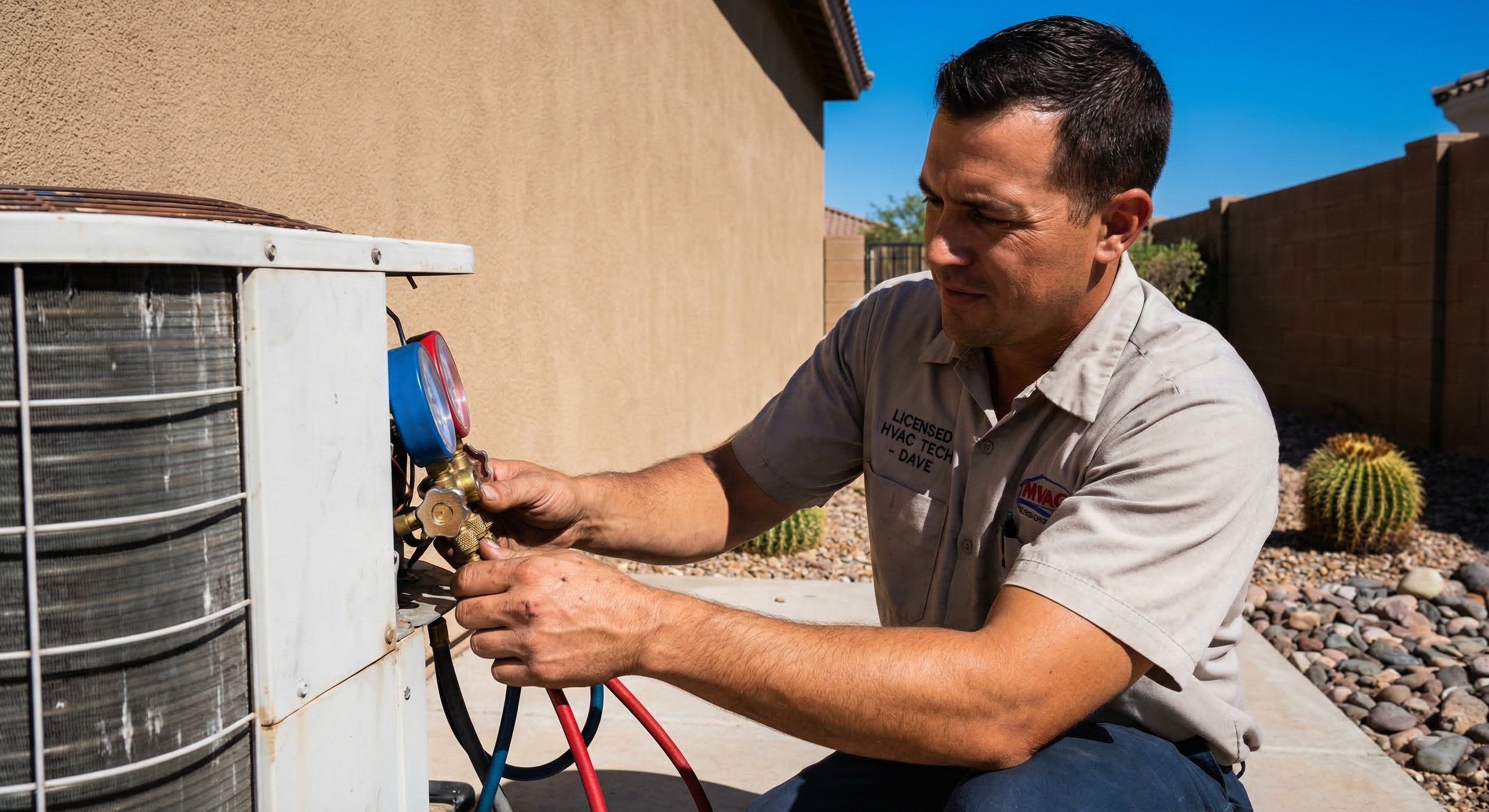
What Is AC Short Cycling?
Short cycling is when your AC compressor starts and stops in rapid, frequent cycles — usually less than 10 minutes each. A healthy system in Phoenix summer should run for 15–20 minute cycles. If yours is running for 2–5 minutes and then shutting off before your home reaches the set temperature, that's short cycling.
The term comes from the idea that the system is cutting its cooling cycle "short" instead of completing a full run.
Why does this matter so much? The hardest moment in your AC's life is startup. Every time the compressor kicks on, it draws a surge of electricity and puts mechanical stress on the motor windings. Run it 3 times an hour instead of 3 times a day and you're burning through that compressor fast.
ENERGY STAR and the Air-Conditioning, Heating, and Refrigeration Institute (AHRI) both cite compressor failure as the #1 cause of premature system replacement — and short cycling is one of the top contributors.
The 6 Most Common Causes of Short Cycling in Phoenix
1. Your Unit Is Oversized
This is the most common cause we see across the Phoenix metro, especially in newer construction in Chandler and Gilbert where builders sometimes installed oversized equipment.
An oversized AC cools the air so fast that the thermostat hits the set point before the unit completes a proper cycle. The system shuts off — but the house hasn't been dehumidified and the temperature quickly rebounds, so the unit kicks back on again almost immediately.
How to check: A properly sized AC should reach your thermostat setpoint in 15–20 minutes when it's 110°F outside. If it hits the target in 5–8 minutes, it's probably too large for your square footage.
The fix: there's no quick patch for an oversized unit. You need either a properly sized replacement or a variable-speed system that can modulate its output. This is also why "bigger is better" in AC is a complete myth — an oversized unit is worse than a correctly-sized one, period.
2. Low Refrigerant (Most Dangerous)
If your refrigerant level is low — from an original undercharge at installation or a developing leak — your system can't absorb heat properly. The evaporator coil pressure drops, temperatures swing, and the unit shuts down on safety controls designed to protect the compressor.
You cannot add refrigerant yourself. It requires an EPA 608-certified technician, and handling refrigerants without certification is illegal under current federal law. More importantly: if you're low on refrigerant, there's a leak somewhere. Topping it off without finding the leak is a temporary band-aid that will fail again.
Signs you're low on refrigerant:
- Warm air blowing even when the system is running
- Ice forming on the refrigerant lines outside the house
- A hissing or bubbling sound near the indoor or outdoor unit
Don't ignore this one. Running a system low on refrigerant causes liquid refrigerant to flood back into the compressor, destroying the valves. That's a $2,000+ repair — or a full system replacement.
3. Dirty Air Filter (The Easy Fix)
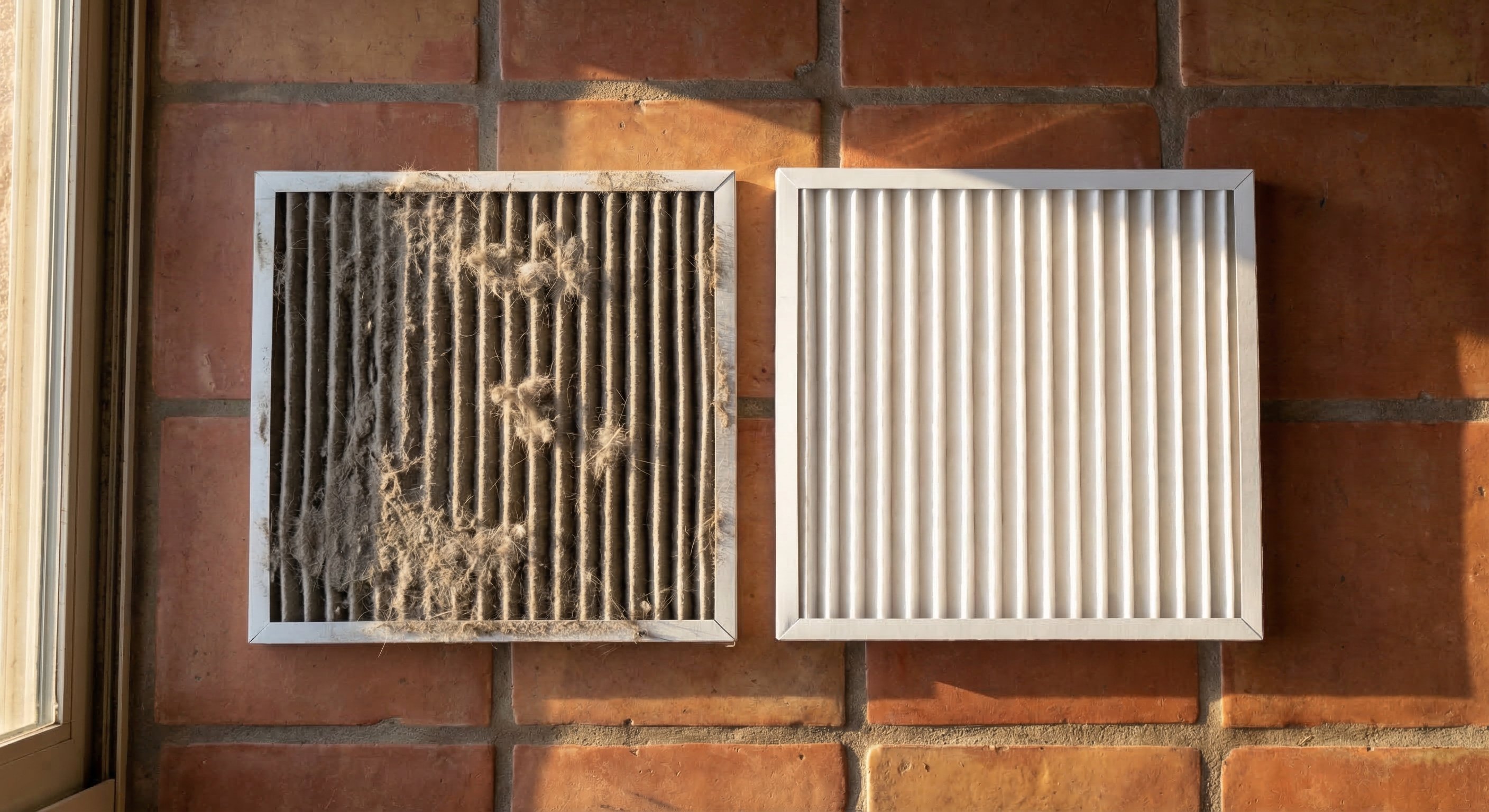
A clogged filter restricts airflow to the evaporator coil. When airflow drops, the coil gets too cold, ice forms, and the system shuts down on the safety switch. Once it thaws, it kicks back on — and the cycle repeats.
This is the DIY fix. Go check your filter right now. If it's gray, if you can't see through it, or if you can't remember the last time you changed it — that may be your entire problem.
In Phoenix and Tempe, where dust storms and haboobs are a regular summer event, check your filter every 30 days from May through September. If you have pets or live near active construction, check it every 2–3 weeks.
A 1-inch filter runs $5–15. A 4-inch media filter runs $25–40 and lasts 6–12 months. The cost of a new compressor because you didn't swap a $10 filter is $1,500–2,500. The math is not complicated.
4. Frozen Evaporator Coil
A frozen coil is often the symptom, not the root cause. The coil freezes because of either restricted airflow (dirty filter — see above) or low refrigerant. When the coil is frozen, it can't absorb heat, the system shuts off, the ice melts, and the system kicks back on — rinse and repeat.
How to check: Turn your AC to "fan only" (not cool) for 2–3 hours. Open the air handler access panel and look at the coil. If it's a solid block of ice, you have a frozen coil. Check the filter first. If the filter is clean and the coil is still freezing, you likely have a refrigerant issue and need a tech.
Do NOT run your AC with a confirmed frozen coil. You're bypassing safety controls and compressor damage follows quickly.
5. Dirty Condenser Coils
Your outdoor unit — the large square unit sitting on a concrete pad next to your house — has coils that expel heat. If those coils are packed with dust, pollen, or cottonwood fluff (Phoenix gets significant cottonwood in spring), they can't release heat efficiently.
When the condenser can't dump heat, refrigerant pressure spikes and the system's high-pressure safety switch trips and shuts everything down. On a Phoenix summer day at 115°F, this can happen multiple times per hour.
DIY fix: With the unit OFF and the circuit breaker disconnected, rinse the condenser fins gently with a garden hose from the inside out. Don't use a pressure washer — you'll bend the fins. A standard garden hose with a regular nozzle is all you need. For deeper cleaning, have a tech use coil cleaner solution during your annual spring tune-up.
6. Thermostat Problems
The thermostat controls when your system kicks on and off. If it's malfunctioning — bad location, dying batteries, faulty sensors — it can send incorrect signals that cause short cycling.
Common thermostat issues in Phoenix:
- Direct sun exposure: If your thermostat is on a wall that gets afternoon sun, it reads warmer than the rest of the house and cycles the AC too aggressively
- Dead batteries: In programmable and smart thermostats, low batteries cause erratic on/off behavior
- Wiring fault: Loose wire connections cause intermittent signals that look like short cycling
Try replacing batteries first. If you have a smart thermostat acting up, reset it to factory settings and reconfigure. If problems persist after that, have a tech check the wiring at the unit.
Why Short Cycling Is Especially Brutal in Arizona
Most HVAC problems are bad everywhere. Short cycling is particularly destructive in the Phoenix metro for a few specific reasons.
Our compressors work harder. When it's 115°F in Chandler and your attic is 150°F, your system is under maximum thermal stress from June through September. A healthy system can handle that stress over a full cycle. A short-cycling system absorbs those startup surges repeatedly with no recovery time.
Our cooling season is twice as long. Phoenix runs AC from April through October — nearly 7 months. Wear that would accumulate slowly in a cooler climate compounds twice as fast here.
Demand pricing kills your bill. APS and SRP both have time-of-use and peak demand pricing structures. Short cycling drives up your demand charges because the system draws startup surge current multiple times an hour instead of once. You're paying for it on every single monthly bill.
According to ENERGY STAR, an AC unit that short cycles can use 10–20% more electricity than a properly functioning unit while delivering less comfort. On an APS bill in a 2,500 sq ft Tempe home during peak summer, that's $50–100/month in completely wasted energy.
Skip the dealer markup
See What a New AC Actually Costs
AC Rebel shows you the real equipment price — no sales pitch, no inflated quote. Get matched with a licensed installer and keep $3,000–$5,000 in your pocket.
Get My Direct Price →How to Diagnose Short Cycling Yourself (Before Calling a Tech)
Run this checklist before you pick up the phone:
Step 1 — Check the air filter. Pull it out. Visibly dirty? Replace it. Run the system for 30 minutes and see if cycling improves.
Step 2 — Check the outdoor unit. Walk outside. Is it running? Do you see ice on the refrigerant lines? Is it tripping off after only a few minutes? If you see ice, shut the system off completely.
Step 3 — Check the thermostat. Replace batteries. Make sure it's not in direct sunlight or near a heat source. Set it to a fixed target temperature (not a schedule) for testing purposes.
Step 4 — Check your circuit breaker. A tripping breaker can look like short cycling. If the AC circuit is tripping repeatedly, that's an electrical issue requiring immediate professional attention — don't reset it more than once.
Step 5 — Time the cycles. Sit and watch. If the unit runs less than 8 minutes before shutting off and restarts within 5 minutes, you have confirmed short cycling.
If you've run all five steps and the problem continues, you need a licensed tech. At that point it's either refrigerant, electrical, or mechanical inside the unit — none of those are DIY territory.
Get a free instant quote at acrebel.com — no markup, no middleman. We'll tell you exactly what the issue costs to fix before we ever start.

Key Takeaways
- Short cycling = your AC runs in cycles shorter than 10 minutes and never cools the house properly
- Most common causes: oversized unit, low refrigerant, dirty filter, frozen coil, dirty condenser coils, thermostat problem
- DIY fixes: filter replacement ($5–15), condenser rinse (garden hose, unit off), thermostat battery swap
- Call a tech for: refrigerant issues, any compressor symptoms, electrical problems, frozen coil that doesn't resolve after filter change
- Phoenix amplifier: our long cooling season and extreme heat turn gradual wear into accelerated failure
- If your unit is chronically short cycling: get a Manual J load calculation done — it may simply be the wrong size for your home
Frequently Asked Questions
Q: How do I know if my AC is short cycling?
A healthy AC in Phoenix should run 15–20 minutes per cycle when it's hot outside. If your system turns on, runs for 5 minutes or less, shuts off, and restarts within a few minutes — that's short cycling. You'll notice it because the house never quite reaches the set temperature, and you'll hear the unit clicking on and off frequently throughout the day.
Q: Can I fix AC short cycling myself?
Some causes are DIY. A dirty air filter is a $5–15 fix you can do in two minutes — replace it, run the system, and see if the problem resolves. You can also rinse dirty condenser coils with a garden hose (power off first) and replace thermostat batteries. For anything involving refrigerant, electrical components, or the compressor itself, you need a licensed HVAC technician. Refrigerant handling requires EPA 608 certification by federal law.
Q: Is short cycling bad for my AC?
Yes — significantly. Every time the compressor starts, it draws a power surge and puts mechanical stress on the motor windings. A compressor designed to last 15 years can fail in 3–5 if it short cycles every summer. In Phoenix, where we run AC for 7+ months a year, the damage compounds faster than in nearly any other climate in the country.
Q: Why does my AC short cycle only when it's really hot outside?
At 110°F+, your system is at maximum capacity. Any inefficiency that barely shows up at 90°F becomes a serious problem at 115°F. Dirty condenser coils that cope in spring become a pressure-trip trigger in July. Low refrigerant that ran adequately in April causes rapid cycling in August. The heat doesn't create new problems — it amplifies every underlying one.
Q: My new AC short cycles. Could it be the wrong size?
Yes — oversized new installations are common in Phoenix, especially in homes upgraded after original construction. Builders and some contractors use rules of thumb instead of Manual J load calculations, and they oversize "to be safe." An oversized unit cools too quickly, hits the thermostat set point before completing a proper cycle, and short cycles constantly. If your new unit is short cycling, ask your contractor for their Manual J load calculation. If they can't produce one, that's a major red flag.
Q: How much does it cost to fix AC short cycling in Phoenix?
It depends entirely on the cause. Filter replacement: $5–15 DIY. Thermostat replacement: $150–400 including labor. Refrigerant leak repair and recharge: $350–800 depending on leak location and refrigerant type. Condenser coil cleaning: $150–250 as part of a tune-up. Compressor replacement if damage has already occurred: $1,200–2,500. Full system replacement if the unit is chronically oversized: $6,000–12,000 installed. The sooner you catch short cycling, the cheaper the repair.
Q: What causes AC short cycling in new construction in Chandler and Gilbert?
The most common issue in newer East Valley neighborhoods is oversized equipment. When tract homes are built quickly at scale, contractors often install slightly oversized units to avoid callbacks for "system isn't keeping up." The result is a new unit that short cycles because it's too powerful for the actual square footage. The fix is either a properly sized replacement or a variable-speed unit that can modulate its output based on real demand.
Short cycling in Phoenix is one of those problems that starts small and becomes very expensive very fast. A $15 filter swap or a $350 refrigerant diagnosis today is worth 10x that amount in compressor protection this summer.
If you've worked through the DIY checklist and still can't find the cause, don't let it run through June and July. The compressor will not survive it.
Get a free instant quote at acrebel.com — straight pricing, no markup, and we'll diagnose exactly what's wrong before we start any work.
Sources: ENERGY STAR Residential HVAC, AHRI Certification Directory, APS Residential Rate Plans
Ready to stop overpaying?
See Your Direct AC Price in 2 Minutes
Skip the dealer. Buy your AC unit at direct pricing and pay a vetted local installer only for the installation. No sales calls. No hidden markup. Most homeowners save $3,000–$5,000+ compared to a traditional quote.
Get My Direct Price — No Credit Card2-minute quote · Licensed installers · 10-year warranty options